
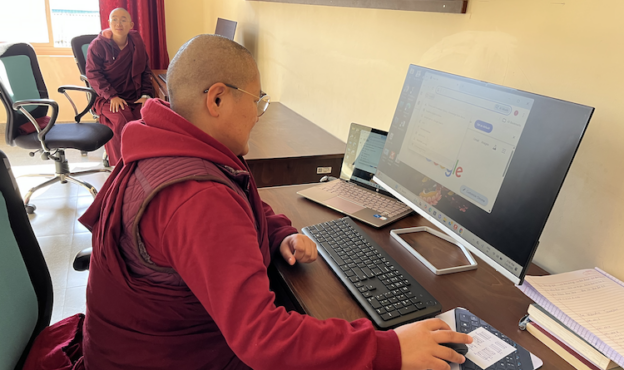
Thanks to five generous donors, the Research Center at Shugsep Nunnery and Institute was fully funded in October 2025, and it opened in March 2026! Here is an interim report with a video about the first three nuns doing research.
In the autumn of 2025, the nuns at Shugsep Nunnery and Institute in India asked for help to establish a Research Training Center for the senior nuns, so they could become qualified researchers and inspire other nuns to follow in their footsteps.
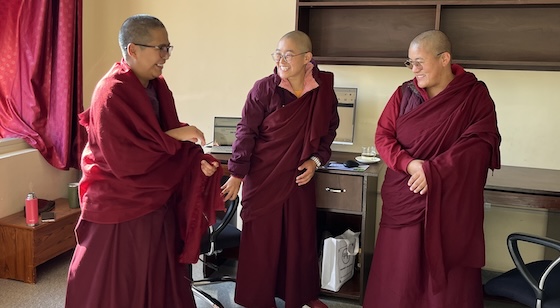
The research center at Shugsep opened in March 2026 with three senior Shugsep nuns as trainee researchers: Tsultrim Dolma (right), Pema Dolma (middle), and Thupten Choewang (also known as Tsering Wangmo) (left).
Thanks to the generosity of five donors, the nuns were able to equip the room and launch the program at the start of the new academic year in March 2026. The research center will strengthen the academic and research foundations of the nunnery and enable the nuns to integrate their traditional Buddhist studies with modern research practices.
Here is a video from March 2026 about the start of the program and the first three nuns who are doing research.
The Research Center at Shugsep Nunnery
The Research Center at Shugsep started in March 2026 with three senior nuns who will learn research best practices and start their research projects. Under the guidance of a certified professor and researcher, they will undergo a rigorous one-year training program. After successfully completing the program, the nuns will be able to train future generations of nuns, thereby bridging the continuity of advanced learning within the nunnery.
As part of the programme, the participating Loponmas will also attend workshops with visits by Professor Dr. Dorji Wangchuk of the University of Hamburg in Germany, who has already established similar research programs at Namdroling Monastery, Dzongsar Institute, Gangtok Institute, and other Nyingma monasteries.
Thanks to our generous donors, the nuns can:
- Purchase and install equipment for the center, such as computers, a projector, printer, battery, and bookshelves.
- Recruit and hire a certified researcher/professor to conduct the one-year training program.
- Support the research program in line with Professor Wangchuk’s curriculum.
- Facilitate the Loponmas’ participation in external workshops at the other established research centers in Nepal, South India, Himachal Pradesh, and Gangtok.
- Support the process of evaluation and certification of the Loponmas as they complete their research training.
The goal is sustainability. The trained Loponmas will assume the role of teachers, thereby continuing the program for future Loponma trainees to be self-reliant.
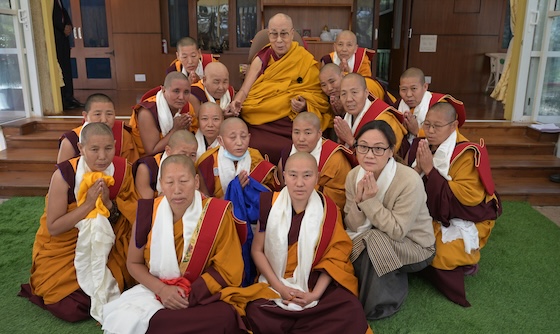
Sixteen of the 19 Khenmos from Shugsep had an audience with His Holiness the Dalai Lama on March 13, 2026.
The Development of Shugsep’s Academic Program
Shugsep Nunnery and Institute was re-established in exile in India by the Tibetan Nuns Project. Construction began in 2006 and the nunnery was inaugurated in 2010. This Nyingma nunnery near Dharamsala is currently home to about 100 nuns.

2025 marked the 15th anniversary of the inauguration of Shugsep Nunnery and Institute, now home to about 100 nuns. The original rented house where the nuns lived after their escape is on the left.
Here is a video made in 2006 telling the story of Shugsep Nunnery in Tibet and how it was re-established in India by the Tibetan Nuns Project.
The original Shugsep in Tibet was destroyed in the Cultural Revolution in 1959, and the nuns were forced to leave. The nunnery was partially rebuilt by nuns in the 1980s, but they faced frequent harassment by the Chinese authorities. Seeking the freedom to practice their religion and culture, many Shugsep nuns escaped from Tibet to northern India.
A Nyingma nunnery, Shugsep traces its rituals and practices to some of the most illustrious female practitioners in Tibetan history. In exile, the nuns were given the opportunity to participate in a nine-year academic program of Buddhist philosophy, debate, Tibetan language and English.

The research training center at the nunnery will promote advanced learning for the senior nuns.
Currently, there are 60 Shugsep nuns who have graduated with their Loponma degree, the highest academic degree in their philosophic tradition, roughly equivalent to a Master’s. In February 2026, 19 senior nuns were enthroned as Khenmos at Shugsep’s historic khenmo enthronement ceremony. A Khenmo is the highest scholarly and teaching title for nuns in the Nyingma tradition of Tibetan Buddhism. It is equivalent to the Khenpo title given to monks.