Category Archives: anniversary

Looking Back at Dolma Ling Nuns Over 30 Years Ago

This special blog post by Julie Brittain has news and archival photos of Dolma Ling Nunnery in 1993 when the nunnery was being built. Julie, now a long-time supporter of the Tibetan Nuns Project, wrote it in 1993 as part of a series of short reports for CBC, the Canadian Broadcasting Corporation. This is a report she wrote about her time at Dolma Ling and describes her time with the nuns as the nunnery was being built.

Dolma Ling Nunnery then and now

On the left, a nun holds a paper model of Dolma Ling. December 8, 2025 is the 20th anniversary of the inauguration of Dolma Ling by His Holiness the Dalai Lama. The nunnery took 12 years to build. Our current project is to build special housing for elder nuns.

Background to Julie’s Letters from Dharamsala 1993

In 1993, when I was in Dharamsala, I was writing 3-minute “letters” to be read out on a CBC Radio Show from St. John’s Newfoundland called “On The Go”.

I first visited Dharamsala in 1988, arriving directly from Lhasa, where I’d worked for a year at Tibet University. I’d been a couple times more to Dharamsala between 1988 and 1993, but this was the longest stay.
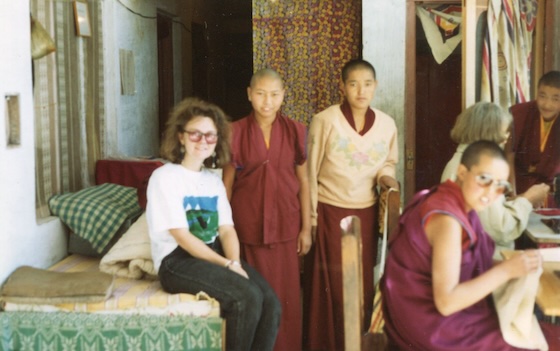
ulie Brittain in Dharamsala 1993

Julie Brittain at Dolma Ling Nunnery near Dharamsala in 1993.

I wrote 20 letters for “On The Go”. CBC Radio didn’t air them all and I was told they didn’t air the two I wrote about Dolma Ling. I guess some were just a bit outside of the listeners’ experience.

Letter from Dolma Ling Nunnery

There’s an understanding in Dharamsala that western visitors should make a contribution to the refugee community while they are part of it. There’s no shortage of worthwhile projects which can use some extra help. One afternoon I ran into Betsy Napper, whom I’d met briefly in Lhasa in 1987. [Elizabeth (Betsy) Napper, PhD, is the US Founder and Board Chair of the Tibetan Nuns Project.]

She told me about an organization called the Tibetan Nuns’ Project. She was co-director. It was set up in 1987 to receive nuns fleeing into exile from Tibet. There were over 100 such nuns in the community now and the Tibetan Nuns’ Project had founded a nunnery, Dolma Ling, to accommodate and care for some of them, eventually, all of them. They could use my help organizing their English teaching programme.
Tibetan Buddhist nuns at Dolma Ling in 1993 by Julie Brittain

The Tibetan Nuns Project was founded in 1987 in response to wave of nuns escaping from Tibet to India. They had walked over the Himalayas and were ill and exhausted. Many of them had been imprisoned and tortured for taking part in peaceful demonstrations calling for basic human rights. Photo by Julie Brittain, 1993.

I’d heard about the Nuns Project. I knew that some of the nuns had served time in prison in Tibet, for taking part in pro-independence demonstrations, or just for simply being nuns. Many of them had been thrown out of their nunneries by the authorities. They came to India, often on foot as far as Nepal, just so that they could carry on their practice as nuns.
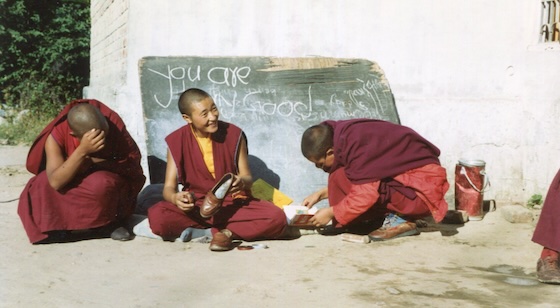
early days at Dolma Ling Nunnery 1993 Julie Brittain

The nuns escaped into exile seeking freedom to practice their religion, culture, and language. The nuns arrived in northern India to a refugee community already struggling to survive. The two existing Tibetan Buddhist nunneries were already overcrowded. Photo by Julie Brittain, 1993.

While I lived in Lhasa, I’d visited many of the nunneries, in the city and further afield. A few in the Lhasa area I’d visit on a regular basis. I heard the nuns’ stories first hand over the year I was there, as we’d talk over the bottomless bowls of butter tea they’d serve me. I admired the courage and conviction that had brought these women on such a dangerous journey, into exile, and I decided this would be my contribution to the refugee community. If I could, I’d return a little of the warm hospitality and friendship they’d shown me in Tibet, where I myself frequently felt alone and confused by life at Tibet University, where I was far from welcome as a foreigner.
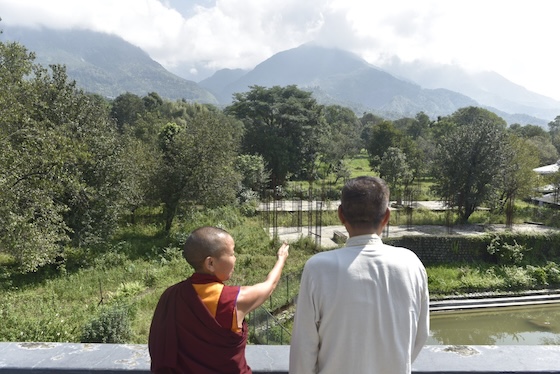
Geshema Delek Wangmo, Sikyong

Photo from 2025 of Geshema Delek Wangmo, the principal of Dolma Ling, showing Sikyong Penpa Tsering, the political leader of the Central Tibetan Administration, the foundations for the housing for elder nuns. Photo tibet.net

The half hour drive down to Dolma Ling Nunnery is spectacular, as is the setting of the nunnery itself. To the north, mountains shoot up dramatically from the valley floor. Clear mountain streams bubble around the big grey glacial boulders.
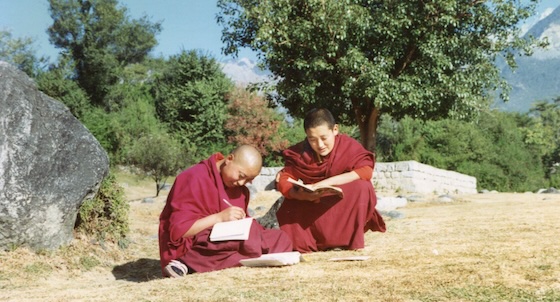
Julie Brittain photo of nuns at Dolma Ling Nunnery 1993

Most refugee nuns escaping to Northern India had no education in their own language, nor had they been allowed education in their religious heritage while in Tibet. Many were illiterate on arrival and could not even write their own names.

Goats, sheep, cows, buffalo, donkeys and horses belonging to neighbouring farms crop the lush grass to a soft green carpet so that the valley looks like a big park.

Right now, Dolma Ling is spread out and make-shift. The nuns live in four rented houses. There are as many bunk beds in each room as will fit.
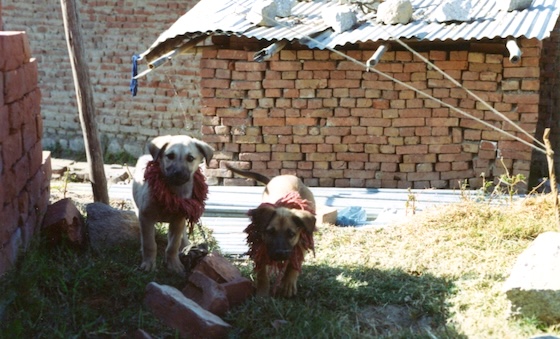
archival photo of Dolma Ling Nunnery 1993 by Julie Brittain

Their classroom and gompa is a doorless building which has a dirt floor, mud-washed walls and a polythene tent roof.

Only in the visitors’ room is there a little space, a carpet and chairs to sit on. This is also where the nunnery valuables are kept – religious books, two sewing machines and the accounts books.

The nuns take off their shoes when they go into this room. Just across the field what will one day be the real Dolma Ling is underway. This is a large complex which will have dormitories for 200 nuns, classrooms, a small hospital, and a gompa. The nuns work on the site in the mornings and evenings, helping the labourers with tasks like carrying bricks.

Tibetan Buddhist nuns helping to build Dolma Ling Nunnery

Construction of Dolma Ling began in 1990 and the major parts of the nunnery were completed in 2005. The nuns themselves took part in the construction of the nunnery, laboring to carry bricks and mortar, and dig the foundations. Photo by Jessica Tampas.

I’ve taught English in a lot of different countries, but the first time I met the nuns was like starting out all over again. Before me, sitting cross-legged on the floor, three rows of shaven-headed ladies aged between about 16 and 35. They all wore identical yellow silk vests and maroon robes. I had no text books, or rather none that were relevant for a Tibetan nun newly arrived in India.

I asked them to tell me about their daily schedule. They get up at 4:30 and pray until 6:30. Then they have breakfast. After that, the whole day is crammed with classes, religious practices and building work. After their evening meal, they spend five or six hours learning scriptures by heart, often not getting to bed before midnight.
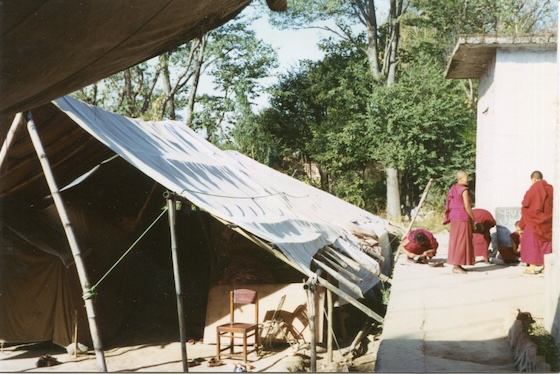
Makeshift buildings at Dolma Ling Nunnery 1993 by Julie Brittain

Dolma Ling Nunnery was successfully completed after 12 years of hard work. Now home to about 300 nuns, it offers a 17-year curriculum of traditional Buddhist philosophy and debate, as well as modern courses in Tibetan language, English, basic mathematics, and computer skills. Photo by Julie Brittain, 1993.

I couldn’t believe anyone could survive such a life. ‘Don’t you get tired?  How can you live that way!’ I asked. They laughed at me, part-hiding their faces in a corner of robe or on a friend’s shoulder. This was the life they loved, the life they’d crossed the Himalayas to pursue. For them the question was how to live any other way.

During the week the Dolma Ling nuns have a tight schedule. If you want to see one of them at leisure, you have to do it on a weekend. I dropped in one Saturday after lunch to visit a 26 year old nun I’ll call Pema – it’s not her real name – who arrived in India this summer. I wanted to hear her story because it’s typical of many Tibetan monks and nuns these days. This piece is broadcast with her permission on the understanding I do not use her real name.

One Nun’s Story

Pema was in prison in Lhasa for three years, from 1989 to 1992. She was one of 20 nuns and three monks arrested for taking part in a small pro-independence demonstration outside a cultural event put on by the authorities. This happened while Lhasa was under martial law in the fall of 1989, in the grounds of the Norbulingka, the Dalai Lama’s Summer Palace. They shouted ‘Free Tibet’ and ‘Long live the Dalai Lama’. They were all sentenced without trial.

During her time in prison Pema was tortured and beaten. Beatings to the head have left her blind in her left eye and suffering from headaches. She was in pain the day I met her. As she spoke to me through an interpreter, she held the palm of her hand against the left side of her face, which seemed swollen.
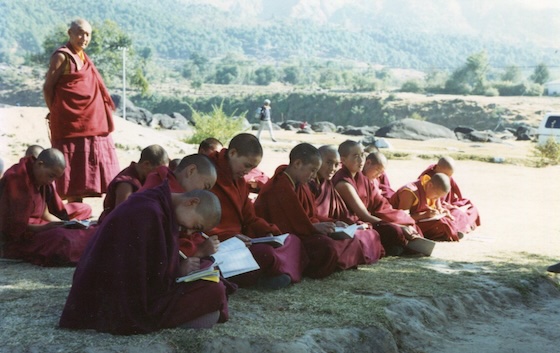
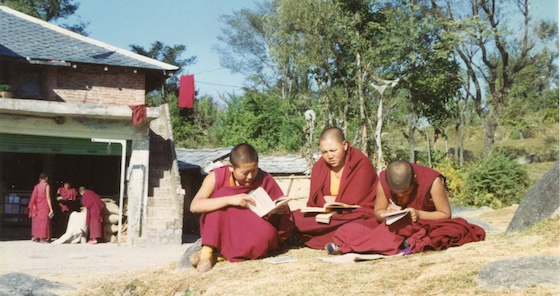
Tibetan Buddhist nuns study outdoors at Dolma Ling Nunnery 1993 by Julie Brittain

Early classroom. “The nuns, when they first came via Nepal to India, were in very poor physical shape and of course they had nothing – from 1987 onwards. They were traumatised and physically battered,” said Rinchen Rinchen Khando Choegyal, Founding Director of TNP. Photo by Julie Brittain, 1993.

Pema comes from a village west of Lhasa. Her family are farmers. She has two older siblings, both of whom are also farmers. At the age of 21 she decided to become a nun. As she put it, by doing this she would ‘bring benefit to all sentient beings’. In 1987 she joined a nunnery not far from Lhasa. I’d visited two or three times in 1987 on horseback – during martial law, travelling by horse was one of the few ways to get around and not have someone from the Public Security Bureau follow to see who you were talking to.

I asked her how she’d got out of Tibet. She told me that she’d walked from Lhasa, south to the Nepali border, in a party of 16 Tibetans. To avoid being spotted by the Chinese troops who patrol all the main roads across Tibet, they walked at night and hid in caves during the day. They were leaving Tibet illegally and would have been arrested if they’d been caught. Their journey lasted 19 days and took them around Mount Everest.

Why, I asked, had she taken part in demonstrations. She knew how dangerous it was. She knew she would be arrested, and most likely tortured and imprisoned. She replied, ‘To obtain freedom for the Tibetan people.’ I wanted to know if she felt it was her duty as a nun to demonstrate. No, she said, it wasn’t her duty. Conviction had made her do it. Monks and nuns in general have a lot of conviction, she told me.
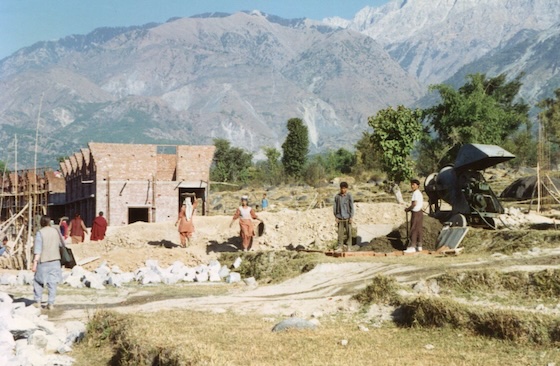
Building Dolma Ling Nunnery. Photo by Julie Brittain 1993.

Building Dolma Ling Nunnery. Photo by Julie Brittain 1993.

While she was in prison she worked six days a week, from nine to five, digging fields. The food was poor and there was never enough of it. There was no meat. Vegetables, served once a day, were often full of maggots. Otherwise, they lived on black tea and steamed bread. She said that even when relatives brought prisoners nutritious food, it was often confiscated by the guards.

Tibetan Buddhist nuns sewing 1993

Tibetan Buddhist nuns sewing in 1993. Today, there is a tailoring section at the nunnery that makes robes and also many items for sale in our online store such as prayer flags, Tibetan door hangings, bags, and dolls.

Why had she come to India, I asked. She told me she wanted to continue her studies, something she couldn’t do in Tibet. Everyone at her nunnery had been  refused a renewal of the papers they needed to be there officially. A condition of her release from prison, in any case, had been that she wasn’t allowed to rejoin her nunnery. The only way for her to continue being a nun was to go into exile. If she tries to return, she said, she’ll be arrested again.

An anonymous Tibetan poet has paid tribute to Pema and the others who were arrested at the Norbulingka that day, in a resistance song that circulated in Lhasa in 1989. In translation the song goes like this:

In the Norbulingka
Many different flowers have bloomed
Neither hailstorm nor winter frost
Will untie our unity

We stand up to leave. Pema places the palms of her hands together and bows to us in the traditional Tibetan way. We wish her happiness in India.
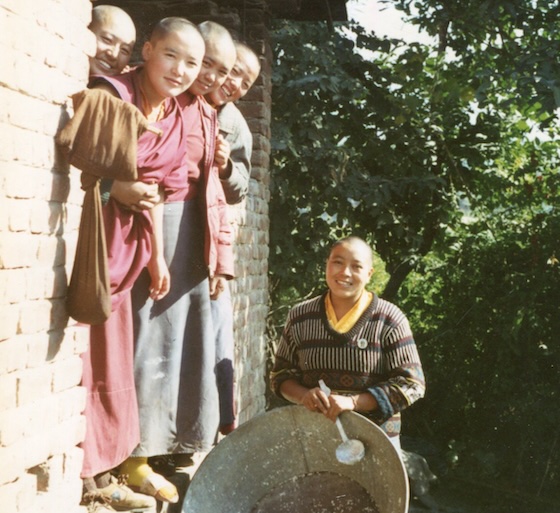
Tibetan Buddhist nuns in 1993 at Dolma Ling Nunnery

One of our goals now is to put our core programs on more solid ground with our Long-Term Stability Fund launched about 30 years after this photo was taken. Photo by Julie Brittain, 1993.

Current Needs

It is now over 30 years since Julie wrote this letter for CBC Radio. The Tibetan Nuns Project is now working on two major projects to help the nuns. The first is our Long-Term Stability Fund to  put more of our core programs on solid ground. The second is to build Housing for Elder Nuns at Dolma Ling.
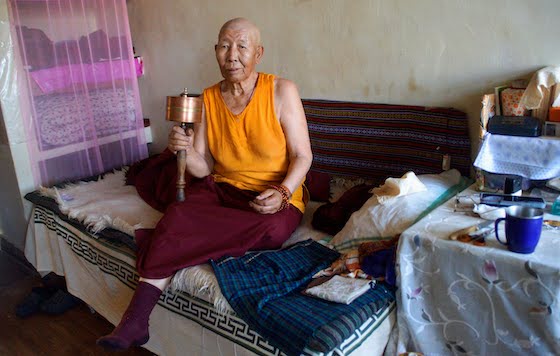
Housing for Elderly nuns at Dolma Ling

Ani Rigzen, aged 74, is one of the elder nuns at Dolma Ling. She said, “I escaped Tibet after torture took everything from me, my family, my home, my culture. Even now, with failing eyesight and constant pain, I carry those scars. Dolma Ling is my only family, the only home I have left. With your support, a senior home here would mean I could spend my last years with dignity and peace, surrounded by my sisters. This would be the greatest gift of my life.”

Dolma Ling Now

December 8, 2025 marks the 20th anniversary of the inauguration of Dolma Ling by His Holiness the Dalai Lama.

In April 2025, the nuns celebrated big changes in the leadership at Dolma Ling Nunnery and Institute. For the first time since the nunnery was inaugurated 20 years ago, Dolma Ling transitioned from having a male principal to leadership by the nuns themselves.

You can learn more about life at Dolma Ling Nunnery and Institute with these slideshows and this blog post about daily life and the nuns’ curriculum.

Thank you so much for your support!


Celebrating 20 Years of Thiusar Magazine: A Blossoming Journey

This year Tibetan Buddhist nuns in India are celebrating a remarkable milestone: 20 years of Thiusar Magazine, a literary publication of the nuns supported by the Tibetan Nuns Project. Since its inception, Thiusar has been a beacon of creativity and expression for the nuns, and we are delighted to reflect on its journey and growth.

Tibetan Buddhist nuns' magazine

In 2024, the Tibetan Buddhist nuns at Dolma Ling celebrated the 20th anniversary of the nuns’ magazine Thiusar. Detail of photo by Robin Groth

The Beginning

Thiusar Magazine started as a heartfelt gesture of gratitude to Kasur Rinchen Khandro, whose leadership and guidance have been foundational to the Tibetan Nuns Project. In the early 2000s, nuns began writing small letters and prose, which they would leave on her desk. These heartfelt notes, filled with gratitude and personal reflections, caught her attention. Recognizing the potential in their writings, Kasur Rinchen Khandro encouraged the nuns to formalize their efforts and create a magazine. Thus, in 2002, Thiusaur Magazine was born.

Growing Together

Over the past two decades, Thiusar has evolved from a budding flower into a fully bloomed one. This transformation is beautifully captured in the 2024 magazine cover design, which features a youthful flower symbolizing the vibrancy and growth of the nuns. The magazine now reflects the incredible progress and blossoming talents of our community. What started as a small gesture has grown into a significant publication, celebrated for its quality and depth.

Tibetan Buddhist nuns holding copies of their magazine

Thiusaur means “budding flower” in Tibetan. When the Tibetan Nuns Project began most of the nuns were illiterate; now they write, edit, and publish their annual magazine in Tibetan. The yellow one is the first edition and the blue on the right is the most recent magazine. Photos by Robin Groth, 2024.

Diverse Voices

The pages of the magazine are filled with essays, articles, short stories, and poems, each piece a reflection of the unique experiences and creative outlet of the nuns. The magazine is distributed annually to every nunnery and various NGOs in India, and its reach and impact are widely appreciated. Thiusar offers a rare glimpse into the hearts and minds of Tibetan nuns, sharing their journeys and perspectives with the world. The diversity of topics and styles in the magazine underlines the varied thoughts and feelings that our nuns bring to their writing.

Embracing Change

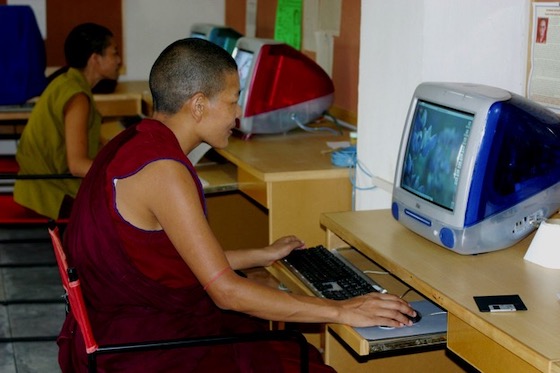
Reflecting on the early days, Venerable Delek Yangdron, a dedicated member of the magazine committee, recalls the challenges of receiving handwritten submissions and painstakingly typing each one. Today, technology has revolutionized our process. Nuns now send their writings via email, making the editorial process smoother and more efficient. This shift has not only eased the workload but has also empowered the nuns, boosting their confidence in their technological and design skills.

Tibetan Buddhist nun working on computer.

Early days. Venerable Delek Yangdron, one of the Dolma Ling media nuns and a dedicated member of the magazine committee remembers receiving handwritten submissions and typing up each submission.

Adapting to digital tools has also opened up new possibilities for collaboration and creativity. Nuns can now work together on projects, share ideas more easily, and access more resources for inspiration. This technological advancement has brought a new dynamism to Thiusaur, enriching the content and making the production process more collaborative and inclusive.

Looking Forward

As we celebrate 20 years of Thiusar Magazine, we look forward to the future with great hope and excitement. The nuns are eager to continue contributing their voices and sharing their stories. The magazine’s journey from its humble beginnings to its current stature exemplifies their dedication and creativity.

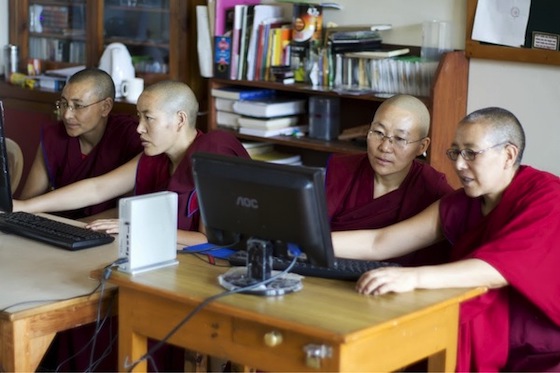
Tibetan Buddhist nuns receiving computer training in 2013. The mission of the Tibetan Nuns Project is to educate and empower nuns of the Tibetan Buddhist tradition as teachers and leaders; and
to establish, strengthen, and support educational institutions to sustain Tibetan religion and culture. Photo by Harald Weichhart.

The celebration of Thiusar’s 20th anniversary is not just about looking back but also about coming together to acknowledge the collective effort that has made the magazine a success. We are immensely grateful to everyone who has contributed to Thiusar over the years — the writers, editors, designers, and supporters.

Tibetan Nuns Project Marks 35th Anniversary

To mark the 35th anniversary of the Tibetan Nuns Project in October 2022, we are re-publishing a 2001 interview with Rinchen Khando Choegyal, our Founding Director and Special Advisor. This interview was first published in our 2001 newsletter and shows how far the nuns have come thanks to your support.

Rinchen Khando Choegya is a former Minister of Education in the Tibetan Government-in-Exile and founding President of the Tibetan Women’s Association. She is married to Ngari Rinpoche, youngest brother of His Holiness the Dalai Lama. She resides in Dharamsala.

Rinchen Khando Choeygal Founding Director Tibetan Nuns Project

Rinchen Khando Choeygal, the Tibetan Nuns Project’s Founding Director and Special Advisor

What were your thoughts when you started the Tibetan Nuns Project?
When we started the Tibetan Nuns Project in 1987, I thought, “How best to look after the nuns?” Of course, the most important thing was to find them food, clothing, shelter and medical attention. It is, however, not enough to be fed and clothed. I knew nuns needed a better system of education, and that is what we have tried to focus on throughout the history of TNP.

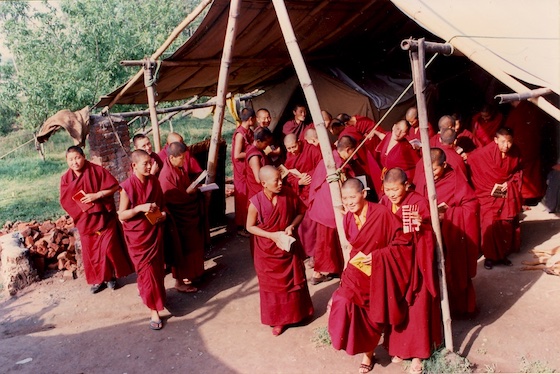
Tibetan refugee nuns outside a tent classroom in India

An archival photo outside a tent classroom in India. Traditionally, Buddhist nuns have not had the same access to education as monks. TNP created a groundbreaking education system aimed at both preserving Tibetan culture and empowering the nuns to live and become leaders in the modern world.

Upon arriving in Dharamsala, 99% of the nuns could neither read nor write. They appeared to be strong young women, but in the classroom it was as if they were in kindergarten. Now there are nuns at both Dolma Ling and Shugsep who are beginning advanced studies. Eventually I hope that the Dolma Ling Institute for Higher Learning will be a place where both nuns and lay women can receive the finest advanced studies in all of the Tibetan Buddhist traditions.

Why is it important for nuns to be well educated?
After His Holiness came to India, he put the education of children, not just boys, on top of his priority list. So, today in the Tibetan community the young men and women are equally educated. Traditionally in Tibet there has been a very profound system of monastic education which was, however, restricted to monks. Women who decided to become nuns focused mainly on learning prayers and how to read and write Tibetan. Now that education in the lay community has become equal between men and women, I personally feel that we must restructure the nuns’ education in order to stay true to His Holiness’ vision. It is important for this vision of equality to trickle down into all parts of society.

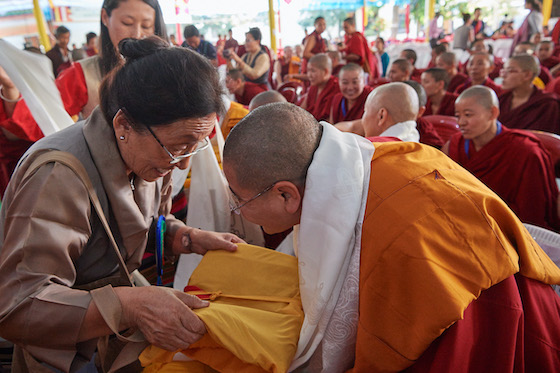
Rinchen Khando Choegyal congratulates Geshemas at historic Geshema graduation ceremony in 2016

Rinchen Khando Choegyal, director of Tibetan Nuns Project congratulating one of the Rinchen Khando Choegyal congratulates Geshemas at the historic graduation ceremony in 2016. The Geshema degree is the highest level of training in the Gelugpa tradition and is equivalent to a PhD in Tibetan Buddhism. This degree was only formally opened to women in 2012. Photo courtesy of Olivier Adam.

So the key is to educate the nuns in a system through which they can study at as high a level as they need to. Luckily, we have full support for this vision from His Holiness and from the Department of Religious and Cultural Affairs. Now the question is, what is the best way to implement this system for the nuns?

My main vision for the Tibetan Nuns Project is an education that will enable the nuns to think for themselves, to learn deeper values like: what is most meaningful at the end of your life? It will not be easy because they are not used to thinking for themselves or thinking highly of themselves.

Do the nuns receive the same education as monks?
In principle, the monks’ education is the same as the education we have implemented at our nunneries. The only difference (and this is changing at the monasteries now, too) is that a traditional monastic education teaches only Buddhist philosophy and Tibetan reading and writing. We also teach the nuns other subjects – English, history, math.

Again, we are trying to implement the vision of His Holiness, who has stressed the importance of learning these things.

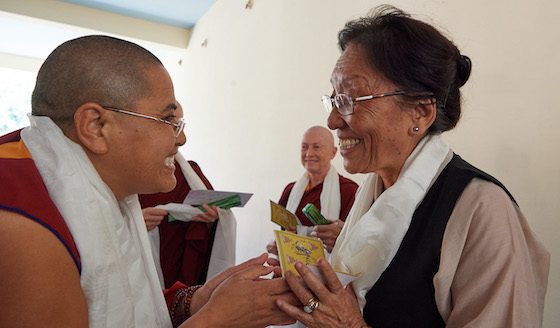
Rinchen Khando Choegyal congratulates one of the 20 Geshemas in 2016, Olivier Adam

Rinchen Khando Choegyal congratulates one of the 20 Geshemas in 2016. Photo by Olivier Adam

What is the role of women’s education in current Tibetan society?
Education is very, very important for any community. Women are particularly important because through them the whole community can be educated (whether they are mothers and wives or nuns teaching in the community). Also, spiritual values are precious to everyone — mothers as well as nuns. There is a terrible lack of opportunity for lay women to engage in spiritual study right now. If a lay woman is able to study, she will be able to affect her whole family. Eventually, some percentage of admission to the Institute for Higher Learning will be reserved for lay women.

Why is the Institute for Higher Learning a non-sectarian institution?
The main reason is that I feel that all the different traditions of Tibetan Buddhism boil down to the same thing, the same message from the Buddha. We are so used to belonging to one tradition or another. This can cause division as religion often does. I have the deepest respect for all traditions. I want the nuns to learn all of the traditions in order for them to get a richer education. All of the different traditions really help you in different ways to reach a high level.

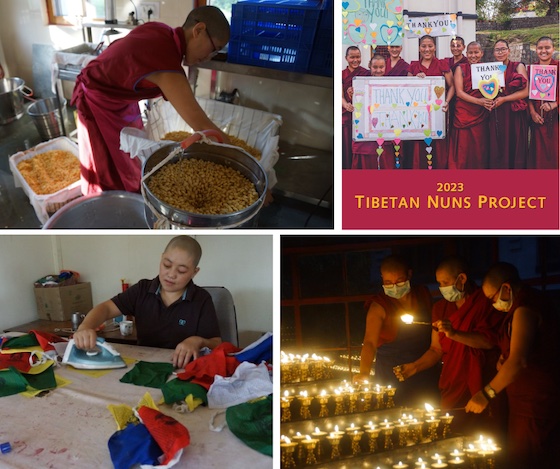
a collage of some of the many self-sufficiency projects at Dolma Ling Nunnery

A primary goal of the Tibetan Nuns Project is to help the nuns achieve more self-sufficiency through education, skill building, and income-generating projects. Here are some of the many self-sufficiency projects including tofu making, the annual calendar, prayer flags, and pujas.

Will the nuns develop “self-sufficiency”?

It is important for the Tibetan nation to be self-sufficient. The rest of the world has been very generous in supporting us in exile, but we need to try our best to attain self­-sufficiency. We can’t just sit back and relax and say, “How nice, we are being supported.” We have to look at these issues: who has which skills, and how can they best work together?

The purpose of life — whether  as a lay person, monk  or nun — is to  develop  yourself  as an individual and to become a useful, productive member of human society — helpful and altruistic. We have started to develop an advanced educational system for the nuns, but not all will be scholars; some nuns will need training of other kinds. All of them have something to give. I want to set up a system where they can be trained as health workers, teachers, midwives, artists, people with skills to offer the community. The nuns could even keep cows. Self-sufficiency should be stressed within each part of society, as well as within the larger society.

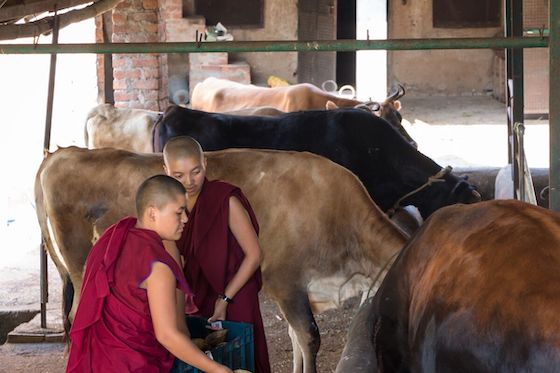
Tibetan Buddhist nuns and dairy cows at Dolma Ling

The nuns at Dolma Ling have now been keeping dairy cows for over 20 years as part of the nunnery’s sustainability efforts. The small herd provides milk and butter for the 261 nuns who live and study there. The dairy herd also provides manure for the nunnery’s gardens.

The basic requirements for real altruism are care and compassion. But you also need to have some skill. Not everyone can be a teacher, but everyone can develop some skills so that they can serve the community. And by doing so, the nuns will be truly living compassion. Altruism starts at home, with the person next to you. Many people care deeply about the environment, or people far away, yet don’t pay much attention to the people close to them. Even nuns can’t pray for all sentient beings and do nothing themselves. Knowing how diligent they have been at their studies, I am certain that they will be equally diligent in serving their communities when they are finished.

What do you see as the future of the Tibetan Nuns Project?
We’ve come a long way in terms of infrastructure, health, and awareness. We started Dolma Ling and Shugsep nunneries, and we also help nuns at Geden Choeling, Tilokpur and other nunneries. Over the next five years, my focus will be on the quality of the nuns’ education and administration.I want to review each and every nun and see what each nun is capable of. I want the administration to become even more efficient. But primarily Iwant to focus on the quality of the nuns’ education and to help develop them individually.

We have a long way to go in terms of fundraising. It is crucial that we build an endow­ment so that Dolma Ling’s operating expenses can become self-sufficient. Of course, we also need to complete the planned infrastructure of Dolma Ling, as well as build the new Shugsep Nunnery. On top of all this, we need to figure out the best way to incorporate the number of nuns arriving fresh from Tibet each year into our system.

Through the Tibetan Nuns Project, I would like to see that I look after all of the nuns in the Tibetan commu­nity. This is probably impossible! The Tibetan Nuns Project is currently helping more than 600 nuns and, at least, I want to see that this job is done correctly in terms of education and social work.

Since 1987, I have worked very hard to improve the lives of nuns. Although I have not received any external reward, it has given me great internal joy. I think through this project I have gained more than anybody in the world.

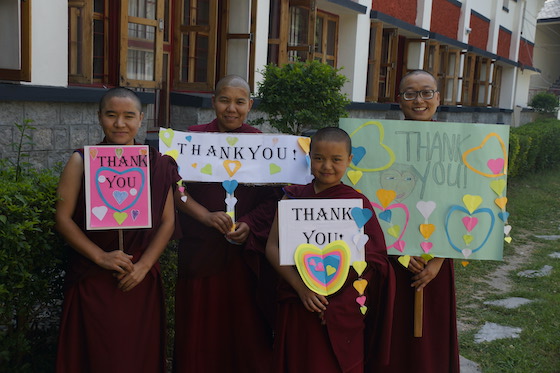
Tibetan Buddhist Nuns holding thank you signs

Since this interview was published in 2001, we made great progress toward our vision to educate and empower nuns of the Tibetan Buddhist tradition as teachers and leaders; and to establish, strengthen, and support educational institutions to sustain Tibetan religion and culture.

Thanks to your generosity we have: