Tag Archives: Tibetan Buddhism

Tibetan Mantra Prayer Flags

Did you know that the Tibetan Nuns Project’s online store sells four different types of Tibetan mantra prayer flags? Mantras are a sequence of words or syllables that are chanted, usually repetitively, as part of Tibetan Buddhist practice.

Tibetan prayer flags with mantras

Tibetan prayer flags are used to promote peace, compassion, strength, and wisdom. Tibetans believe the prayers and mantras printed on the flags will be spread by the wind and bring goodwill and compassion to benefit all beings.

These special prayer flags are handmade and blessed by Tibetan Buddhist nuns at Dolma Ling Nunnery and Institute near Dharamsala, India. Because they are handmade, sizes vary slightly, but each flag measures approximately 4″ x 5″.

Each set includes between 5 and 12 flags, depending on the mantra, with one or two syllables of the mantra per flag. The length of the sets of prayer flags also varies, depending on the mantra. The Tara and Vajra Guru sets are about 4′, the Mini Mani set is  2′ long, and the Buddha Shakyamuni mantra prayer flag set is 5′ long, with each set having about 1 1/2′ of string on each end.

Four designs of Mantra Prayer Flags

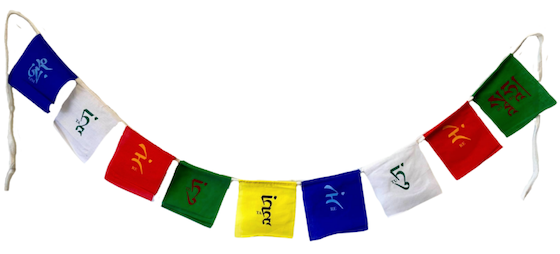
Mini Mani Mantra Prayer Flags

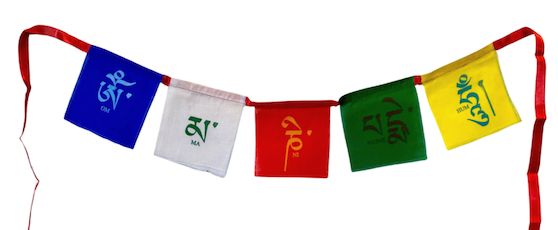
Tibetan prayer flag with mantra of compassion

Set of mini Tibetan prayer flags with the six-syllable mantra of Avalokitesvara or Chenrezig, Om Mani Padme Hum.

Om Mani Padme Hum is the six-syllable mantra of Avalokitesvara or Chenrezig in Tibetan. Tibetan Buddhists believe that saying this mantra out loud or silently to oneself invokes the powerful benevolent attention and blessings of Avalokitesvara, a bodhisattva who embodies the compassion of all Buddhas. Even viewing the written form of the mantra is said to have the same effect. This extremely popular and well-known Tibetan mantra is often carved into stones, creating mani stones that are placed for people to see them.

Buddha Shakyamuni Mantra Prayer Flags

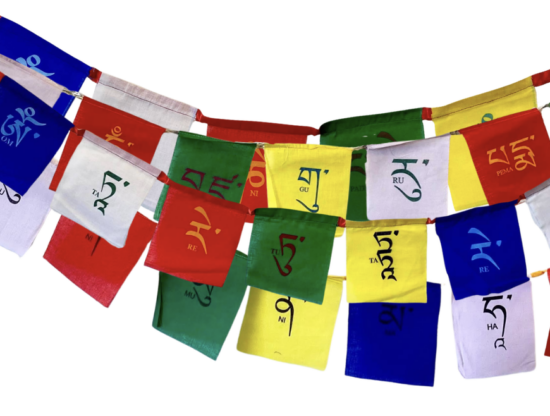
Tibetan prayer flags with mantra of Buddha Shakyamuni

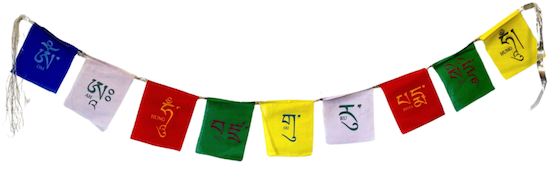
Tibetan prayer flags with mantra of Buddha Shakyamuni, Om Muni Muni Maha Muniye Soha. This set of prayer flags has 12 flags with one syllable of the mantra per flag.

Om Muni Muni Maha Muniye Soha is the mantra of Buddha Shakyamuni, the historical Buddha. Also known as Siddhartha Gautama, Shakyanmuni Buddha was born in the 6th or 5th century BCE and founded Buddhism. The name Buddha means the “awakened” or “enlightened” one. Following his enlightenment, Shakyamuni taught a path which others can follow to be awakened to the true nature of reality and to be freed from suffering. Muni means sage and Maha means great. So the mantra means, “Om wise one, wise one, greatly wise one, wise one of the Shakyans, Hail!”

Tara Mantra Prayer Flags

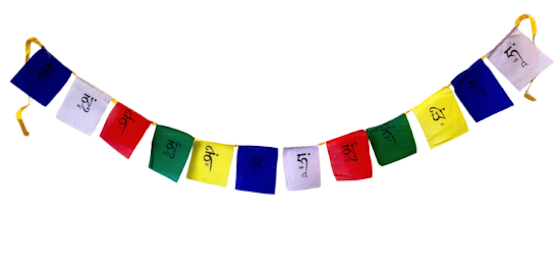
Tibetan prayer flags with the Tara mantra.

Tibetan prayer flags with the Tara mantra.

These prayer flags are printed with the ancient Tibetan mantra to Tara, Om Tare Tuttare Ture Soha. Tara is considered to be a Bodhisattva or Buddha of compassion, relieving us of physical, emotional, and spiritual suffering. Tara has 21 major forms, each of which has a different color and spiritual attribute, and this mantra is most associated with Green Tara. Of her 21 forms, two forms of Tara are especially loved by Tibetans – Green Tara, who is associated with abundance and enlightened activity, and White Tara, who is associated with compassion and long life.

Vajra Guru Mantra Prayer Flags

Tibetan prayer flags with the Vajra Guru mantra.

Tibetan prayer flags with the Vajra Guru mantra.

The 12-syllable mantra of Guru Padmasambhava is Om Ah Hung Benza Guru Pema Siddhi Hung. The Vajra Guru Mantra is the heart essence of Padmasambhava who is also know as Guru Rinpoche, the Precious Master. Padmasambhava was an Indian tantric master who played a major role in bringing Vajrayana Buddhism to Tibet in the eighth century and is considered as the founder of Tibetan Buddhism. This mantra is also the mantra of all the masters, buddhas, yidams, dakas, dakinis, and protectors. When you chant it, you are invoking the very embodiment of Padmasambhava.

About Tibetan Prayer Flags

You don’t have to be a Buddhist to hang prayer flags. Your motivation and intentions are key. Hang them with a wish for all beings to be free of suffering and the causes of suffering, or for a positive intention of your choice.

According to Traditional Tibetan medicine, health and harmony are produced through the balance of the five elements.

Blue symbolizes the sky and space.
White symbolizes the air and wind.
Red symbolizes fire.
Green symbolizes water.
Yellow symbolizes earth.

Prayer flags are made of block-printed fabric using traditional printing techniques going back hundreds of years. They come in various types and sizes and we have many other types of Tibetan prayer flags available in our online store here.

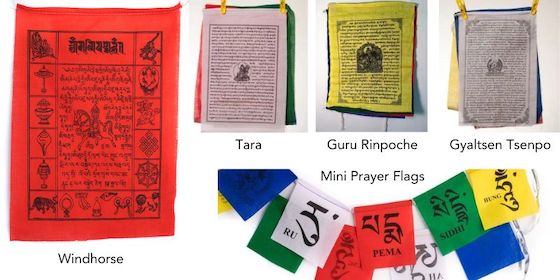
Tibetan prayer flags, types of Tibetan prayer flags, lungta, windhorse prayer flag

Here are some of the types of Tibetan prayer flags sold in the Tibetan Nuns Project online store. They are made and blessed by the nuns at Dolma Ling Nunnery.

All our prayer flags are handmade and blessed by Tibetan Buddhist nuns in India. Your purchase of them helps to provide education, food, shelter, clothing, and basic medical care to over 900 Tibetan Buddhist nuns in India.

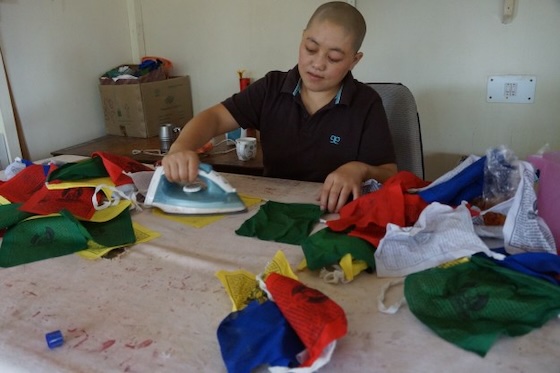
A Tibetan Buddhist nun makes prayer flags at Dolma Ling Nunnery

A Tibetan Buddhist nun makes prayer flags at Dolma Ling Nunnery. All the prayer flags sold in our online store are made and blessed by nuns in India.


Conference on Women’s Empowerment in Tibetan Buddhism

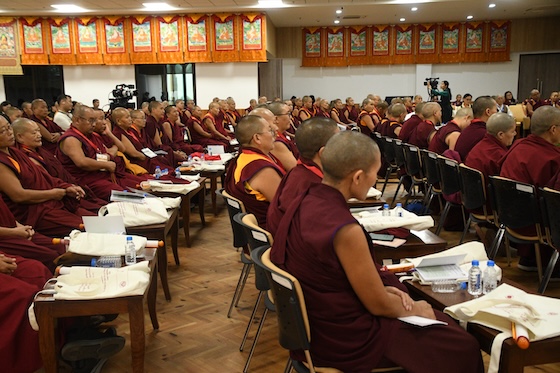
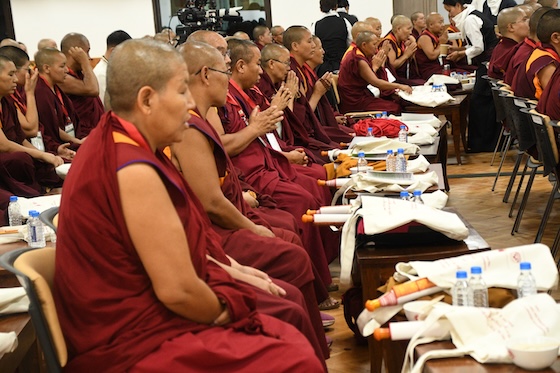
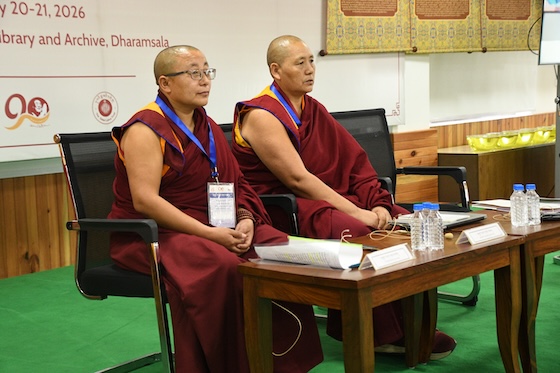
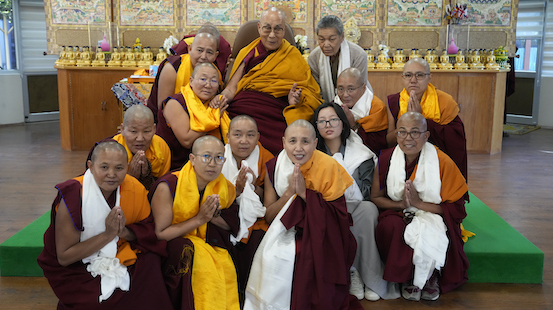
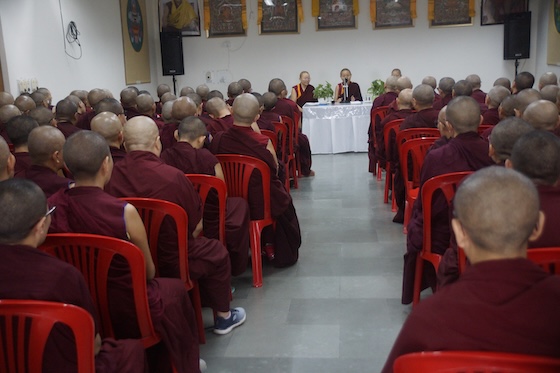
A two-day “Conference on Women’s Empowerment in Tibetan Buddhism” took place on May 20–21, 2026 in Dharamsala, India. This landmark gathering sought to highlight His Holiness the 14th Dalai Lama’s vision and contributions toward strengthening the education, ordination, and recognition of Buddhist women. The photos are by the Dolma Ling Media Nuns.

Womens empowerment conference May 2026 11

The two-day event was convened with three principal objectives: to reflect on His Holiness the Dalai Lama’s commitment to women’s empowerment in Tibetan Buddhism, to review ongoing developments in women’s education and recognition, and to strengthen collaboration among monastic institutions, educational centers, and lay communities.

The conference was jointly organized by the Central Tibetan Administration’s Department of Religion and Culture and the Dalai Lama Trust, with support from the Tibetan Nuns Project and the Tibetan Women’s Association. It was part of the ongoing celebrations of His Holiness the Dalai Lama’s 90th birthday and the Year of Compassion.

Held at Dharamsala’s Library of Tibetan Works and Archives, the conference brought together 86 participants from 13 nunneries in India and Nepal, including 69 Geshemas and 17 nuns representing all schools of Tibetan Buddhism as well as the Yungdrung Bon tradition.

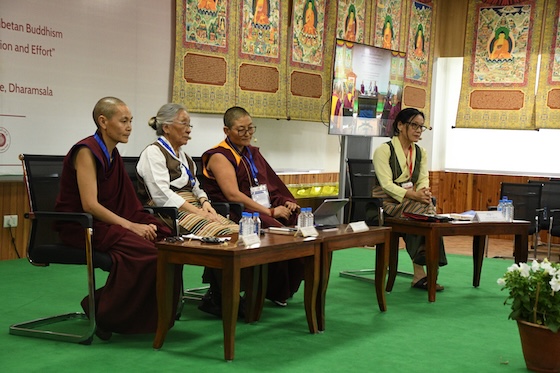
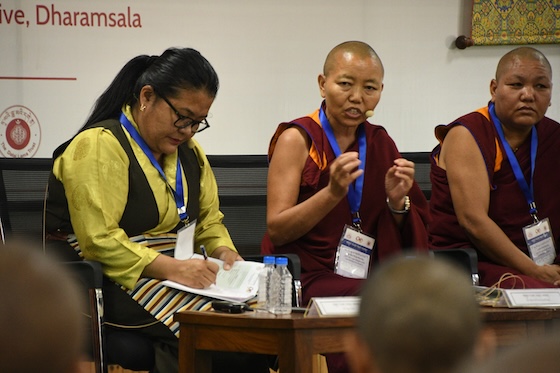
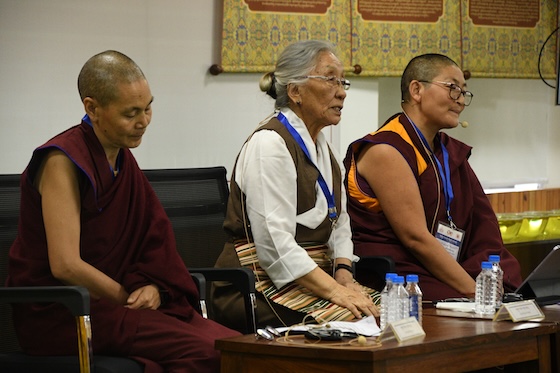
The Tibetan Nuns Project was represented by former Kalon Rinchen Khando Choegyal, our Founding Director and Special Advisor; Youdon Aukatsang, the Director of the Tibetan Nuns Project in India and member of the 17th Tibetan Parliament-in-Exile; and Geshema Delek Wangmo, Academic Principal of Dolma Ling Nunnery and Institute.

Womens empowerment conference May 2026 14

Rinchen Khando Choegyal, TNP’s Founding Director and Special Advisor second from left and Youdon Aukatsang, the Director of the Tibetan Nuns Project in India, far right.

Key discussions focused on the institutionalization of the Geshema degree, the recognition of 21 Tibetan and Indian female Mahasiddhis, and the possibility of establishing Bhikshuni ordination within the Tibetan Mulasarvastivada Vinaya tradition.

The conference also deliberated on the curriculum development in nunneries, institutional support for the Tibetan Nuns Project, the leadership role of Geshemas in society and monastic institutions, and prospects for greater international recognition of Buddhist women.

Womens empowerment conference May 2026 19

Geshema Delek Wangmo, Academic Principal of Dolma Ling Nunnery and Institute, spoke at the conference.

The conference was inaugurated by Kyabje Kundeling Tatsak Jedrung Rinpoche and Sikyong Penpa Tsering attended the closing ceremony. Other attendees included the Department of Religion and Culture Secretary Dhondul Dorjee; Dalai Lama Trust Secretary Jamphel Lhundup; scholar and translator Geshe Thupten Jinpa; Tibetan Women’s Association President Tsering Dolma; Library of Tibetan Works and Archives Director Geshe Lhakdor;  Ven. Thupten Yarphel; Additional Secretary of the Department of Education (CTA) Tenzin Pema; and Head of the Women’s Empowerment Desk at the Department of Finance (CTA) Tsering Kyi.

Recognizing His Holiness the Dalai Lama’s Leadership and Vision

The event recognized the lifelong efforts of His Holiness the 14th Dalai Lama to support gender equality and expand opportunities for women within Tibetan Buddhism. The conference aimed to examine “His Holiness’s vision and concrete contributions toward strengthening the education, ordination, and recognition of Buddhist women.” His Holiness the Dalai Lama is the patron of the Tibetan Nuns Project.

The conference brought together 86 participants from 13 nunneries in India and Nepal, including 69 Geshemas and 17 nuns representing all schools of Tibetan Buddhism as well as the Yungdrung Bon tradition.

“Within the Tibetan Buddhist tradition, His Holiness the Dalai Lama has long been an advocate for the empowerment and equal rights of women, particularly nuns,” said Jamphel Lhundup, Secretary of the Dalai Lama Trust.

“He has given numerous teachings on the importance of equality and has taken significant steps to re-establish the lineage of women’s monastic ordination… Over time, he also reintroduced the historic title of ‘Geshema’, and in 2016, the first Geshema degrees were conferred by him at Drepung Monastery in southern India. Today, there are more than 120 Geshemas, and this recognition underscores the high esteem and respect accorded to Tibetan nuns. All these achievements bear witness to the profound impact of the grace and vision of His Holiness the Dalai Lama,” Jamphel Lhundup said.

Womens empowerment conference May 2026 10

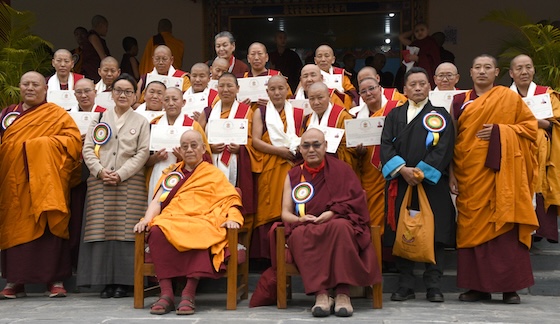
The conference included 69 Geshemas. Ten years ago, in 2016, the first Tibetan Buddhist nuns earned their Geshema degrees. That historic occasion was a dream come true for the 20 pioneering nuns, most of whom were illiterate when they escaped from Tibet. The Geshema degree is the highest level of training in the Gelug tradition and is equivalent to a PhD in Tibetan Buddhist philosophy.
During the closing ceremony, Sikyong Penpa Tsering stressed that it was due to the astute and visionary leadership of His Holiness the Dalai Lama that Tibetan Buddhism has continued to be preserved in exile, including the unprecedented conferment of Geshema degrees, regarded as a landmark reform in Tibetan Buddhism.

Womens empowerment conference May 2026 18

Rinchen Khando Choegyal, the Tibetan Nuns Projects’s Founding Director and Special Advisor, spoke at the conference.

The Tibetan Nuns Project Higher Studies Fund

One of the projects that the Tibetan Nuns Project is working on now is the Higher Studies Fund, a quasi-endowment dedicated to supporting the Geshema degree process as well as post-graduate training in Tantric Studies.

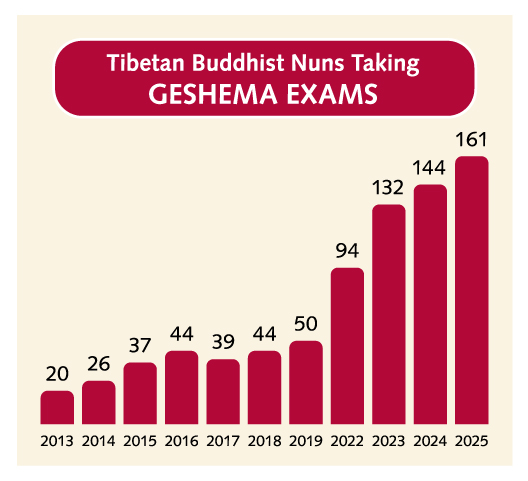
An increasing number of nuns in the Gelug tradition are seeking higher education. They are taking the rigorous four-year Geshema exams in record numbers, and many also wish to pursue post-graduate training in Tantric Buddhism as part of a program launched by the Tibetan Nuns Project in 2017.

Geshema exams chart 2025

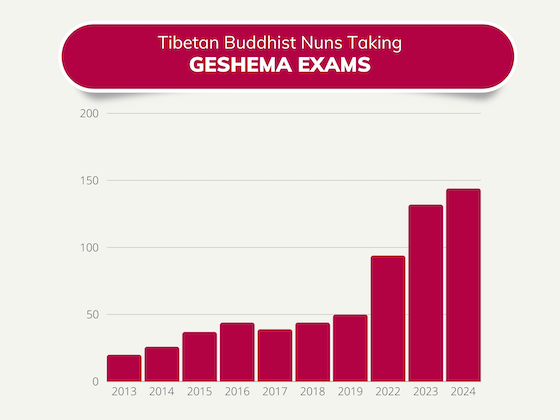
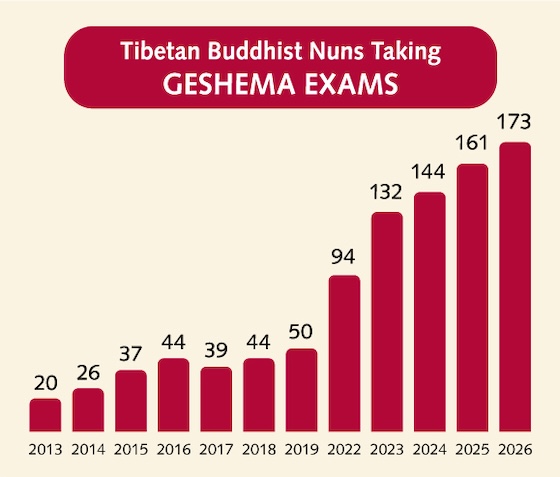
The number of nuns taking the four-year Geshema exams has tripled since 2019. The small fund we created in 2021 no longer covers the costs for the growing numbers or rising food and transport.  Please support the Higher Studies Fund, a quasi-endowment that will support Tibetan Buddhist nuns who wish to become Geshemas, teachers, and leaders and to preserve their religion, culture, and language.

Unfortunately, the modest Geshema Endowment Fund that the Tibetan Nuns Project established in 2021 can no longer support the growing number of nuns and the rising costs of transportation and food. Our goal is to build up the Higher Studies Fund so that both the Geshema exam process AND the Tantric Studies program are self-sustaining.

Through higher studies, Tibetan Buddhist nuns can become fully qualified teachers of their traditions and help preserve Tibet’s rich religion and culture.

Learn more and donate to Higher Studies here.

The mission of the Tibetan Nuns Project is to educate and empower nuns of the Tibetan Buddhist tradition as teachers and leaders; and to establish, strengthen, and support educational institutions to preserve the Tibetan religion and culture. You can see all our current projects here.

Historic First Khenmo Enthronement at Shugsep Nunnery: Photos and Videos

The first-ever Khenmo enthronement at Shugsep Nunnery was held on February 18, 2026, the first day of Tibetan New Year or Losar. Here is a report with photos by the media nuns at Shugsep Nunnery.

Historic Khenmo Enthronement Ceremony Shugsep Nunnery 2026

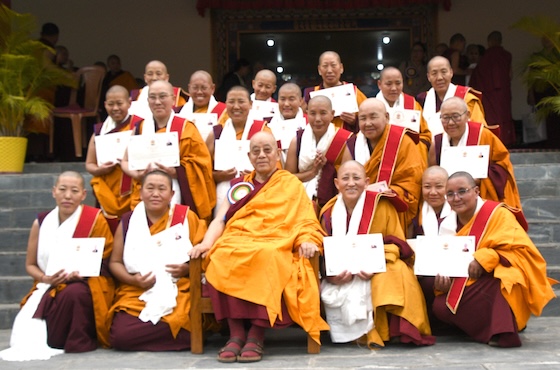
At the historic Khenmo enthronement on February 18, 2026 with chief guests. There are only 18 Khenmos pictured instead of 19 because one nun is currently teaching in the United States and was unable to attend the ceremony.

A Khenmo is the highest scholarly and teaching title for nuns in the Nyingma tradition of Tibetan Buddhism. It is equivalent to the Khenpo title given to monks.

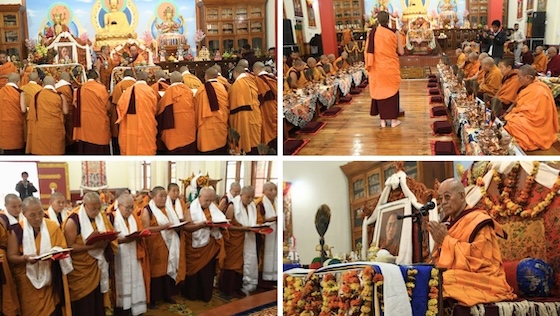
Ceremonial procession for the historic Khenmo enthronement Feb 2026 Shugsep Nunnery

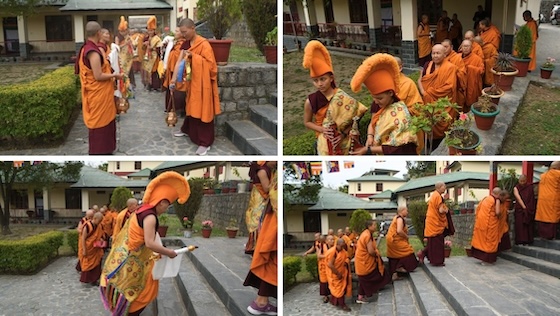
A collage of photos showing the ceremonial procession for the historic Khenmo enthronement on February 18, 2026.
The ceremony was led by Khenchen Pema Sherab Rinpoche, the main preceptor for the enthronement. The event included traditional ritual prayers, a white scarf (katak) offering ceremony, speeches by various dignitaries, and the presentation of special items such as the red hat signifying the Khenmos’ status.

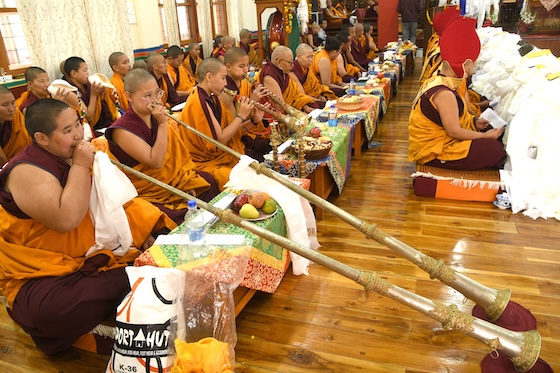
Nuns playing Tibetan long horns or dungchens

Nuns playing Tibetan long horns or dungchen, They have a deep, low sound and are played to welcome high lamas and Rinpoches to a monastery or temple.

On this day, in the presence of Khenchen Pema Sherab, all 19 nuns received the Khenmo title through the enthronement ceremony, followed by oath-taking, rituals, the offering of ceremonial scarves, and speeches.

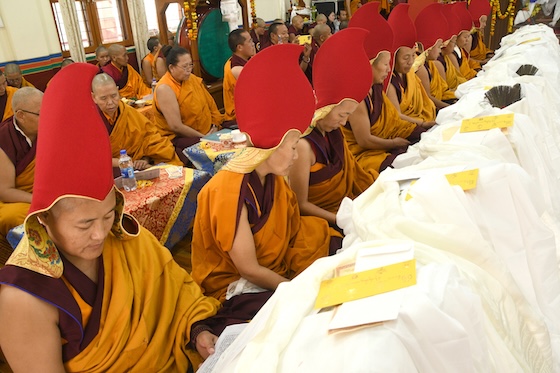
New Khenmos at Shugsep Nunnery receiving ceremonial kataks

The Khenmos, wearing their red hats signifying their status, are seated in front of huge piles of ceremonial white scarves or kataks given to them as a mark of respect.

The day was also covered by the Voice of Tibet news station, based in Dharamsala. Here is the video. Can’t see the video? Click here.

Special Guests

The guest list included:
– Chief Guest Khenpo Sonam Tenphel, Speaker of the Tibetan Parliament-in-Exile
– Mr. Dhondul Dorjee, Secretary of the Department of Religion and Culture, Central Tibetan Administration
– Staff members of the Tibetan Nuns Project India office
– Ms. Nangsa Choedon, Former Director of the Tibetan Nuns Project office in India
– Representatives from nunneries, monasteries, and non-governmental organizations around Dharamsala

Khenchen and Shugsep Khenpo Namgyal shared the history of Shugsep and the significance of the Khenmo title, and expressed gratitude to the Tibetan Nuns Project for its continuous support.

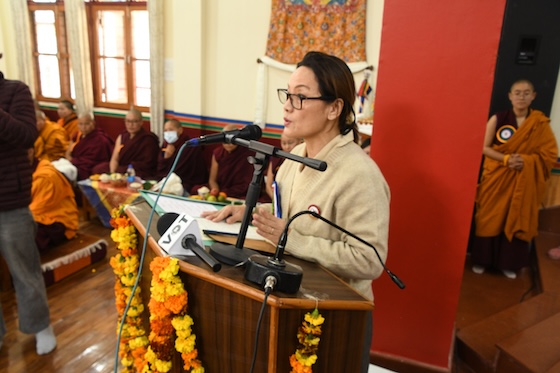
Tibetan Nuns Project Director Youdon Aukatsang, Mr. Dhondul Dorjee (Secretary of the Department of Religion and Culture, CTA), and the Chief Guest Khenpo Sonam Tenphel (Speaker of Tibetan Parliament in Exile) also delivered speeches.

TNP India Director Youdon Aukatsang speaking at the Khenmo Enthronement

Youdon Aukatsang, the Director of the Tibetan Nuns Project office in India, said, “The millennium-old Shugsep Nunnery has reached a momentous milestone with the elevation of its nuns to the Khenmo level. We share a duty to ensure they have the support needed to translate their deep knowledge into a legacy of service for all humanity.”

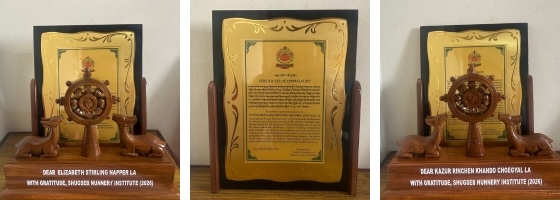
During the ceremony, Shugsep Nunnery also presented souvenirs to honor Rinchen Khando Choegyal (TNP’s Founding Director and Special Advisor) and Dr. Elizabeth (Betsy) Napper (TNP’s U.S. Founder and Board Chair) for their lifelong support and service to the nunneries.

certificates of appreciation from Shugsep Nunnery

The souvenirs for Rinchen Khando Choegyal and Dr. Elizabeth (Betsy) Napper and one of the two certificates of appreciation from Shugsep Nunnery marking their decades of dedication to the nuns.

Part of the text on the Certificate of Appreciation reads:

… for the upliftment of Tibetan Buddhist nuns in exile in all aspects — education, healthcare, character building, management skills, resilience and above all self-confidence and community service. Thanks to your unflinching support, many nuns have been successful in graduating with Loponma, Geshema and Khenmo degrees, the highest certification in advanced Buddhist philosophical studies which is unprecedented in the history of traditional Tibetan Buddhist nunneries.

In March, the Khenmos had a special audience with His Holiness the Dalai Lama. Here’s a very nice video about the audience in Tibetan, with interviews with some of the khenmos and with Youdon Aukatsang, the Director of the Tibetan Nuns Project in India. The video also speaks about this history of Shugsep Nunnery and shows archival photos of the original Shugsep nunnery in Tibet.

What is a Khenmo?

A Khenmo is the highest scholarly and teaching title for nuns in the Nyingma tradition of Tibetan Buddhism. It is equivalent to the Khenpo title given to monks. To become eligible for Khenmo:

  • A nun must complete nine years of rigorous Buddhist studies.
  • She has received the Loponma degree, equivalent to a Master’s degree.
  • After this, she must serve the nunnery for at least four years.
  • Service includes teaching, administration, guiding students, or other responsibilities.
  • She must maintain pure discipline, with no record of serious violations.

Unlike the Geshema degree, there is no written examination for the Khenmo title. Eligibility is based on education, years of service, leadership, and moral conduct.

A collage of photos from the historic Khenmo Enthronement at Shugsep

A collage of photos from the historic Khenmo enthronement at Shugsep on February 18, 2026.

The nuns enthroned in February 2026 completed their Loponma studies between 2004 and 2022. Since then, they have fulfilled their required years of service: Some have taught Buddhist texts, some have managed administrative duties, some have guided study and revision programs for junior nuns.

Why This System is New for Nuns

Traditionally, only monks were enthroned as Khenpo. This was because the full nun ordination lineage (Gelongma) was not historically present in Tibet. Without full ordination, nuns could not receive the same monastic titles.

In recent decades, Tibetan Buddhist leaders recognized this historical gap and created a new system. Instead of requiring full Gelongma ordination, nuns who complete higher studies and long-term service can now be enthroned as Khenmo. This change opened the door for nuns to receive equal recognition as scholars and spiritual leaders.

Historic Khenmo Enthronement at Shugsep Nunnery Feb 2026

The Khenmos with Khenchen Pema Sherab Rinpoche. Only 18 Khenmos are in the pictures instead of 19 because Loponma Tsering Lhamo was unable to attend the ceremony, as she is currently serving as a teacher at Tara Mandala International Buddhist Community in the United States.

Responsibilities After Enthronement and Impact

The role of the Khenmos is not only scholarly, but also leadership and representation. After receiving the Khenmo title, the nuns will take on greater responsibilities:

  • Some will continue teaching advanced Buddhist studies.
  • Some will lead administrative management of the nunnery.
  • Some will enter long-term retreat.
  • During major events, Khenmos will represent Shugsep Nunnery in religious gatherings and official functions.
  • Some will train for the research center.

The Khenmo enthronement strengthens leadership among nuns, raises educational standards in the nunnery, ensures self-sufficiency in teaching and training, inspires younger nuns to pursue higher studies, and promotes gender equality in Tibetan Buddhism.

The Meaning of Windhorse Tibetan Prayer Flags

We are sometimes asked about the meaning of windhorse Tibetan prayer flags. The windhorse is a sacred mythical creature in Tibetan culture, believed to carry prayers to the heavenly realm using the strength and speed of the wind.

Lungta (Tib: རླུངྲ་) means air or wind, and ta (རྟ་) is horse. So, Lung-ta means an air-horse or windhorse. Lungta, or windhorse, is a sacred symbol in Tibetan culture. It is believed to raise a person’s energy and carry prayers and intentions to the divine. When travelling through Tibetan settlements or Himalayan villages, you will often see colorful prayer flags hanging on rooftops, trees, bridges, and mountain ridges.

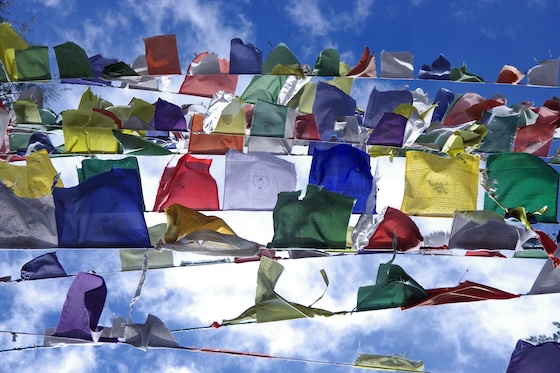
Tibetan prayer flags in the breeze

Different types of prayer flags hanging in the breeze. Different types of prayer flags hanging in the breeze. Lungta in Tibetan ( རླུང་རྟ) is translated to “windhorse”. The first Tibetan syllable “lung” རླུང represents the element “wind” or “air” in the five elements of “earth, water, fire, air, and space”. The second syllable “ta” རྟ means horse.

In Tibetan Buddhism, many actions are done with spiritual meaning, and religious items are often blessed before use. Hanging Lungta, or prayer flags, is an important tradition. Tibetan Buddhists hang Lungta flags after they have been blessed by lamas or at monasteries. Once the flags receive these blessings, they are believed to be spiritually empowered and ready to be hung.

hanging Tibetan prayer flags, prayer flags

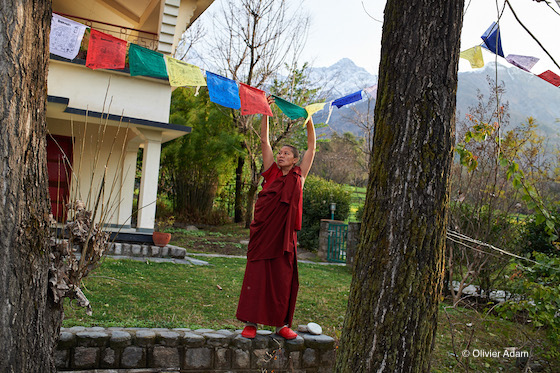
A Tibetan Buddhist nuns hangs new prayer flags at Dolma Ling Nunnery and Institute. It is traditional to hang new prayer flags at Losar or Tibetan New Year. Photo courtesy of Olivier Adam.

After an object is blessed and the ritual is completed, it is important to handle it respectfully — for example, keeping it in a safe and clean place and using it appropriately. Likewise, the Tibetan prayer flags we sell here through our online store are all made by nuns and have already undergone the necessary rituals and blessings. When placed outdoors such as on rooftops, mountain passes, or sacred sites, the wind carries the prayers and mantras printed on the flags, spreading blessings, compassion, peace, and good fortune to all beings.

Meaning of the Symbols on Windhorse Prayer Flags

the meaning of windhorse Tibetan prayer flags lungta

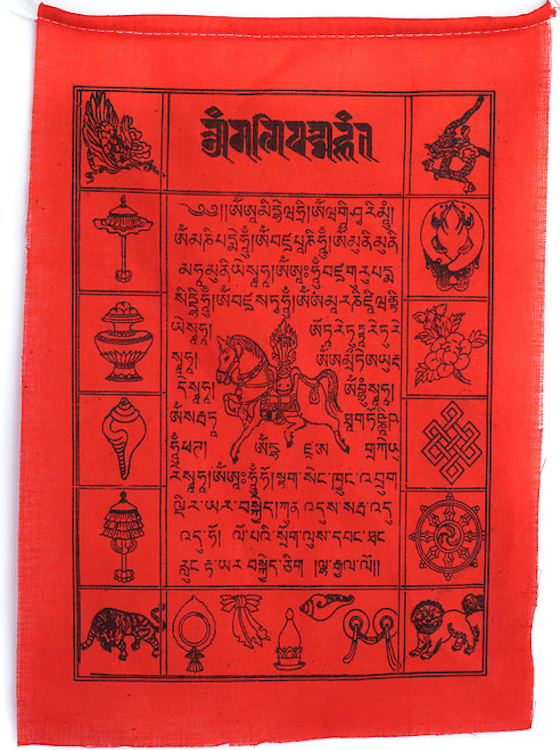
Here’s a detailed photo of one of the windhorse (Lungta) prayer flags made by the nuns, showing the prayers and sacred symbols. The Lungta or windhorse is in the center, surrounded by mantras. In the corners are the four auspicious animals, and, at the sides, are the eight auspicious Buddhist symbols.

The central image on the prayer flag is the windhorse, symbolizing good fortune, luck, and the power to influence events. It is depicted carrying a wish-fulfilling jewel on its back.

In the four corners of each prayer flag are the Four Auspicious Animals. Clockwise from the upper left, they are the Garuda (upper left), Dragon (upper right), Snow Lion (bottom right), and Tiger (bottom left).

A Tibetan Buddhist nun makes prayer flags at Dolma Ling Nunnery

A Tibetan Buddhist nun makes prayer flags at Dolma Ling Nunnery. All the prayer flags sold in our online store are made and blessed by nuns in India.

These “Four Auspicious Animals” are also called the Four Mythical Creatures, the Four Guardians, the Four Gods, or the Four Dignities in Buddhist mythology. In Buddhism, these four guardian animals symbolize the overcoming of birth, old age, sickness, and death. They are also known as the guardians of the four cardinal directions: north, south, east, and west.

These sacred mythical animals also represent the qualities and attitudes that bodhisattvas develop on the path to enlightenment — qualities such as awareness, vast vision, confidence, joy, humility, and power.

The Meaning of the Four Auspicious Animals in Buddhism

GARUDA: The Garuda is an enormous, mythical bird of prey that represents fearlessness, power, and wisdom. Known for its ability to soar to great heights, it symbolizes the mind’s ability to rise above worldly concerns and attain spiritual liberation. It is believed to be able to subdue nagas (serpent spirits), representing the victory of wisdom over ignorance. It represents the north in the four cardinal directions.

DRAGON: The thunder dragon, also known as druk (འབྲུག) in Tibetan and Bhutanese mythology, is the national symbol of Bhutan and is depicted on the Bhutanese flag. The dragon was adopted as an emblem by the Drukpa Lineage, which originated in Tibet and spread to Bhutan. Tibetan dragons are used on prayer flags, carpets, furniture, thangkas, and to decorate temple gates and roofs. They are believed to bring enlightenment. elegance, generosity, calmness, and achievements.

Tibetan flag

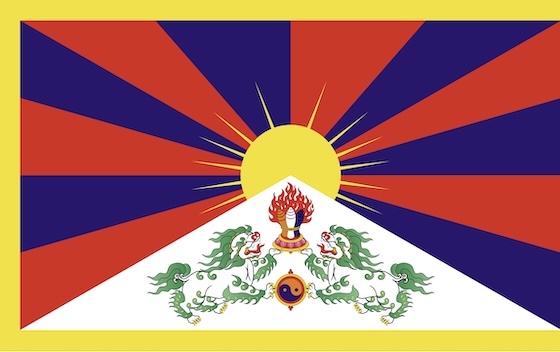
The Tibetan flag with the pair of snow lions. The snow lion is the emblem of Tibet and is one of the Four Auspiciaous Animals on the corners of the windhorse prayer flag.

SNOW LION: The snow lion (གངས་སེང་གེ་) is the emblem of Tibet, and a pair of snow lions is on the national flag of Tibet. The snow lion represents both the snowy mountain ranges and glaciers of Tibet and also symbolizes fearlessness and joy, power and strength, the direction east, and the earth element. The lion’s roar embodies the sound of “emptiness” (Sanskrit: Śūnyatā), courage and truth, and this is often a synonym for the Buddhadharma, the Buddha’s teachings and the challenging call to awakening.

TIGER: The tiger may represent power, confidence, discipline, and modesty. In Tibetan Buddhist culture, the tiger is often associated with the famous Buddhist saint, Guru Rinpoche (Padmasambhava), who is believed to have subdued the local deities and demons, bringing Buddhism to the region. The tiger represents the earthly realm and the fierce determination needed to overcome obstacles on the spiritual path.

What are the Prayers on the Prayer Flags?

At the center of a Lungta is the windhorse carrying three flaming jewels on its back. The horse represents strength, energy, and the ability to turn misfortune into good fortune. The three jewels represent the Buddha, the Dharma (the teachings), and the Sangha (the Buddhist community), which are the three main pillars of Tibetan Buddhism.

om mani padme hum, mantra, Tibetan mantra, meaning of om mani padme hum

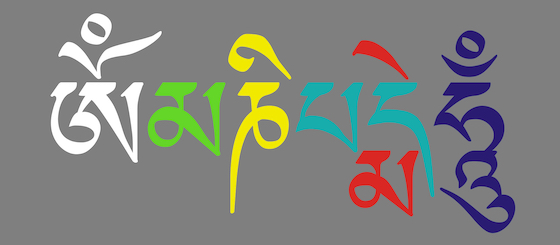
The mantra Om Mani Padme Hum in Tibetan.

At the top of the prayer flag, in an archaic script, it says OM MANI PADME HUM. This is the primary mantra of Avalokiteshvara, the Buddha and Bodhisattva of compassion. It is recited by Tibetans everywhere, and may be loosely translated as “Om, the Jewel in the Lotus, HUM.”

Around the central symbol of the windhorse or lungta are traditional mantras. Tibetan prayer flags vary, but the mantras used are one of the hundreds recited by the three Bodhisattvas or Gurus — Padmasambhava or Guru Rinpoche, Chenrezig, the embodiment of compassion, or Manjusri, known for transcendent wisdom. The oldest and most popular Buddhist mantra on the flags is Om Mani Padme Hum. Here’s a blog post in which His Holiness the Dalai Lama explains the deep  meaning of Om Mani Padme Hum.

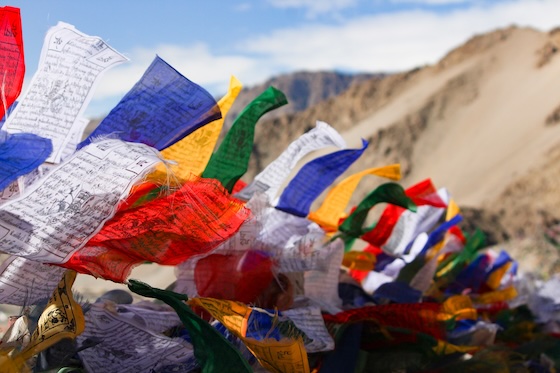
Tibetan prayer flags at a mountain pass

Tibetan prayer flags flutter in the wind at a mountain pass. Each of the five colors has a specific meaning and represents an element.

The Meaning of the Colors of Prayer Flags

Tibetan prayer flags come in sets of five, with one flag in each of the five colors. The colors from left to right are in this specific order: blue, white, red, green, and yellow. Each color has a meaning and represents an element.

According to Traditional Tibetan medicine, health and harmony are produced through the balance of the five elements.

  • Blue symbolizes the sky and space.
  • White symbolizes the air and wind.
  • Red symbolizes fire.
  • Green symbolizes water.
  • Yellow symbolizes earth.

Traditionally, prayer flags are hung from high points like mountain passes, temples, and rooftops, allowing the wind to carry the prayers far and wide.

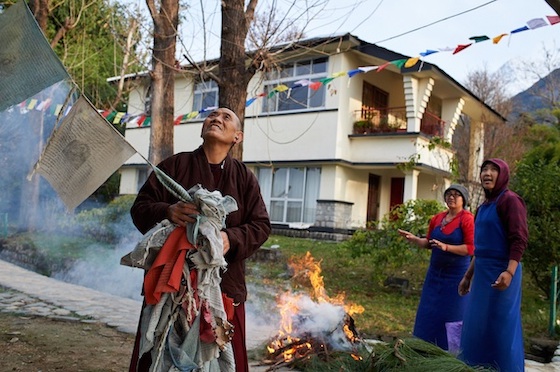
burning old Tibetan prayer flags

It is traditional to hang new prayer flags at Losar, Tibetan New Year. Here a nun at Dolma Ling Nunnery removes the old weathered prayer flags and respectfully burns them. Photo courtesy of Olivier Adam.

In Tibetan Buddhism, people often choose an auspicious day or date to hang a Lungta (prayer flag). These days are selected based on the lunar calendar and traditional astrological calculations to ensure that the blessings of the flags are most effective. Hanging the flags on a favorable day is believed to increase positive energy, bring good fortune, and enhance the spiritual power of the prayers and mantras printed on the flags. Many families and communities make it a special occasion, sometimes performing small ceremonies or offerings before placing the flags outdoors.

You can order prayers flags made and blessed by the nuns here. 

Results Announced for 2025 Geshema Exams

Record Number of Nuns Take 2025 Geshema Exams

The 2025 Geshema exam results are in!

During the summer, a record number of Tibetan Buddhist nuns took various levels of the four-year exams for the Geshema degree. Of the 161 nuns, 154 passed. This is a 96% pass rate.

Forty-seven nuns passed their fourth and final year of exams and will formally graduate as Geshemas in November.

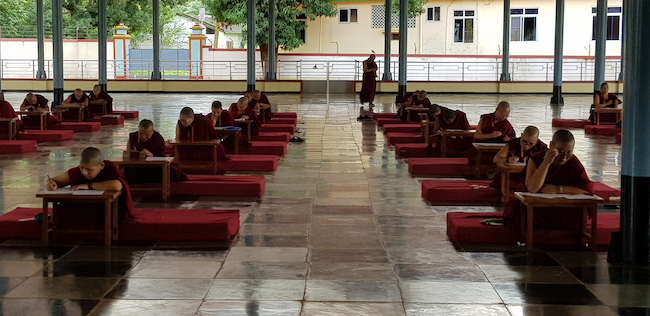
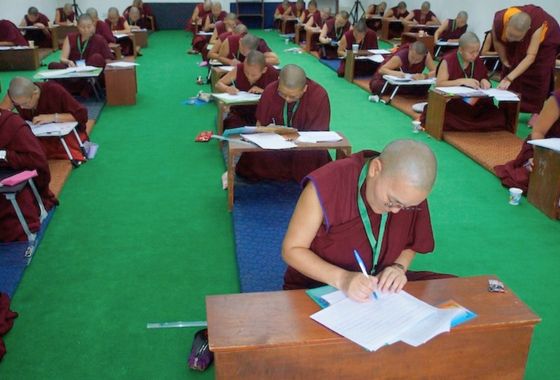
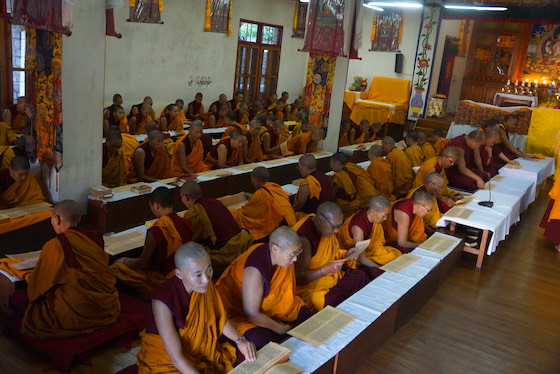
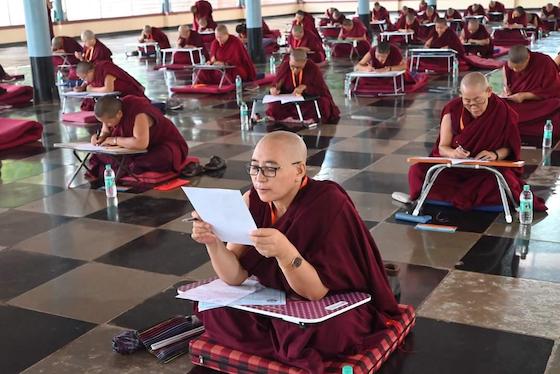
Rows of Tibetan Buddhist nuns taking Geshema exams in 2025

Rows of Tibetan Buddhist nuns taking Geshema exams in 2025. Photo by the Dolma Ling Media Nuns.

The Geshema degree is the highest level of training in the Gelug tradition and is roughly equivalent to a PhD in Tibetan Buddhist philosophy. It is the same as the Geshe degree for monks, but the ending “ma” marks it as referring to a woman. Until recently, this degree was reserved for men. It was only formally opened to women in 2012. The opening up of higher degrees for nuns is a breakthrough for Tibetan Buddhist nuns’ education.

In 2025, nuns took the exams as follows:
1st-year exams: 48 nuns, 44 passed
2nd year: 33 nuns took exams, 32 passed
3rd year: 31 nuns took exams, 31 passed
4th and final year: 49 nuns took exams, 47 passed

Geshema exams chart 2025

2025 marks another new record for nuns taking various levels of the 4-year Geshema exams. The degree was only opened to women in 2012. No exams were held in 2020 or 2021 due to COVID.

The exams were hosted this year by Dolma Ling Nunnery and Institute near Dharamsala from July 21 to August 16, 2025. The costs of the nuns’ travel, food, and the exam process were once again covered by the Tibetan Nuns Project’s Geshema Endowment Fund.

Tibetan Buddhist nuns reading messages of support for the 2025 Geshema exams

Tibetan Buddhist nuns reading messages of support for the 2025 Geshema exams. Thank you to everyone who sent good wishes to the nuns!

The nuns gathered in late June for a final, one-month study period before the start of the exams. The nuns from Kopan Nunnery in Nepal created this charming video about their journey to Dolma Ling and the final days of exam preparation. Can’t see the video? Click here.

About the Geshema Degree

The Geshema degree enables Tibetan Buddhist nuns to become teachers, leaders, and role models. It makes these dedicated women eligible to assume various leadership roles in their monastic and lay communities reserved for degree holders and hence previously not open to women.

The exams take four years to complete, with one set held each year over two weeks. Candidates are examined on the entirety of their 17-year course of study of the Five Great Canonical Texts. They must achieve a score of at least 75 per cent during their studies to be eligible to sit the exams.

TNP’s Founding Director and Special Advisor Rinchen Khando Choegyal has said, “Educating women is powerful… It’s about enabling the nuns to be teachers in their own right and to take on leadership roles at a critical time in our nation’s history.”

Here’s a video by the Dolma Ling Media Nuns about the 2025 Geshema exams. Can’t see the video? Click here.

The formal graduation ceremony for the 47 new Geshemas will take place in November after the annual inter-nunnery debate in Bodh Gaya. This will bring the total number of Geshemas to 120.

Here’s a list of the Geshema graduations since women were first allowed to take this degree in 2012:

The Geshemas are paving the way for other nuns to follow in their footsteps and the momentum is building. Not long ago, this increased status of nuns was almost unimaginable and we are so grateful for your support to educate and empower these dedicated women!

Thank you to everyone who sent good luck messages to the nuns this year! We gathered 74 messages from around the world and posted them at Dolma Ling for everyone to read before and during the exams.

Here’s a sample message from Scott: “Very inspired by your dedication! May your incredible effort benefit countless beings. Thank you!!” Steve wrote, “Your accomplishment brings great benefit and light to the world, at a time of darkness elsewhere. Bowing with great respect for your vision and perseverance.”

Gratitude to His Holiness the Dalai Lama

The success of the nuns would not be possible without the support and encouragement of His Holiness the Dalai Lama, patron of the Tibetan Nuns Project. As this recent article outlines, His Holiness “encouraged nuns to become advanced degree holders as part of his broader goal to increase gender parity.”

“Biologically there is no difference between the brains of men and women and the Buddha clearly gave equal rights to men and women,” His Holiness the Dalai Lama said in 2013. In 2018, he said, “In the beginning when I spoke about awarding Geshema degrees, some were doubtful. I clearly told them that Buddha had given equal opportunity for both men and women.”

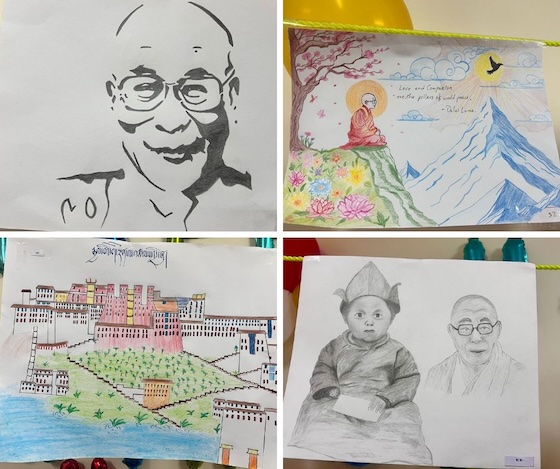
Art from painting contest by Shugsep nuns as part of celebrations of Dalai Lama's 90th birthday

Art from painting contest by Shugsep nuns as part of celebrations of Dalai Lama’s 90th birthday

Long-Term Stability

The costs associated with the annual Geshema exams are covered thanks to the 159 donors to the Geshema Endowment, including the Pema Chodron Foundation, the Pierre and Pamela Omidyar Fund of the Silicon Valley Community Foundation, the Frederick Family Foundation, and the Donaldson Charitable Trust. We are also very grateful to all those who sponsor nuns and help them on their path. More sponsors are always needed and you can learn more about sponsoring a nun here.

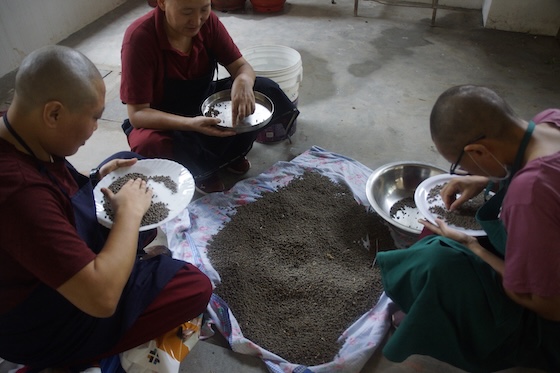
Preparing food for 2025 Geshema exam candidates

Nuns on kitchen duty sort through lentils to search for any small stones. Hosting the Geshema exams is a big enterprise with over 100 more nuns to feed for at least a 6-week period.

We would like to put more of our core programs on solid ground. By giving to the Long-Term Stability Fund, you will be helping current and future Tibetan Buddhist nuns at a critical time in Tibet’s history.

Every little bit helps! No matter what the future of Tibet holds, you can help these dedicated and courageous women to preserve their culture and spiritual traditions. Thank you!

Information session for the 2025 geshema exams

Information session for the 2025 Geshema exams. One sponsor wrote this message of encouragement: “Your accomplishment brings great benefit and light to the world, at a time of darkness elsewhere. Bowing with great respect for your vision and perseverance.”

Thank you for your support and dedication to the Tibetan Buddhist nuns!

New Housing for Geshemas Doing Tantric Studies

In 2019, the Tibetan Nuns Project started fundraising for a significant initiative, Housing for Geshemas. We sought your help to build 16 rooms at Dolma Ling Nunnery and Institute for Geshema-degree graduates. These rooms allow these senior nuns to live and study while they attend a year-long Tantric studies program at Gyuto Tantric Monastery.

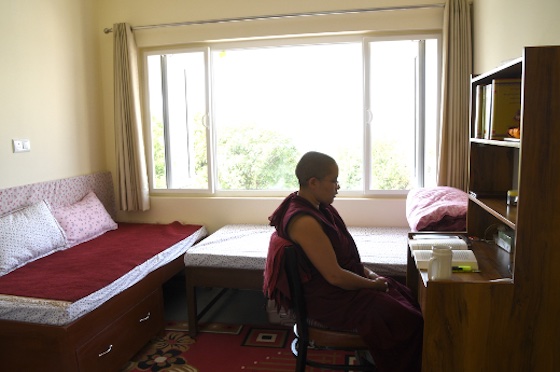
A Geshema Tibetan Buddhist nuns studies at Dolma Ling Nunnery May 2025

A Geshema Tibetan Buddhist nun studies in one of the 16 purpose-built rooms at Dolma Ling Nunnery, May 2025.

The Geshema degree (called a Geshe degree for men) is the highest level of training in the Gelugpa tradition and is equivalent to a PhD in Tibetan Buddhism. The degree was only formally opened to women in 2012.

We are happy to report that the rooms are now built, furnished, and occupied. The Geshemas are very grateful for your generosity and kindness.

A Tibetan Buddhist nun studies in new housing block at Dolma Ling Nunnery May 2025

A Geshema nun engaged in peaceful and focused studies. The 16 rooms can be double or single occupancy. In spring 2025, 13 nuns from Nepal and India moved in when they started their year-long Tantric studies program.

In spring 2025, 13 Geshema nuns began their Tantric studies program at Gyuto Tantric Monastery, about two miles from the nunnery.

This year’s nuns came from four nunneries in India and Nepal. There are five nuns from Kopan Nunnery in Nepal, four from Jangchup Choeling Nunnery in south India, three from Geden Choeling Nunnery in Dharamsala, and one from Dolma Ling.

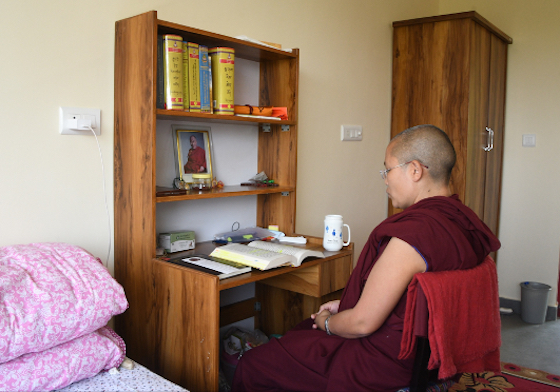
Geshema Tantric Housing at Dolma Ling spring 2025

One of the 13 nuns who began her Tantric studies this spring. The Geshemas are delighted with their rooms. They offer a wonderful atmosphere for study and contemplation.

The Tantric Geshema program began in 2017 under the guidance and support of His Holiness the 14th Dalai Lama and the Tibetan Nuns Project. The first group of 23 Geshemas graduated from the program in 2019. The program is thriving.

Though there have been accomplished female practitioners in Tibet’s history, until 2017, women did not have the opportunity to study Tantric Buddhism formally. The nuns travel from Dolma Ling to Gyuto Tantric Monastery for classes.

Happy Geshema Tibetan Buddhist nun at Dolma Ling Nunnery

Nuns engage in text memorization outside their rooms.

The original Gyuto Tantric University was founded in Tibet in 1474 and was re-established in exile. It continues an unbroken tradition for over 500 years and provides the highest level of Tantric training in the Tibetan Buddhist tradition.

The Tantric Buddhism program provides Geshemas with training in tantric theory, rituals, and mind-training techniques used by those engaged in advanced meditation. This level of training is essential to enable the Geshemas to be fully qualified for advanced leadership roles, such as the head of a nunnery.

Two photos of the new rooms for Geshemas at Dolma Ling Nunnery

Photos of the new rooms for Geshemas at Dolma Ling Nunnery. The 16 rooms can be either single-bed rooms or, as the groups of Geshema graduates become larger, accommodate two nuns per room.

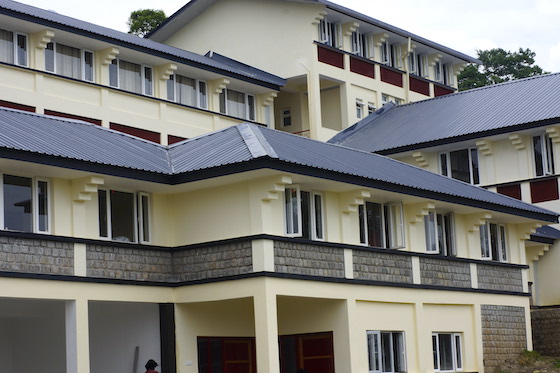
The 16 rooms and facilities are on the third floor of the Yangchen Lophel Study Center at Dolma Ling. These rooms create a good environment for study and contemplation. Each room has enough space for their intensive studies.

The nuns send their gratitude for the improved study conditions and the opportunity to deepen their knowledge of Tantric philosophy and practice.

Housing for Geshemas at top of new Yangchen Lophel Study Center

The 16 rooms and facilities are on the third floor of the Yangchen Lophel Study Center at Dolma Ling.

Before the 16 rooms were built, the nunnery was struggling to make space for Geshemas to stay during their course. It placed a strain on the nunnery and restricted the number of new nuns who could be admitted to Dolma Ling because of a lack of accommodation.

His Holiness the Dalai Lama blesses the Geshema nuns who have completed their further studies in Tantric Buddhism.

His Holiness the Dalai Lama blesses the previous group of nine Geshemas who graduated from the Tantric Studies program on February 19th, 2025. The laywomen are Nangsa Choedon, Director (top) and Tenzin Palkyi, Project Coordinator at the Tibetan Nuns Project in India.

We would like to thank everyone who supported the Housing for Geshemas project and the Tantric Studies Program.

The Tantric studies program is now funded through our Geshema Endowment, which also supports the annual Geshema exams and Geshema graduation. We are extremely grateful to the donors to the Geshema Endowment, including the Pema Chodron Foundation, the Pierre and Pamela Omidyar Fund of the Silicon Valley Community Foundation, the Frederick Family Foundation, and the Donaldson Charitable Trust. We hope to put more of our core programs on a solid footing through our Long-Term Stability Fund.

See our Current Needs page for all our projects.

Geshemas studying Tantric Buddhism

Part of the first group of 23 Geshema nuns who had the opportunity to do Buddhist Tantric Studies. Photo by the Dolma Ling Media Nuns.

Tibetan Buddhist Prayers or Pujas

The Power of Prayer

Buddhists believe that prayers can help relieve suffering and overcome obstacles. In Tibetan culture, it is common to request Buddhist nuns and monks to say prayers and perform spiritual ceremonies. The prayers and pujas can be for many purposes such as good health, long life, success, and to ease the journey of someone who has passed away.

Tibetan Buddhist nuns praying at Dolma Ling Nunnery

Tibetan Buddhist nuns praying at Dolma Ling Nunnery.

In challenging times when we feel helpless, sponsoring prayers and pujas brings comfort to the giver and the person receiving the blessings. Tibetans recite mantras and prayers to purify the mind, deal with negative emotions, increase merit, and invite help from the Buddha and various enlightened beings.

What is a puja?

Puja is a Sanskrit term meaning offering or worship. In Tibetan Buddhism, the word puja is used to describe a variety of ritual performances and prayers typically conducted in temples, nunneries, or monasteries.

The specific actions vary depending on the tradition but generally include chanting and reciting ritual texts to bring blessings, purify the mind, and cultivate merit. Pujas generally include offerings to show respect and reverence for Buddhas and bodhisattvas. These offerings include incense, light as butter lamps or candles, flowers, fruit, and water.

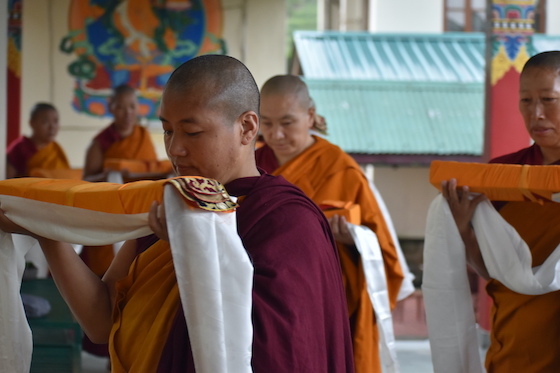
Tibetan Buddhist nuns at Shugsep Nunnery holding sacred texts as part of a puja

Tibetan Buddhist nuns at Shugsep Nunnery holding sacred texts as part of a puja.

How to Sponsor a Puja by Tibetan Buddhist Nuns

You don’t have to be a Buddhist to request prayers. You can ask the Tibetan Buddhist nuns in northern India to perform prayers and pujas on your behalf.

People around the world can sponsor pujas or prayers through our Tibetan Nuns Project website. You can sponsor prayers in honor of loved ones, friends, family members, or even pets who may be suffering from obstacles, ill health, or who have passed away.

When requesting a puja or prayers from the Tibetan Nuns Project please provide information about who the prayers are to be directed to and for what purpose. The funds given to the nuns to sponsor pujas are used to purchase supplies and also help to support the nunnery as a whole.

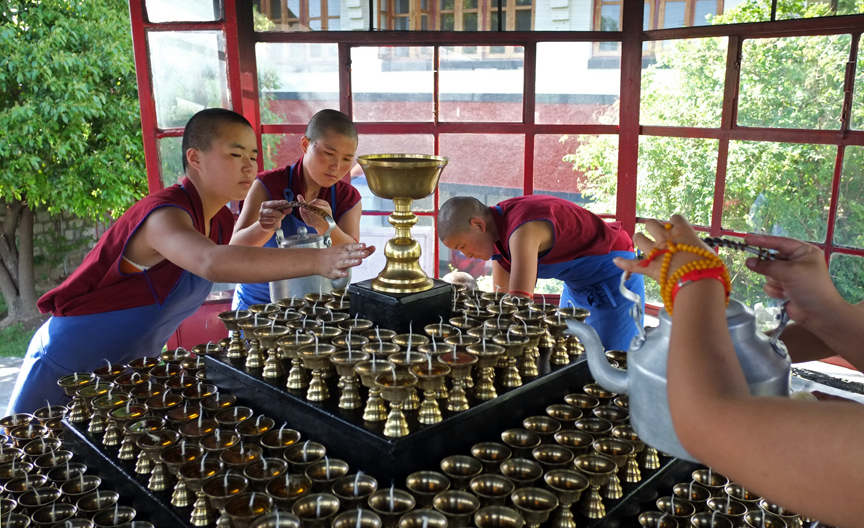
butter lamps, Tibetan Buddhist nuns, Dolma Ling, Dharamsala, pujas, order pujas

Tibetan Buddhist nuns at Dolma Ling Nunnery prepare hundreds of butter lamps for a special puja.

A gift of prayer is something very special. As soon as we receive your request for a puja, we will send you a thank you message by email. As soon as possible after that, the nuns will email you a confirmation note and receipt to let you know that the puja has been performed.

Types of Tibetan Buddhist Pujas by the Nuns

There are many different types of prayers or pujas to choose from, ranging from offering 100 butter lamps to the elaborate “21 Praises to Tara” which includes 100,000 recitations of the Tara prayer, renowned for removing obstacles and fulfilling wishes. Here are the descriptions. You can find all the pujas and costs listed here.

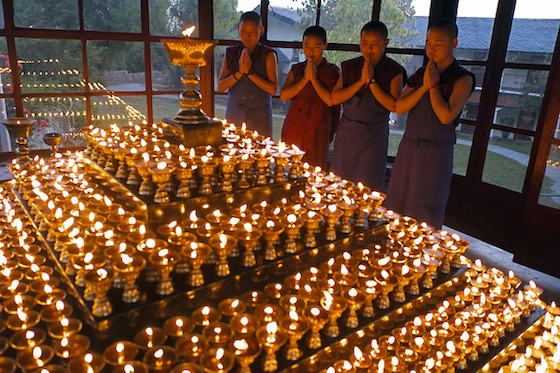
Butter Lamps Offering (Mar-me): Butter lamps are part of daily traditional Tibetan practice and are also lit for many occasions. It is common to offer butter lamps for those who are sick or have passed away (to light the path towards liberation). Butter lamps are also lit for happy occasions like birthdays and marriages, or to aid with focus and meditation. Tibetans light butter lamps on sacred days in the Tibetan Buddhist calendar, such as the 10th, 15th and 25th day of each lunar month, as well as during the holy month of Saga Dawa. This offering will provide fuel to light 100 butter lamps, which is usually butter or oil.

Tibetan Butter lamps

Tibetan nuns at Dolma Ling Nunnery offer butter lamps as part of a healing puja. Photo by Brian Harris

Medicine Buddha (Men-la): This puja aids in healing physical, mental, and emotional ailments. It invokes the wisdom and blessings of the Medicine Buddha (Sang-gyay Men-la) and can also enhance and support your work if you are a medical practitioner.

Offering to Tara (Drol-chok): Tara is known as a protector who relieves physical, emotional, and spiritual suffering. This elaborate offering involves creating ritual cakes called tormas and the use of musical instruments. This puja is particularly effective in removing obstacles and fulfilling wishes.

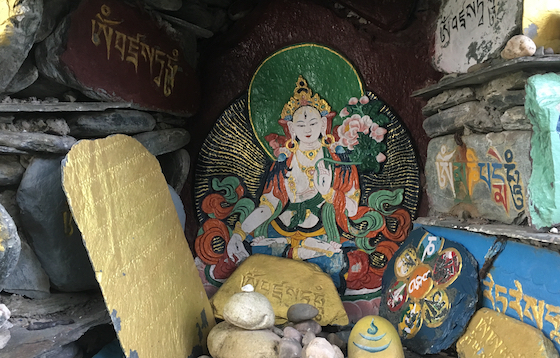
White Tara surrounded by mani stones by Heather Wardle

White Tara surrounded by mani stones. Tara is especially revered in Tibetan Buddhism and is known as the “mother of liberation”. Photo courtesy of Heather Wardle

Twenty-One Praises to Tara (Dolma-bum): Tara is believed to be a Bodhisattva of compassion and a protector who relieves physical, emotional, and spiritual suffering. Each of the twenty-one emanations of Tara has her own name, special attributes, and a specific mantra with which she is associated, offering protection from various types of fears, harm, and calamities. The Praises to the 21 Taras puja protects you from fear and dangers and is renowned for removing obstacles and fulfilling wishes, especially wishes on the spiritual path. This puja includes 100,000 recitations of the “Twenty-one Praises to Tara” prayer. Due to the time-intensive nature of this prayer, it will take an average of two weeks to complete.

Here is a sound recording made by Olivier Adam of the nuns chanting the Tara Puja. Can’t hear it? Click here and scroll down.

Long Life Ritual (Nam-gyal Tse-chok): This is a prayer for longevity to the female deity, Nam-gyal-ma, one of the three buddhas of long life.

Tibetan tormas, Tibetan Buddhist nuns, Tibetan sacred arts, tormas, Tibetan ritual arts

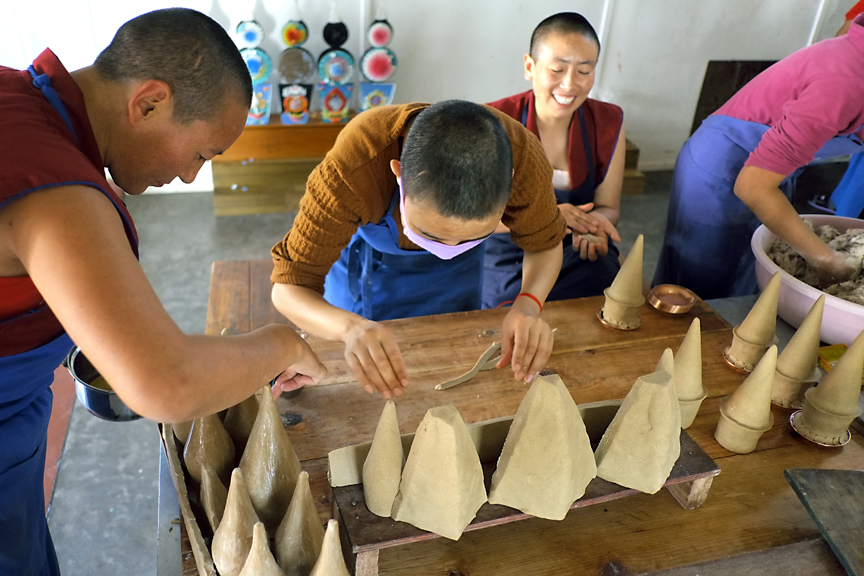
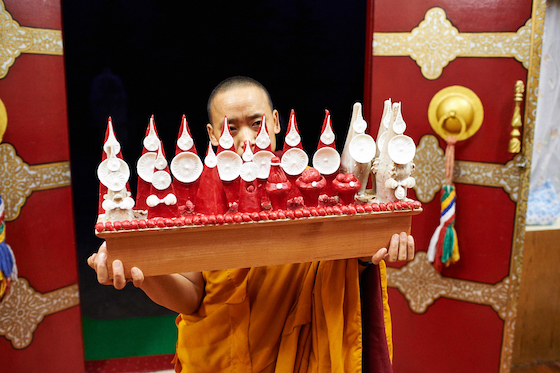
Tibetan Buddhist nuns prepare tormas for a puja. Tormas are figures made mostly of flour and butter used in tantric rituals or as offerings. Photo courtesy of Brian Harris.

Four Hundred Offerings (Gyab-zhi): Gyab-zhi is one of the most widely practiced ceremonies in Tibetan Buddhism. The ritual involves four sets of 100 offerings: 100 butter lamps to eradicate delusion; 100 ritual cakes called tormas to overcome desires; 100 human effigies made of dough to subdue the demon of death; and 100 tsa-tsa which are stamped clay votive images to overcome tainted aggregates. The intention of the Four Hundred Offerings is to aid in overcoming inauspiciousness, disease, untimely death, and challenging supernatural forces.

Tibetan Buddhist nun holding torma

Tibetan Buddhist nun holding tormas. Photo by Olivier Adam copy

Three Pairs (Chak-sum): Chak-sum is an offering of three ritual cakes, or tormas: one to the protectors of the Buddha Dharma, another to local spirits, and a third to the suffering beings of the “Hungry Ghost Realm.” These offerings are intended to aid in the purification of negativities.

Cutting Through the Ego (Chöd – Simple): This puja aims at cutting through the hindrances or obscurations of self-cherishing thought and ignorance, the greatest obstacles on the path to enlightenment. The Chöd puja involves prayer, chanting, visualizations and the playing of Tibetan instruments such as the hand drum. It can also be effective for those who are severely ill. This puja is performed by the nuns at Shugsep Nunnery and Institute.

Chod practice at Shugsep Nunnery and Institute

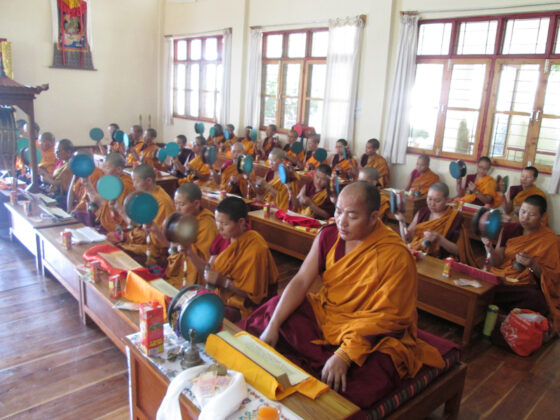
Chod practice at Shugsep Nunnery and Institute

Cutting Through Ego (Chöd – Elaborate with Tormas): The tantric practice of Chöd is effective for those who are severely ill. This elaborate version of Chöd (pronounced chö) involves the creation and offering of various ritual barley cakes called tormas. During the ritual, the nuns immerse themselves in chanting, music, prayer and visualizations. While reciting the Chöd rite the nuns are accompanied by the sound of several Tibetan instruments: the damaru or hand drum, the kangling, a reed instrument, and the large Chöd drum, which is larger than the hand drum. This puja is performed by the nuns at Shugsep Nunnery and Institute.

Gya-thong-pa & Sung-dhu: This puja involves reading the 800-verse Perfection of Wisdom Sutra and the Collection of Dharanis. It generates great merit and helps to overcome sickness and other obstacles.

A Paradigm Shift for Tibetan Buddhist Nuns

A Paradigm Shift

Less than ten years ago, the first Tibetan Buddhist nuns made history when they graduated with the Geshema degree, equivalent to a PhD in Tibetan Buddhism.

Until 2012, the highest degree was only open to men. The 2016 Geshema graduation ceremony, presided over by His Holiness the Dalai Lama, marked a new chapter in the education of ordained Buddhist women.

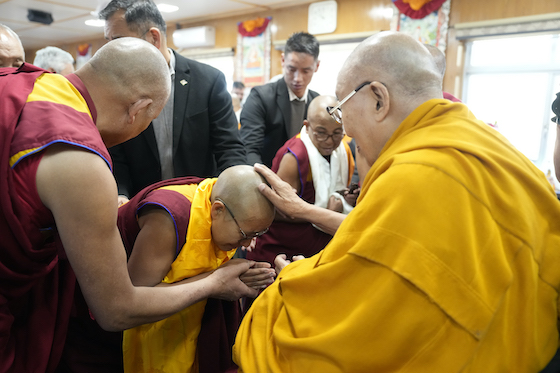
His Holiness the Dalai Lama blesses the Geshema nuns who have completed their further studies in Tantric Buddhism.

This winter, His Holiness the Dalai Lama blessed the Geshema nuns who completed a one-year program in Tantric Buddhism. The laywomen are Nangsa Choedon, Director (top) and Tenzin Palkyi, Project Coordinator at the Tibetan Nuns Project in India.

Their success fulfilled a longstanding wish of His Holiness the Dalai Lama, the patron of the Tibetan Nuns Project. It was even more remarkable because some of the nuns were illiterate when they escaped from Tibet.

Since those first 20 nuns stepped across the stage to make history, many nuns have followed in their footsteps. Last year, a record 144 nuns sat various levels of the four-year Geshemas exams and 13 graduated as Geshemas, bringing the total number of Geshemas to 73.

Geshema graduation ceremony

His Holiness the Dalai Lama with the 20 Geshema graduates in 2016. Photo courtesy of OHHDL.
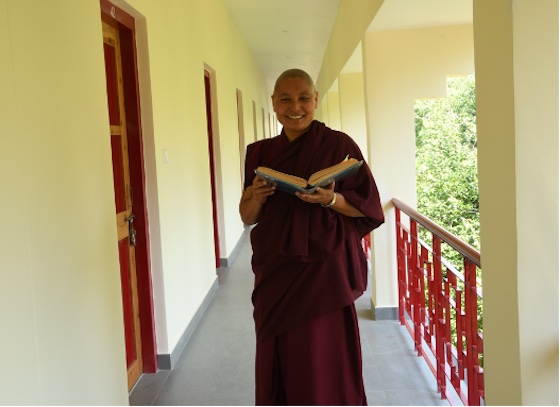

This change in the status and education of Tibetan Buddhist nuns would not have been possible without the steadfast generosity of our supporters. Thank you! The Geshemas are now assuming leadership and teaching roles previously closed to women.

Fifth Set of Graduates from the Tantric Studies Program

Last month, on February 19th, 2025, nine Geshemas graduated from the year-long Tantric Studies program at Gyuto Tantric University near Dolma Ling Nunnery and Institute.

Here’s a charming video of the graduation made by the Dolma Ling Media Nuns. Can’t see the video? Click here.

The Tibetan Nuns Project launched the Tantric Buddhism study program in 2017 thanks to the support of generous donors. Although there have been accomplished female practitioners in Tibet’s history, women have never before been given such an opportunity to formally study Tantric Buddhism.

A Tibetan Buddhist nun receives a blessing from His Holiness the Dalai Lama Dec 2024

A Geshema receives blessings from His Holiness the Dalai Lama in December 2024 after completing a one-year program in Tantric Buddhism. These women pioneers have accomplished a level of scholarship and Buddhist training that, until recently, was only open to men.

Another Step Towards Equality

The Tibetan Nuns Project has played a pivotal role in advocating for equality of access to education and higher degrees. The Tantric Buddhism program for nuns helps bring them more in line with monks for learning opportunities and advancement along the spiritual path.

Once monks attain their Geshe degree, if they want to be fully qualified masters capable of teaching their complete tradition, they must add to their knowledge an understanding of the principles of Tantra and the main Tantric practices of their tradition. For these studies, monks usually join one of the two Tantric Colleges where they have access to highly qualified teachers, texts, and a supportive community of practitioners. Until recently, these options weren’t available to nuns.

Tantric studies, Tibetan nuns, Tibetan Buddhism, Dolma Ling

For the first time in the history of Tibet, Buddhist nuns have the opportunity to formally study Tantric Buddhism. The program started in 2017 and now the fifth set of nuns has graduated. Photo courtesy of the Nuns Media Team.

The Tantric studies program for nuns began in 2017 after a committee of representatives from six nunneries approached His Holiness the Dalai Lama for advice about the curriculum and how to proceed.

His Holiness the Dalai Lama kindly gave detailed instructions about the treatises to be used and recommended that the Geshema nuns study as a group at Dolma Ling Nunnery. The first Geshemas graduated in 2019.

Tibetan Buddhist nun graduates from Tantric Buddhism Program Feb 2025

Nangsa Chodon, Director of the Tibetan Nuns Project in India, presents the degree certificate at the graduation ceremony on February 19, 2025, for the fifth group of Geshemas who completed their studies in Tantric Buddhism.

The Tantric Studies program will continue as more nuns obtain the Geshema degree. In January 2025, the Tibetan Nuns Project completed the funding for 16 rooms at Dolma Ling where the Geshemas from India and Nepal can stay while they take the program. This is an exciting development of a safe space for the nuns to stay and focus on their studies.

Building a Solid Future

The Tantric studies program for nuns is funded through our Geshema Endowment which also supports the annual Geshema exams and the Geshema graduation each November. We are extremely grateful to the 159 donors to the Geshema Endowment, including the Pema Chodron Foundation, the Pierre and Pamela Omidyar Fund of the Silicon Valley Community Foundation, the Frederick Family Foundation, and the Donaldson Charitable Trust.

Feb 2025 Graduation ceremony for Tibetan Buddhist Geshemas who completed their one-year program in Tantric Buddhism

On February 19, 2025, the fifth cohort of Geshemas graduated from their one-year program in Tantric Buddhism. Nine nuns graduated from this special program launched by the Tibetan Nuns Project in 2017.

The Tibetan Nuns Project wants to put more of its core programs on solid ground through our Long-Term Stability Fund and through encouraging supporters to leave a legacy of compassion to help the nuns.

As one supporter said, “A donation to this cause benefits beyond helping just the nuns… it benefits the Tibetan culture, it benefits refugees from Tibet, it benefits education for women, it benefits the Buddhist religion and community and all of this spreads like a ripple of compassion for others beyond that community. This is not charity; it is an investment in humanity.”

Results Announced for the 2024 Geshema Exams

Record Number of Nuns Take 2024 Geshema Exams

The 2024 Geshema exam results are in! During the summer a record number of Tibetan Buddhist nuns took various levels of the four-year exams for the Geshema degree. Of the 144 nuns, 123 passed which is an 85% pass rate. All 13 nuns who took their fourth and final year of exams passed.

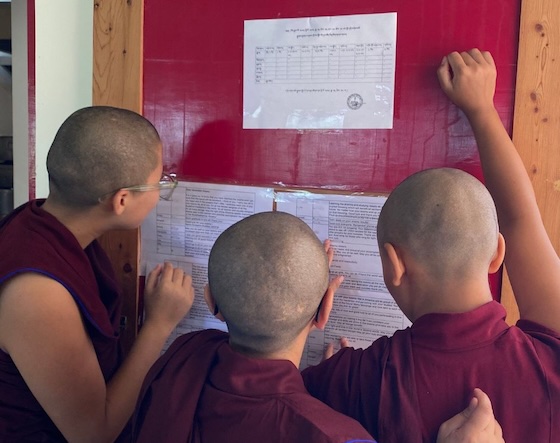
Geshema exam results 2024, geshema exams

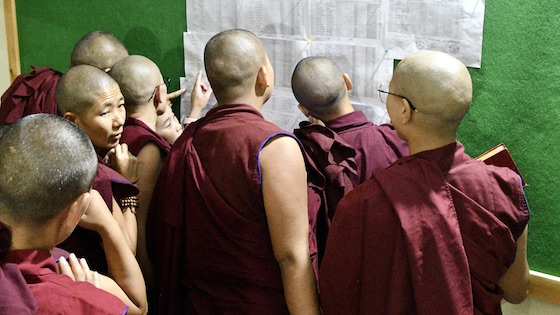
Nuns gather eagerly around the noticeboard at Dolma Ling Nunnery to read the results of the 2024 Geshema exams.

The Geshema degree is the highest level of training in the Gelugpa tradition and is equivalent to a PhD in Tibetan Buddhist philosophy. It is the same as the Geshe degree for monks but the ending “ma” marks it as referring to a woman. Until recently, this degree was reserved for men. It was only formally opened to women in 2012. This is a breakthrough for Tibetan Buddhist nuns’ education.

Tibetan Buddhist nuns taking Geshema Exams in 2024

Nuns taking Geshema exams in 2024.

The 2024 Geshema exams were held from July 21st to August 15th at Jangchub Choeling Nunnery in Mundgod, South India. In an earlier blog we stated that 147 nuns were planning on taking exams in 2024, but several were unable to take part. The actual number was 144 — a new record.

Nuns from seven nunneries in India and Nepal took the exams as follows:
1st-year exams: 46 nuns, 30 passed
2nd year: 35 nuns took exams, 30 passed
3rd year: 50 nuns took exams, all 50 passed
4th and final year: 13 nuns took exams, all 13 passed


Geshema exam stats graph - 1

There has been a dramatic increase in nuns taking their Geshema exams. No exams were held in 2020 and 2021 because of the COVID pandemic.

The formal graduation ceremony for the 13 new Geshemas will occur in November 2024 after the annual inter-nunnery debate in Bodh Gaya. This will bring the total number of Geshemas to 73.

Here’s a list of the Geshema graduations since women were first allowed to take this degree in 2012:

The Geshemas are paving the way for other nuns to follow in their footsteps and the momentum is building. Not long ago, this increased status of nuns was almost unimaginable and we are so grateful for your support to educate and empower these dedicated women!

2024 Geshema exams results

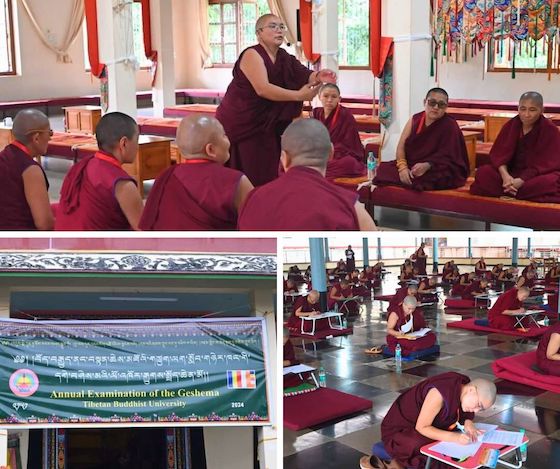
More photos from the 2024 Geshema exams. Geshemas and Geshes are the most educated monastics, carrying much of the responsibility for preserving the Tibetan religion and culture.

The Geshema degree enables Tibetan Buddhist nuns to become teachers, leaders, and role models. It makes these dedicated women eligible to assume various leadership roles in their monastic and lay communities reserved for degree holders and previously not open to women.

Thank you to everyone who sent good luck messages to the nuns this year! We gathered the 172 messages and sent them to South India for everyone to read before and during the exams. Here’s a sample message from Sara: “Dear Dharma sisters and sources of inspiration, May your final study be effective and may you have every kind of confidence when you take your final exams. You are setting such an amazing example for all practitioners, but I think especially for women, all around the world.”

Tibetan Buddhist nuns at Dolma Ling depart for south India to take their Geshema exams.

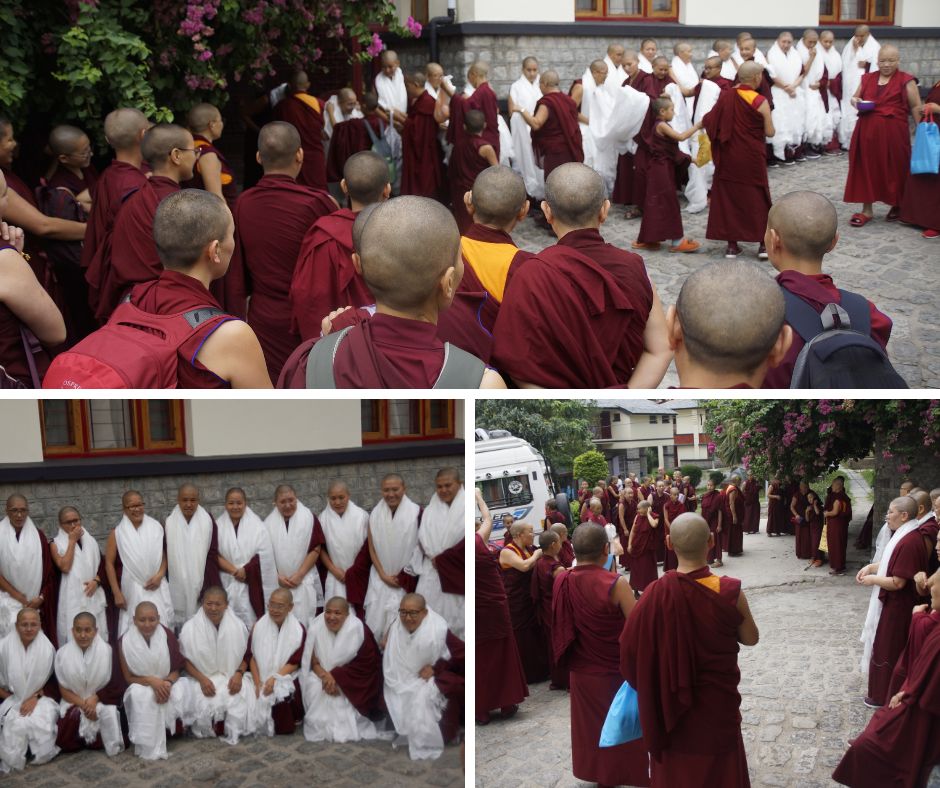
Photos of nuns leaving Dolma Ling in June for their Geshema exams in Mundgod, South India. The nuns who took these photos said, “Courage, determination, and faith accompany our nuns on their exam journey.”

We are grateful to the 159 donors to the Geshema Endowment which funds the annual exams including the Pema Chodron Foundation, the Pierre and Pamela Omidyar Fund of the Silicon Valley Community Foundation, the Frederick Family Foundation, and the Donaldson Charitable Trust. Thank you also to everyone who sponsors a nun and helps them on their path.

2024 Geshema exams

Collage of photos from the 2024 Geshema exams. In her good luck message, Judith wrote, “I celebrate with all of you as you reach this amazing milestone in your studies. We so need monastics in the world –and especially nuns – who can teach the dharma with depth and insight. Those of us who support you from afar are overjoyed to see your many months of effort and study bear fruit. Wishing you great success in your exams!”

“Educating women is powerful,” said TNP’s Founding Director and Special Advisor Rinchen Khando Choegyal. “It’s about enabling the nuns to be teachers in their own right and to take on leadership roles at a critical time in our nation’s history.”

Thank you for your support and dedication to the Tibetan Buddhist nuns!


More Nuns Earn Highest Degree

2023 Geshema Graduation and Annual Debate Event

On November 27th, seven Tibetan Buddhist nuns graduated with their Geshema degrees at a special convocation ceremony in the holy city of Bodh Gaya, India.

Geshema graduation 2023, Geshema

The seven Tibetan Buddhist nuns who earned their Geshema degrees in 2023 at the graduation ceremony in Bodh Gaya. Photo by the Dolma Ling Media Nuns.

The degree is the female equivalent of the Geshe degree for monks and is the highest academic degree available in the Gelug tradition, roughly equivalent to a PhD.

This was the sixth cohort of Geshemas since the degree was opened to women in 2012. The first 20 nuns graduated in 2016.

At the ceremony, Nangsa Choedon, the director of the Tibetan Nuns Project in India, spoke about the work to ensure a strong future for Tibetan nuns.

Geshema graduation 2023, Nangsa Choedon

Nangsa Choedon of the Tibetan Nuns Project presents the Geshema graduates with robes and the yellow hats that signifies the holding of this highest degree. Photo by the Dolma Ling Media Nuns.

Other special guests who attended the graduation included Kunga Gyaltsen, the additional secretary of Religion and Cultural Affairs for the Central Tibetan Administration (CTA) who offered congratulations to the new Geshemas on behalf of the CTA. He encouraged the nuns to educate their local communities on core Buddhist teachings and also urged them to encourage participation in projects aimed at bringing insights from modern science to monastics.

2023 Geshema graduation

Tibetan Buddhist nuns line up to offer congratulations and ceremonial white katak scarves to the Geshema graduates. Photo by the Dolma Ling Media Nuns.

The Geshema degree enables these dedicated women to assume various leadership roles in their monastic and lay communities reserved for degree holders and hence previously not open to women.

Geshemas, 2023 inter-nunnery debate

At the 2023 Jang Gonchoe inter-nunnery debate event, there were five Geshemas from previous years who acted as teachers during the month of intensive training in monastic debate. Two were from Jangchup Choeling, one from Kopan Nunnery, one from Jangyang Choeling, and one from Dolma Ling.

The Geshema exams took place in the summer and a record 132 nuns took various levels of the four-year exams. This is 38 more than the 94 nuns who took exams in 2022. Here’s a video  made by the nuns about the 2023 exams.

Tibetan Buddhist nuns, Geshema exams in 2023

In 2022, 94 nuns sat Geshema exams. This year, a record 132 nuns are taking various levels of the four-year exams. Photo by the Dolma Ling Media Nuns.

Momentum is building and an increasing number of nuns wish to attain this highest academic standing. Many young and new nuns who join the nunneries we support in northern India are saying in their introductory interviews that they want to pursue the rigorous 17-year training that precedes the Geshema exam process.

They look to examples of Geshemas as teachers and leaders and they are inspired to follow in their footsteps. As of the end of 2023, there are 60 Geshemas in this tradition of Tibetan Buddhism.

2023 Jang Gonchoe Inter-Nunnery Debate

The graduation was the culmination of the nuns’ annual inter-nunnery debate event called the Jang Gonchoe which took place from October 25th to November 28th.

inter-nunnery debate,2023 Jang Gonchoe

In 2023, over 500 Tibetan Buddhist nuns from India and Nepal took part in the month-long inter-nunnery debate event called the jang Gonchoe.

This year around 520 nuns from 10 nunneries from India and Nepal gathered at the Kagyu Monlam in Bodh Gaya to take part in the month-long intensive training in monastic debate.

Nuns practicing debate daily at Dolma Ling Nunnery.

Nuns practicing debate daily at Dolma Ling Nunnery. Monastic debate is of critical importance in traditional Tibetan Buddhist learning. Through debate, nuns test and consolidate their classroom learning. Photo courtesy of Olivier Adam.

Throughout the year nuns practice debate daily at their nunneries. But, the Jang Gonchoe debate event provides the training and practice that is essential for nuns who wish to pursue higher degrees.

Long-Term Stability

Both the Geshema exams and the inter-nunnery debate are funded by endowments through the Tibetan Nuns Project and are self-sustaining. We are grateful to all those who supported these two funds.

Tibetan Buddhist nuns

Some of 510 nuns who took part in the 2023 inter-nunnery debate. Their food and travel costs were covered by the Debate Fund. Now we want to more more of our core programs on a sustainable footing with TNP’s Long-Term Stability Fund.

Now our wish is to put more of the Tibetan Nuns Project’s core programs on a sustainable footing. To that end, we launched the Long-Term Stability Fund. You can learn more about this vision and donate here