
Tag Archives: Geshema exams

A Message from the Directors of the Tibetan Nuns Project

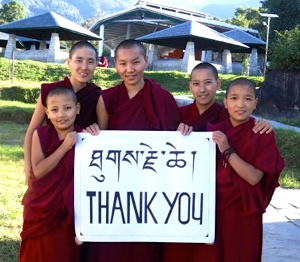
5 Tibetan Buddhist nuns hold a thank you sign in Tibetan and EnglishThank you for being a supporter of the Tibetan Nuns Project.

You are part of a community of compassionate people who care deeply about providing equal access to education for ordained Buddhist women, about the Dharma, and about preserving Tibet’s unique culture.

We wanted to share with you some of our achievements this year that you’ve helped make possible:

  • 23 nuns reached an historic milestone when they sat the first part of the Geshema exam in May, like a PhD in Tibetan Buddhism;
  • 8 retreat huts at Dolma Ling Nunnery have been built and furnished. Now, for the first time, the nuns of Dolma Ling can go on retreat;
  • Over 400 nuns from 8 nunneries in India and Nepal have participated in the month-long Jang Gonchoe debate session in October, a special step in their learning;
  • Over 700 nuns living in exile have been provided with food, shelter, education and health care.

We still need your help urgently.

Within Tibet the situation is truly dire. There is no real freedom for the nuns there to practice their religion. They, like their sisters in India, wish nothing more than to live, study, practice, and teach in accordance with their spiritual beliefs. With your help we can ensure the survival of Tibet’s religion and culture and we can offer refuge to those who have escaped and help heal their trauma.

Inflation and rising food prices in India are stressing all of the nunneries. With hundreds of mouths to feed each day, you can imagine the effect of skyrocketing food and fuel prices. Sponsorship dollars were only meeting about 2/3rd of the daily needs of the nuns so we did a big sponsorship push this summer. We are incredibly grateful to everyone who signed up as a sponsor, who renewed a past sponsorship, or who generously agreed to increase their sponsorship contribution.

HERE ARE 7 WAYS YOU CAN HELP THE NUNS:

1. SPONSOR A NUN
For $1 a day you can sponsor a nun and help provide her with food, shelter, education and health care. 100% of the funds go directly to India and you will receive updates about the impact of your gifts.

2. MAKE A SINGLE DONATION
We have a number of current projects where you can direct your gifts or you can make an undesignated gift and we will direct the funds where they are needed most.

3. LEAVE A LEGACY OF COMPASSION
By including a gift in your will to the Tibetan Nuns Project, you will be leaving a legacy of compassion that will have a ripple effect for generations to come.

4. GIVE A GIFT IN HONOR OF SOMEONE
Celebrate a loved one this holiday season, thank a spiritual teacher, or honor the memory of someone with a gift. When you make a tribute gift, we can send a beautiful card to the person being honored.

5. BUY TNP PRODUCTS
We always have a range of products available through our online shop or by calling the office. Our products include the 2014 Calendar, malas, prayer flags, TNP sweatshirts, and much more. Many of the products are made by the nuns to generate income for the nunneries.

6. DEDICATE PRAYERS
Through our online shop you can request that the nuns say prayers or perform special pujas for you or for someone dear to you who may need spiritual help.

7. DO YOUR OWN THING!
Explore your own creative idea for helping the nuns. Every little bit helps. Whether it’s hosting a house party using our kit or coming up with your own idea, like New York artist Miya Ando who created a series of glowing “Prayer Flag” paintings and auctioned them off raising over $4,000 to help with the nuns Media Center and Café at Dolma Ling.

We’re going to give the last word to one of our supporters who wrote to tell us why the Tibetan Nuns Project was important to her:

“Each aspect you are addressing is important not just to these women, but to women, refugees, Buddhists and non-Buddhist religious women EVERYWHERE. This is a model for the future for any group of displaced, religiously persecuted, and in-need-of-support-to-sustain-themselves group. I applaud the efforts of your organization very highly.”
Linda Anne, Idyllwild CA

With our deepest thanks for your compassion and generosity,


Rinchen Khando Choegyal, Director
Elizabeth Napper, Co-Director
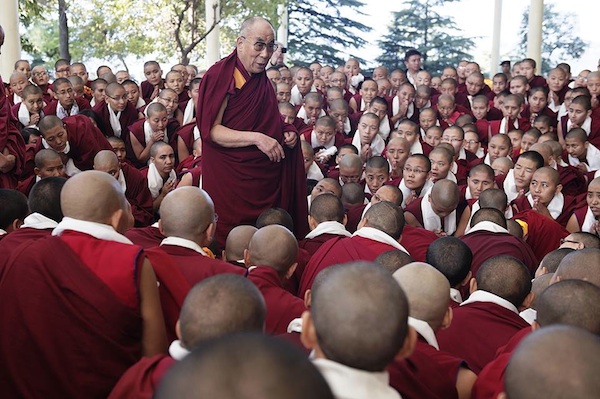
His Holiness the Dalai Lama Addresses Nuns After the Great Winter Debate Session

Thekchen Chöling, Dharamsala, India  3 November 2013
Report from the Office of His Holiness the Dalai Lama

This morning His Holiness the Dalai Lama met briefly with nuns from eight nunneries who for the last month have been taking part in the Jang Gonchoe, the Great Winter Debate, held this year at Dolma Ling Nunnery. He began:

“You’ve all been engaged in debate based on Dharmakirti’s ‘Commentary on Epistemology’ (Pramanavarttika), What did you learn from each other?”

His Holiness the Dalai Lama addresses the nuns after debate session Nov 3 2013

His Holiness the Dalai Lama speaking encouragingly to nuns from several nunneries who had taken part in the just concluded annual winter debate session during their meeting at the Main Tibetan Temple in Dharamsala, India on November 3, 2013. (Photo by Tenzin Choejor/OHHDL)

He said that there are reports that at one time in Tibet there was a tradition of nuns studying the classic Buddhist texts, which eventually lapsed. This has changed. He cited nuns from Kopan in Nepal last year defying the Tibetan joke about nuns being proud of having memorized the Samantabhadra prayer when they memorized not only Chandrakirti’s ‘Supplement to (Nagarjuna’s) Treatise on the Middle Way’ (Madhyamakavatara) and Maitreya’s ‘Ornament for Clear Realization’ (Abhisamayalankara), but also Haribadra’s commentary ‘Clear Meaning’ (Sputartha), which His Holiness admitted was even more than he had done.

As to how a revival of nuns studying the classic texts has come about, His Holiness referred to the description of Tibet as a Central Land. This does not have any bearing on its geographical location, but on the existence of a complete Sangha, the fourfold Buddhist community, monks, nuns and male and female laypeople holding vows.

Referring to the as yet unresolved question of instituting the bhikshuni ordination in the Tibetan tradition, His Holiness said:

“Some people have complained about this, because a conclusion has not yet been reached. But this is not something that can be decided by me alone. The Buddha laid down rules and procedures that a single monk cannot decide to change. It requires a consensus within the monastic community. We have held meetings and discussions amongst ourselves and with other communities such as the excellent upholders of the Vinaya (monastic discipline) in the Pali tradition.

“In Tibet we follow the Mulasarvastivadin tradition of Vinaya established by Shantarakshita, a tradition that comes down from Rahula, the Buddha’s own son. This is the tradition we have carefully preserved that differs only superficially from the Theravada Vinaya observed in the Pali Tradition. When Atisha came to Tibet, out of respect for the already established Mulasarvastivadin tradition, he said there was no point in his trying to propagate the Lokattaravada tradition that he followed himself.”

His Holiness stressed that observing vinaya purely is of fundamental importance. The Mulasarvastivadin texts suggest that senior bhikshunis need to preside over a bhikshuni ordination and suggest that it is not proper for bhikshus alone to preside over such a ceremony. Therefore, if bhikshus alone were to conduct such a ceremony it is not clear that it would be flawless. This is the impasse which is yet to be answered. His Holiness mentioned a Chinese vinaya master, who is no longer alive, who advised that while doubts exist, efforts should be made to resolve them. What still needs to be decided is whether a bhikshuni ordination ceremony can be conducted according to the Mulasarvastivadin rite with or without the presence of senior bhikshunis.

“Some people have criticized me, calling me a ‘male chauvinist’, because I am not exercising my alleged authority. But I cannot decide this on my own. However, what I can do is to encourage nuns to study the classic texts. Biologically there is no difference between the brains of men and women and the Buddha clearly gave equal rights to men and women. In tantra women are accorded special respect. And yet when it comes to vinaya we have to follow tradition.”

His Holiness reiterated that nuns have an equal right to study, which is why almost 40 years ago he encouraged nuns to embark on the study of philosophy. They began at Geden Choeling and this has since become the norm in other nunneries.

“I have witnessed nuns debating,” he said, “and they do very well. We have finally decided on holding Geshema exams for nuns, which is a proper conclusion of their years of study. When we first discussed a Geshema degree, some scholars expressed surprise, but we persisted. This is about education and the gaining of knowledge.

“In the past, masters like Gyen Pema Gyaltsen studied for 30 or 40 years before taking their Geshe exams. These days it generally takes about 20 years. I made a request that nuns be able to study the philosophical texts, you have done it and I’d like to thank you.”

He clarified that the Buddha’s teaching comprises realization as well as knowledge, so it is important to follow a course of practice as well as a course of study. This is how the Dharma is preserved. Study is necessary to achieve understanding and practice is necessary to achieve realization. Practice can only take place on the basis of understanding. His Holiness talked about people he has met who said they were Buddhists, who said that to be a Buddhist you have to take refuge in the Buddha, but who could not say what the Buddha is.

He said that many of us aspire to become a Buddha, but if we do not understand the path, we cannot reach the goal. We may have Buddha nature, but we need to understand emptiness to realize it. We may be full of negative emotions to start with, but we can free ourselves of them. Where there is knowledge there is no place for blind faith. We cannot practise the Dharma on the basis of faith alone. We need not only knowledge, but understanding too.

“We study the Three Collections of Scripture to learn about the three trainings in ethics, concentration and wisdom. Once we have studied we need to gain experience through practice. It’s not enough to say I’ve read or I’ve heard that it’s good if you practise the Three Trainings. You need to be able to teach on the basis of your own experience. Because of our emphasis on study, people can get carried away by debate without giving much thought to practice. This is why I have requested the monasteries to establish places where monks can go into retreat. If we study the Perfection of Wisdom texts we’ll find in them exhortations to engage in practice.

“The Dharma is at a critical juncture. You might think that it would be good to spend the rest of your life as a hermit, but we also need qualified people to teach others. Once you complete your studies we need some of you nuns to teach. Until now you have relied on monks to teach you, but in future it will be very important that there are also nuns to teach nuns. More than that, we also need nuns to teach in our secular schools. In the past, because they had not studied themselves, parents were unable to teach their children the Dharma. Therefore, I request you, after your studies consider going into retreat, and after that resolve to teach others. That’s all – thank you.”

His Holiness posed for photographs with groups of nuns and with all of them together before returning to his residence.

Tibetan Nuns Granted the Opportunity for Geshema Degree

After years of deliberation, Tibetan Buddhist nuns are finally set to receive Geshema degrees, or the equivalent of a PhD in Buddhist Philosophy.

The Central Tibetan Administration reached this unanimous and historic decision on May 19th 2012 after a two-day meeting in Dharamsala attended by high lamas, representatives of nuns from six different nunneries, and members from the Tibetan Nuns Project.

Previously, Geshe degrees were open only to Tibetan monks. Now nuns will be allowed to appear for the doctorate exams. Continue reading