
For generations, Tibetan culture has been sustained through its language, spiritual traditions, monastic institutions, and the dedication of Buddhist practitioners. Part of the Tibetan Nuns Project’s mission is to sustain Tibetan religion and culture.
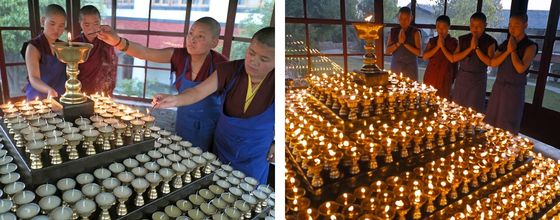
In March 2026, His Holiness the Dalai Lama, patron of the Tibetan Nuns Project, wrote, “I appeal to every Tibetan to take personal responsibility and make dedicated efforts to cherish and preserve our Tibetan religion, culture, and language” as part of his annual message for March 10th, Tibetan National Uprising Day. Photos by Brian Harris
Our work is taking place against a backdrop of cultural genocide in Tibet. For the third year in a row, Tibet has received a global freedom score of 0 from the international human rights monitoring group Freedom House. Tibet remains “not free,” and its score of zero ties South Sudan for the second-lowest on the list of 208 areas examined.
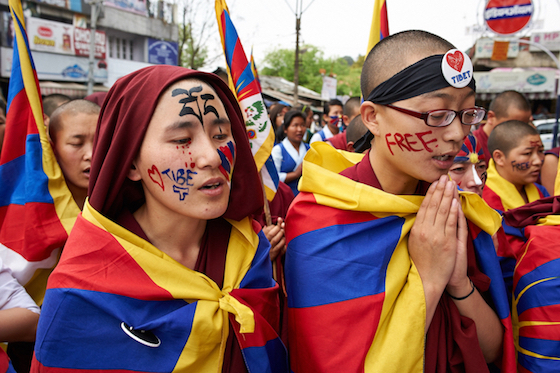
Draped in the Tibetan flags, Tibetan Buddhist nuns in India take part in peaceful demonstrations to mark the anniversary of Tibetan Uprising Day, March 10th. Photo courtesy of Olivier Adam
About 1 million Tibetan children have been separated from their families and placed into Chinese residential schools. Photos of His Holiness the Dalai Lama are banned, and celebrating his birthday can lead to arrest. Peaceful calls for religious freedom are punished with imprisonment under vague charges like “separatism” or “endangering state security”.
On July 1st, a sinister new Chinese law promoting linguistic, cultural, and ideological assimilation came into effect. Part of it mandates a “national common language” and prohibits any organization or individual from obstructing its dissemination. In practice, this may criminalize efforts by Tibetan communities to preserve and promote their own language in their own land.
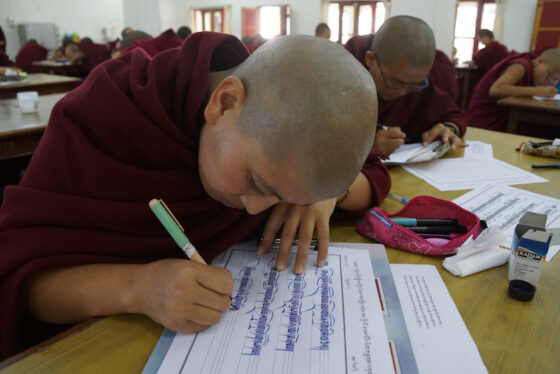
Preserving Tibet’s unique culture and religion is a service to the world. Your generosity helps protect a priceless heritage and empowers the women who are dedicating their lives to keeping it alive.
“The survival and identity of any people depends fundamentally on the preservation of their language,” said His Holiness the Dalai Lama’s representative in London. “Religion, culture, history, and collective memory are all preserved and transmitted through language. If a language disappears, the identity of that people gradually fades with it… With Tibetan children in Tibet being denied the right to learn their own language, we are approaching a critical threshold that threatens our existence as a distinct people in the world.”
Although we cannot directly change the situation inside Tibet, we can help Tibetans preserve their identity in exile.
Tibetan National Identity Preservation Week
The Central Tibetan Administration has declared the annual “Tibetan National Identity Preservation Week” to be observed from the fourth Wednesday of September through the following Wednesday. This year, the week runs from September 23 to September 30, 2026.
The week is part of a global campaign to confront and counter the Chinese Communist Government’s implementation of various methods and systematic policies aimed at eradicating Tibetan identity—specifically, its recently implemented so-called “Law on Promoting Ethnic Unity and Progress.”
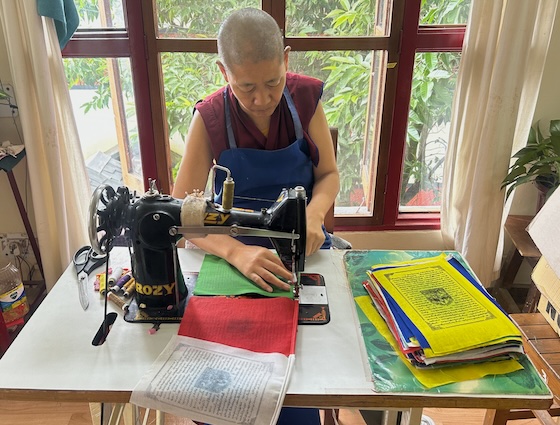
A Tibetan Buddhist nun sews prayer flags at Dolma Ling Nunnery and Institute. Our online store sells many Tibetan items made and blessed by the nuns.
It’s significant that the week runs from a Wednesday to a Wednesday because “White Wednesday” or Lhakar is the day the Dalai Lama was born and is known as his “soul day.” On Lhakar, Tibetans actively resist China’s occupation by supporting and promoting Tibetan culture, eating Tibetan food, wearing Tibetan clothing, speaking Tibetan and celebrating their Tibetan identity. Lhakar is about celebrating Tibetan culture and engaging in civil resistance.
So far, the governments of Canada, the United States, Germany, Belgium, the United Kingdom, Australia, the Czech Republic, Japan, and the European Union have issued official statements declaring that the Chinese law violates international law, serves as a tool for forced assimilation, and poses a risk of transnational repression.
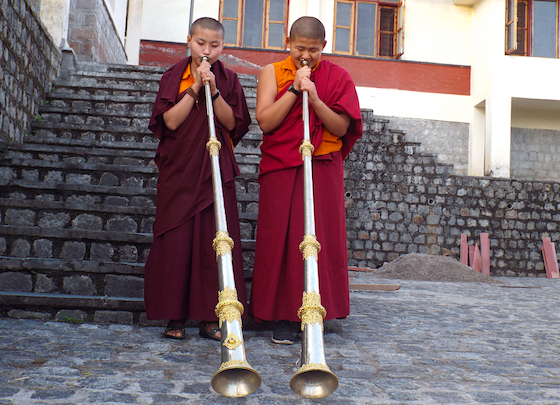
Nuns playing the dungchen, a long trumpet with a deep, low sound used to are played to welcome high lamas and Rinpoches to a monastery or temple. Photo by the Media Nuns.
The Tibetan language is the backbone of Tibetan culture and history and a mirror of the Tibetan people’s unique identity and traditions. It is the primary medium for expressing the Five Major Sciences—arts, medicine, grammar, epistemology, and Buddhist philosophy—and the Five Minor Sciences—poetry, lexicography, prosody, drama, and astrology. It is also a vast treasury for passing down Tibet’s history, politics, economy, military, society, and geography to future generations. It serves as a vital core for safeguarding social unity, collective rights, and the capacity to self-govern.
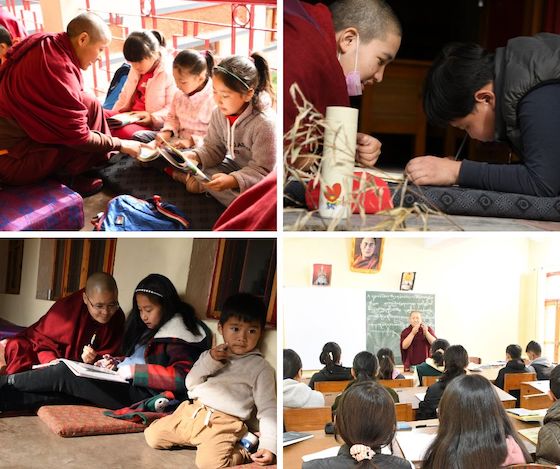
Wisdom and compassion. At Dolma Ling, Geshemas, nuns who hold the highest degree in their tradition, teach Tibetan refugee children how to read and write Tibetan during the school holidays. Photos by the Dolma Ling Media Nuns.
According to research by modern historians and linguists, the Tibetan script was created in the 7th century, modelled after the Gupta or Brahmi scripts prevalent in northern India. With a history spanning over 1,300 years, it is recognized as one of the world’s ancient languages with uninterrupted use.
The largest and most complete collections of Buddha’s teachings, Buddhist philosophy, epistemology, and psychology transmitted from India are found in the Tibetan language. Enriched by tens of thousands of volumes of treatises and commentaries, it has become a vital treasury housing crucial components of ancient Indian wisdom.
Studying the Tibetan language helps preserve and promote Tibet’s unique cultural heritage, benefiting all sentient beings. In line with the vision of His Holiness the Dalai Lama, it helps us nurture individuals who can guide others along the path of non-violence and compassion and shoulder responsibility for the greater good of this world.
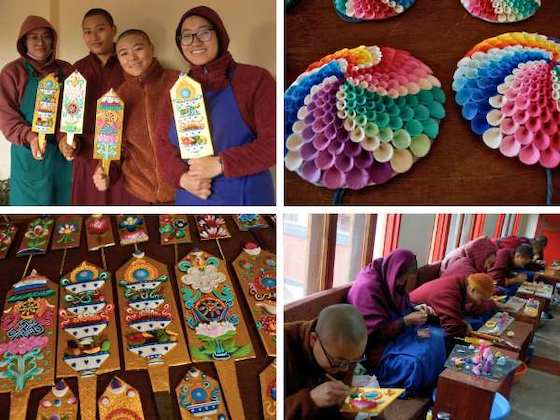
Nuns at Dolma Ling learn the sacred art of making Tibetan butter sculptures.
Calls to Action
- Spread the word about what is happening inside Tibet
- Sponsor a Tibetan Buddhist nun in India for $1 a day
- Support our Higher Studies Fund to help more nuns become teachers and leaders during this critical time
- Purchase Tibetan items made by nuns in our online store such as prayer flags, malas, kataks, incense, and our 2027 Tibetan Nuns Project calendar.
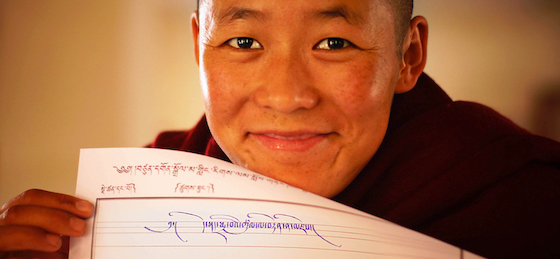
A Tibetan Buddhist nun shows her calligraphy. Photo courtesy of Tenzin Sangmo.