Tag Archives: Tibetan language

Building Academic Excellence at Shugsep Nunnery

Traditionally, Buddhist nuns have not had the same access to education as monks, but your generosity is changing that. We would like to extend a special thank you to everyone who sponsors a nun.

Here are photos showing recent academic competitions at Shugsep Nunnery and Institute, a nunnery built and fully supported by donors to the Tibetan Nuns Project.

Shugsep Annual Tibetan Grammar Competition Day

The nuns at Shugsep Nunnery held their annual Tibetan grammar competition in November. The preservation of Tibet’s unique language and culture remains one of the most critical areas of focus for Tibetans, both inside Tibet and in exile.

Events like this enhance the nuns’ knowledge of various subjects, boost their confidence, encourage creativity, strengthen their communication skills, and provide the nuns with valuable practice in expressing their ideas clearly.

Quiz time Tibetan grammar Shugsep Nunnery

The annual Tibetan grammar competition at Shugsep Nunnery. Tibet has its own language, including a unique alphabet and various written forms. Tibetan calligraphy is beautiful, and there are numerous Tibetan writing styles.

These types of competitions are held in various subjects and topics, depending on the class level. They help the nuns become more comfortable speaking and writing in front of others, and they build a healthy sense of discipline and motivation.

The idea for this competition originated at a staff meeting, when some teachers suggested holding regular activities to enhance the nuns’ overall knowledge and, most importantly, to help build their confidence.

On November 8th, the nunnnery held a Tibetan Language Skills competition that included poem writing and application for the higher grades. The competition had questions such as “Write down five different proverbs,” “What are the elements needed to complete a composition?” and other Tibetan grammar questions.
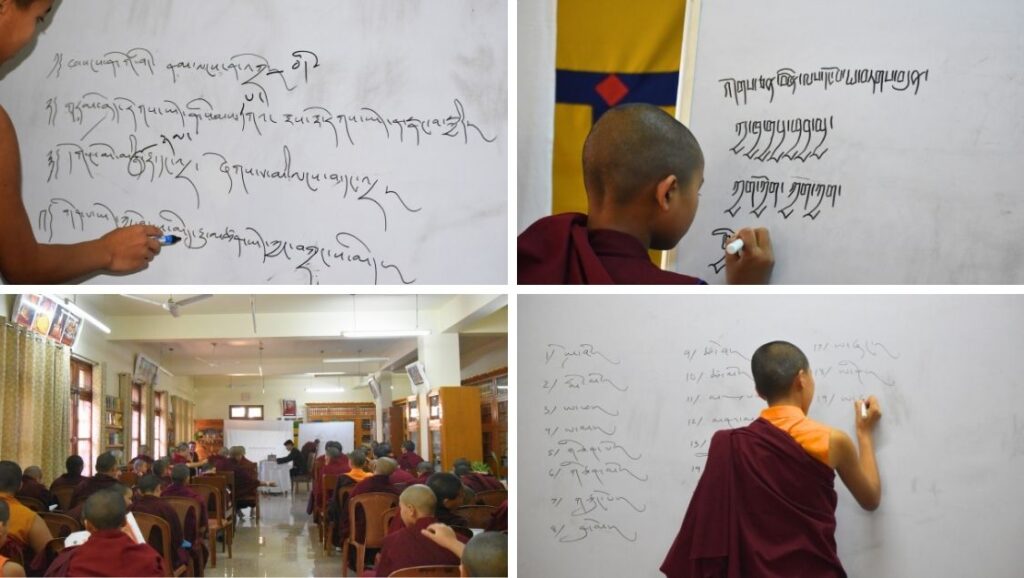
Tibetan grammar competition Shugsep Nunnery, quiz time

The Tibetan alphabet has 30 characters or letters and four vowels. Like English, it is written from left to right in horizontal lines. Tibetan writing may be broadly divided into two types: “headed”, called Uchen, and “headless”, called Umeh. These two forms of Tibetan script correspond roughly to printed and cursive writing.

For the younger students, the activities included a reading competition and a spelling exam, where students were asked to write specific names or words.

Around 50 nuns participated, except for those who had already completed their Loponma degrees, roughly equivalent to a master’s degree. A panel of teachers scored the competitions and awarded prizes for 1st, 2nd, and 3rd place.

Annual English Competition and The Alchemist

Here are some delightful photos taken by the nuns during the annual English competition held on December 6th at Shugsep. The event took place in the presence of Khenpo-la (the head of the nunnery) and all the teachers. They watched a lovely drama performed by the children and viewed many beautiful drawings created by the junior students.
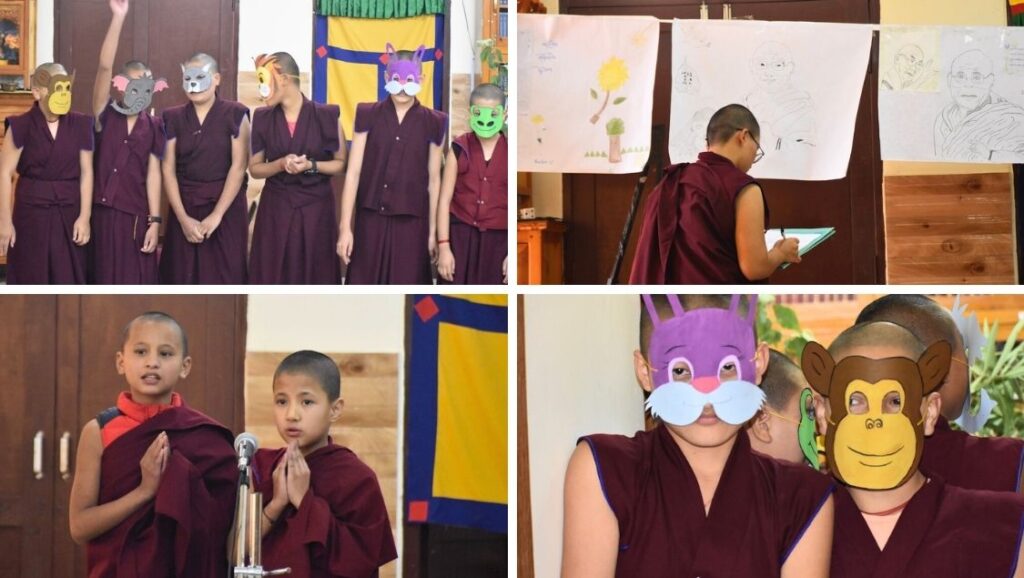
English competition at Shugsep Nunnery

It’s never easy standing up in front of your classmates, all your teachers, and your principal. It’s even more challenging when you have to speak a foreign language. Congratulations to all the nuns who took part in the annual English competition. The young nuns performed a drama.

The junior students created many beautiful drawings to reflect daily life at the nunnery and also the Year of Compassion, honouring the 90th birthday of His Holiness the Dalai Lama.
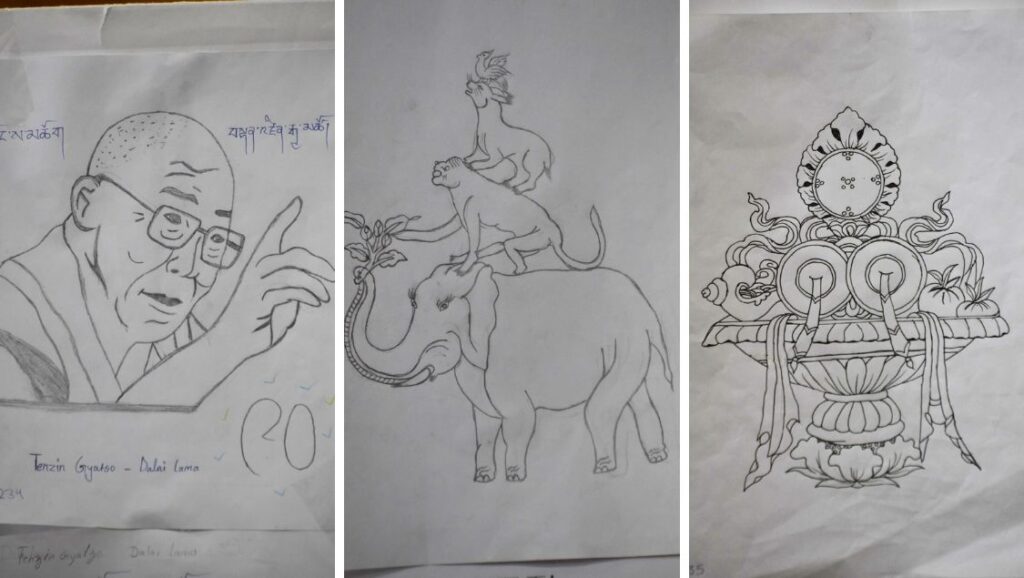
drawings by young Tibetan Buddhist nuns

Here are some of the drawings by the junior nuns at Shugsep. The nuns had to describe the images in English to the assembled crowd. This builds confidence and skills in English and public speaking. The picture on the left honors His Holiness the Dalai Lama’s 90th birthday, and the middle picture is the “Four Harmonious Friends”, one of the Jataka tales of Buddhist mythology.

As part of the competition, the senior nuns wrote English poems and notices.

English competition at Shugsep Nunnery

Shugsep is now home to about 100 nuns. The senior nuns are writing in front of their classmates and teachers as part of the annual English competition.

The nuns also spoke about the famous novel The Alchemist by Brazilian writer Paulo Coelho. The book’s main theme is about finding one’s destiny.
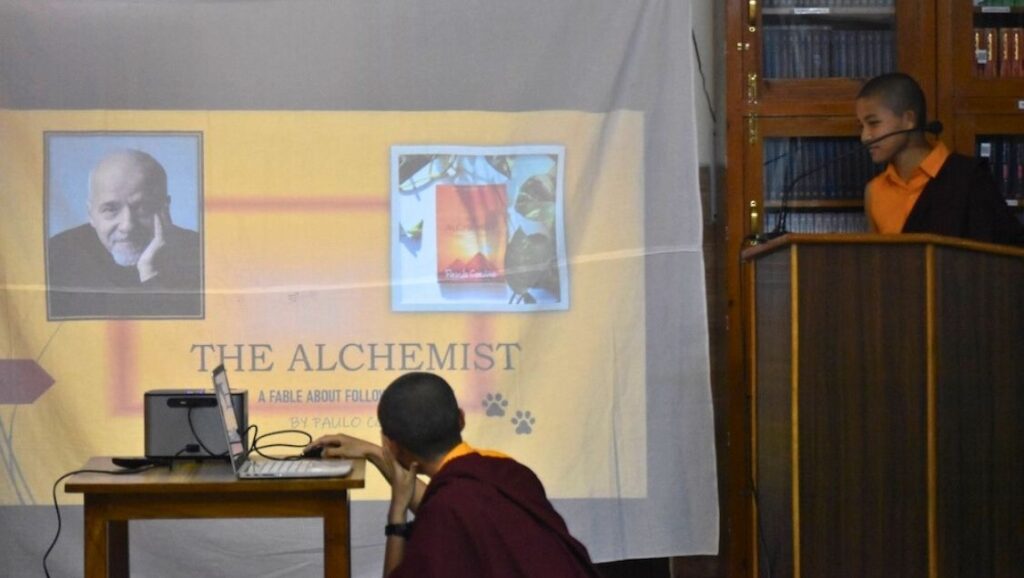
Tibetan Buddhist nuns explaining The Alchemist

In this photo, two nuns are explaining the introduction of The Alchemist to the audience, highlighting the book’s strong and important vocabulary and philosophical concepts.

The Tibetan Nuns Project aims to elevate the educational standards and the position of women. As TNP’s Founding Director and Special Advisor Rinchen Khando Choegyal has said, “Educating women is powerful… It’s about enabling the nuns to be teachers in their own right and to take on leadership roles at a critical time in our nation’s history.”

Thank you for helping the nuns on their path!

Tibetan calligraphy and the Tibetan language

Tibet has its own language, including a unique alphabet and various written forms. Tibetan calligraphy is beautiful and there are numerous Tibetan writing styles. This blog post showcases some of them.

Tibetan calligraphy, Tibetan writing, calligraphy, Tibetan language, Tibetan culture, Tibetan calligraphy competition,Tibetan Nuns Project

Tibetan Buddhist nuns at Dolma Ling Nunnery in India take part in the annual Tibetan calligraphy competition. Photo courtesy of the Nuns’ Media Team.

The Tibetan alphabet has 30 characters or letters and four vowels. Like English, it is written from left to right in horizontal lines. The origins of Tibetan as a written language date back to the 7th century AD and the reign of King Songtsen Gampo. One of the king’s ministers, Thonmi Sambhota, is credited with creating the Tibetan alphabet. He and other scholars were sent by the king to India to study the art of writing with the aim of making the Buddhist teachings available to Tibetans.

Buddhism plays a central role in Tibetan culture. This is true for Tibetan writing as well. Many examples of Tibetan calligraphy come from religious texts. Most Tibetan scribes or experts in Tibetan calligraphy come from monastic backgrounds.

Here is a video of Tibetan Buddhist nuns practicing Tibetan calligraphy. Can’t see the video? Click here.

Traditionally, Tibetan nuns did not have access to the same level of education as monks. Now Tibetan nuns, such as those studying at the nunneries supported by the Tibetan Nuns Project, have the opportunity to learn their own written language and various forms of Tibetan calligraphy. This is groundbreaking because many of the nuns who escaped from Tibet and arrived in exile in India were completely illiterate on their arrival. Most of them couldn’t even write their names.

Tibetan calligraphy, Tibetan writing, calligraphy, Tibetan language, Tibetan culture, Tibetan Nuns Project

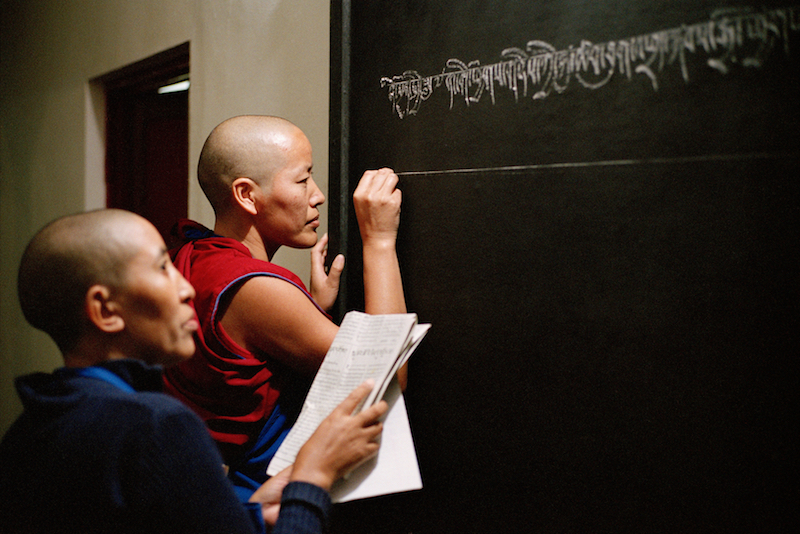
Tibetan Buddhist nuns writing on a chalkboard. The form of Tibetan script they are using is called Tsukring. Photo courtesy of Olivier Adam.

Tibetan Calligraphy

Tibetan writing may be broadly divided into two types, “headed” called Uchen and “headless” called Umeh. These two forms of Tibetan script correspond roughly to printed and cursive writing.

Uchen (U-chen)

The most common script for Tibetan writing and the one used in printed books because of its clarity is called Uchen (དབུ་ཅན།). Uchen means “with head” and this form of Tibetan writing is basically printing.

The Uchen form of Tibetan writing has heavy horizontal lines (heads) and tapering vertical lines. For Tibetan students of all ages this is the the most basic form of both handwriting and calligraphy. Students, including the Tibetan Buddhist nuns, must master this form of writing before moving on to other styles.

Tibetan calligraphy, Tibetan writing, calligraphy, Tibetan language, Tibetan culture, Tibetan Nuns Project

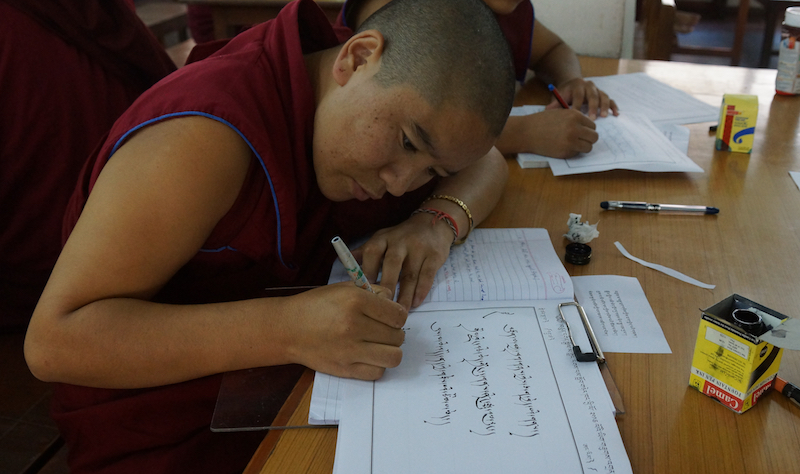
A Tibetan Buddhist nun at Dolma Ling Nunnery and Institute writes a calligraphy exam. She is using Uchen (དབུ་ཅན།), the headed writing which is the same style of Tibetan script used in printed books for its clarity. Photo by the Nuns’ Media Team.

Unlike English, there is not a distinction in the Tibetan alphabet between capital letters and lowercase letters. There is only the one letter form in the printed form Uchen which is more like block printing. In fact, the Uchen form of Tibetan writing is used for wood block prints and on Tibetan prayer flags.

Umeh (Umê)

Another form of Tibetan writing is called Umeh (དབུ་མེད།) or “headless” form and this encompasses a range of different styles. Umeh is essentially cursive writing in various forms that may be used for inscriptions, formal letters, and correspondence. It looks quite different to Uchen because of the lack of the horizontal lines (heads) on top of the letters.

Tibetan calligraphy, Tibetan writing, calligraphy, Tibetan language, Tibetan culture, Tibetan Nuns Project

Nuns are taught and examined on Tibetan language and Tibetan calligraphy. In this exam paper, a Tibetan Buddhist nun demonstrates her skill and knowledge of Drutsa, a form of “headless” cursive writing that is used for formal purposes. Photo by the Nuns’ Media Team.

Tibetan calligraphy, Tibetan writing, Tibetan alphabet, Tibetan language, Tibetan culture, uchen,

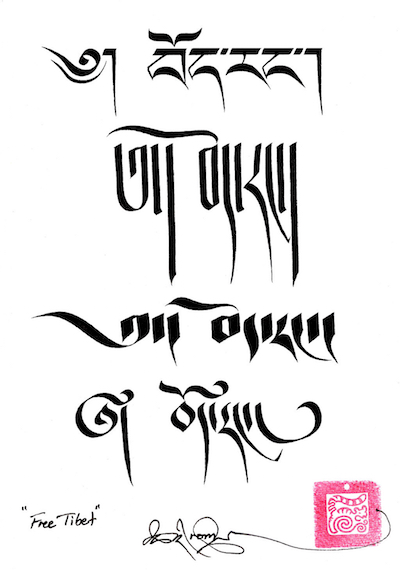
Here are the words “Free Tibet” written in 4 styles of Tibetan calligraphy. The top is in Uchen, the printed form, followed by Tsukring, Paytsik, and Drutsa. At the bottom is the artist’s signature in Chuyig style. Photo and calligraphy by Tashi Mannox, Wikicommons.

There are many forms of Umeh writing, including:

  • Drutsa འབྲུ་ཚ། An artistic form of Tibetan calligraphy that is used for official documents and titles. With its long, tapered descending lines, Drutsa is both formal and more “flamboyant” that some other scripts.
  • Chuyig འཁྱུག་ཡིག། (also spelled Kyug’yig or Gyuk yig) means “fast letters” or “flowing script”. This form of cursive writing is used in day-to-day life for things such as informal handwritten notes and personal letters.
Tibetan calligraphy, Tibetan writing, calligraphy, Tibetan language, Tibetan culture, Tibetan Nuns Project, Shugsep Nunnery, drutsa script

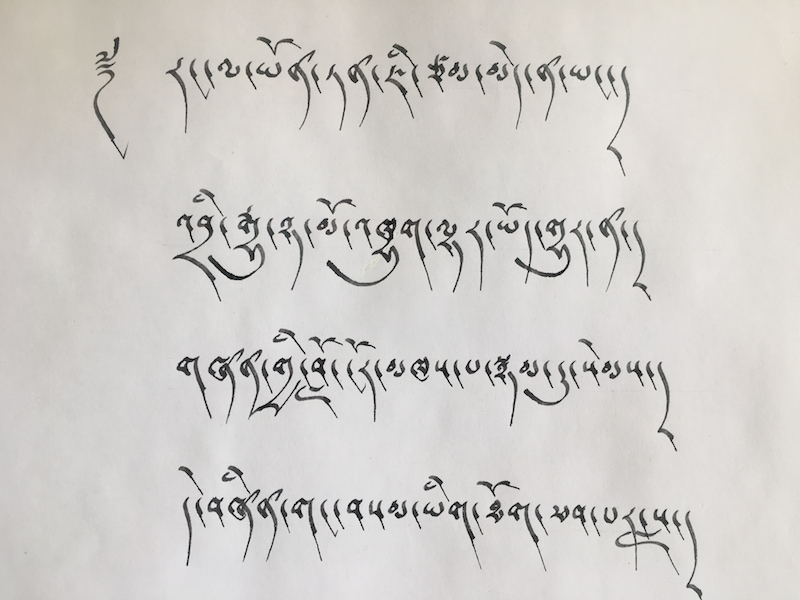
This example of Tibetan calligraphy was pinned to a classroom bulletin board at Shugsep Nunnery. It was written by a nun in the Drutsa style of Tibetan writing. It says, “Even if one is not highly learned, if your handwriting is elegant like the shape of a fish, others will think you are highly learned, and therefore it is easy to write what you think and feel!”

What do Tibetan Buddhist nuns study?

We are often asked what the Tibetan Buddhist nuns study.

In addition to providing basic educational requirements, the Tibetan Nuns Project seeks to elevate the educational standards and the position of women within the monastic community. To prepare the nuns for positions of leadership and moral authority in a culture that is going through a very challenging transition, it is essential to combine traditional religious studies with aspects of a modern education.

Tibetan Nuns, Tibetan Nuns Project, Tibetan education, Tibetan culture, what Tibetan Buddhist nuns learn

Nuns at Shugsep Nunnery learning geography. Photo courtesy of Brian Harris

A primary goal of the Tibetan Nuns Project is to assist nuns in reaching the same level of education as the monks. Each of the four traditions schools of Tibetan Buddhism has its own specific curriculum and degrees attained, but much is shared. All are based on the teachings of the Buddha and the Indian commentaries that developed to explicate them.

Tibetan Nuns, Tibetan Nuns Project, Tibetan education, Tibetan culture, what Tibetan Buddhist nuns learn, Sherab Choeling, Tibetan Buddhist nuns

Nuns at Sherab Choeling Nunnery in the remote Spiti Valley at an outdoor classroom. Photo courtesy of Olivier Adam

Exactly which commentaries the nuns most closely rely on varies between traditions as do the number of years of study, but there is uniformity as to the basic topics. Thus, all the nuns study:

  • Logic and Epistemology, which provide the basic tools for advanced philosophical study;
  • Perfection of Wisdom for understanding of the Buddhist path;
  • Middle Way for understanding of Buddhist philosophy; and
  • Tantra for the final level of teachings.

Continue reading