Tag Archives: education

Tibetan calligraphy and the Tibetan language

Tibet has its own language, including a unique alphabet and various written forms. Tibetan calligraphy is beautiful and there are numerous Tibetan writing styles. This blog post showcases some of them.

Tibetan calligraphy, Tibetan writing, calligraphy, Tibetan language, Tibetan culture, Tibetan calligraphy competition,Tibetan Nuns Project

Tibetan Buddhist nuns at Dolma Ling Nunnery in India take part in the annual Tibetan calligraphy competition. Photo courtesy of the Nuns’ Media Team.

The Tibetan alphabet has 30 characters or letters and four vowels. Like English, it is written from left to right in horizontal lines. The origins of Tibetan as a written language date back to the 7th century AD and the reign of King Songtsen Gampo. One of the king’s ministers, Thonmi Sambhota, is credited with creating the Tibetan alphabet. He and other scholars were sent by the king to India to study the art of writing with the aim of making the Buddhist teachings available to Tibetans.

Buddhism plays a central role in Tibetan culture. This is true for Tibetan writing as well. Many examples of Tibetan calligraphy come from religious texts. Most Tibetan scribes or experts in Tibetan calligraphy come from monastic backgrounds.

Here is a video of Tibetan Buddhist nuns practicing Tibetan calligraphy. Can’t see the video? Click here.

Traditionally, Tibetan nuns did not have access to the same level of education as monks. Now Tibetan nuns, such as those studying at the nunneries supported by the Tibetan Nuns Project, have the opportunity to learn their own written language and various forms of Tibetan calligraphy. This is groundbreaking because many of the nuns who escaped from Tibet and arrived in exile in India were completely illiterate on their arrival. Most of them couldn’t even write their names.
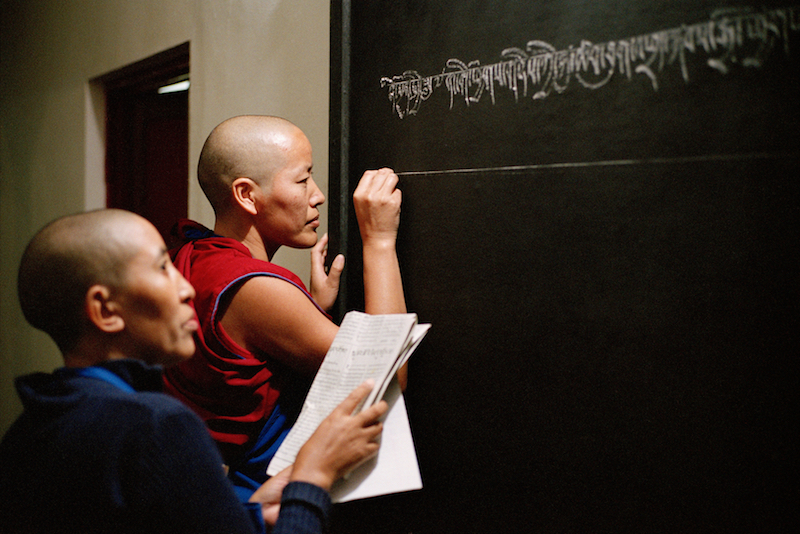
Tibetan calligraphy, Tibetan writing, calligraphy, Tibetan language, Tibetan culture, Tibetan Nuns Project

Tibetan Buddhist nuns writing on a chalkboard. The form of Tibetan script they are using is called Tsukring. Photo courtesy of Olivier Adam.

Tibetan Calligraphy

Tibetan writing may be broadly divided into two types, “headed” called Uchen and “headless” called Umeh. These two forms of Tibetan script correspond roughly to printed and cursive writing.

Uchen (U-chen)

The most common script for Tibetan writing and the one used in printed books because of its clarity is called Uchen (དབུ་ཅན།). Uchen means “with head” and this form of Tibetan writing is basically printing.

The Uchen form of Tibetan writing has heavy horizontal lines (heads) and tapering vertical lines. For Tibetan students of all ages this is the the most basic form of both handwriting and calligraphy. Students, including the Tibetan Buddhist nuns, must master this form of writing before moving on to other styles.

Tibetan calligraphy, Tibetan writing, calligraphy, Tibetan language, Tibetan culture, Tibetan Nuns Project

A Tibetan Buddhist nun at Dolma Ling Nunnery and Institute writes a calligraphy exam. She is using Uchen (དབུ་ཅན།), the headed writing which is the same style of Tibetan script used in printed books for its clarity. Photo by the Nuns’ Media Team.

Unlike English, there is not a distinction in the Tibetan alphabet between capital letters and lowercase letters. There is only the one letter form in the printed form Uchen which is more like block printing. In fact, the Uchen form of Tibetan writing is used for wood block prints and on Tibetan prayer flags.

Umeh (Umê)

Another form of Tibetan writing is called Umeh (དབུ་མེད།) or “headless” form and this encompasses a range of different styles. Umeh is essentially cursive writing in various forms that may be used for inscriptions, formal letters, and correspondence. It looks quite different to Uchen because of the lack of the horizontal lines (heads) on top of the letters.
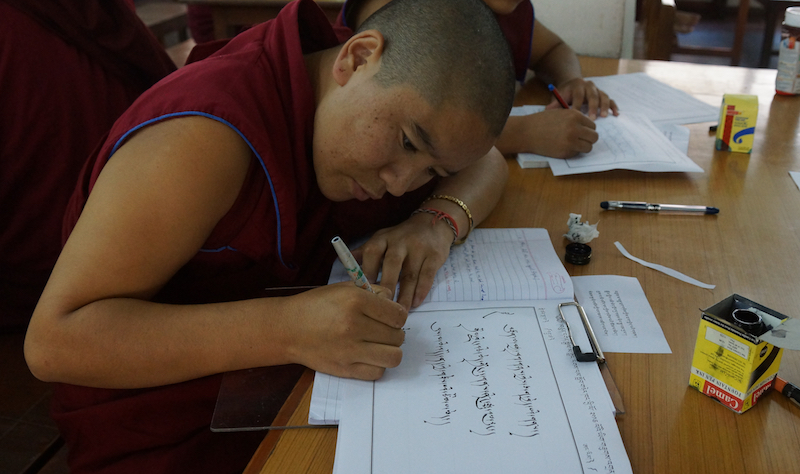
Tibetan calligraphy, Tibetan writing, calligraphy, Tibetan language, Tibetan culture, Tibetan Nuns Project

Nuns are taught and examined on Tibetan language and Tibetan calligraphy. In this exam paper, a Tibetan Buddhist nun demonstrates her skill and knowledge of Drutsa, a form of “headless” cursive writing that is used for formal purposes. Photo by the Nuns’ Media Team.
Tibetan calligraphy, Tibetan writing, Tibetan alphabet, Tibetan language, Tibetan culture, uchen,

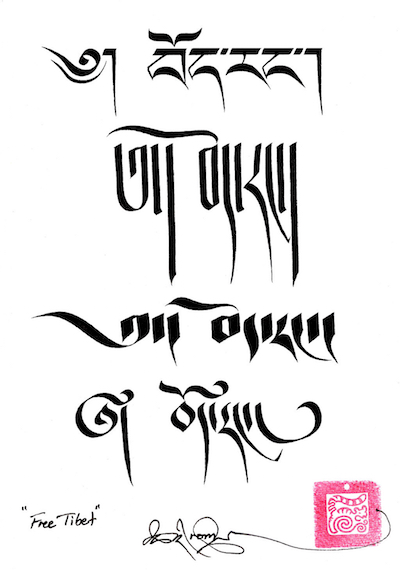
Here are the words “Free Tibet” written in 4 styles of Tibetan calligraphy. The top is in Uchen, the printed form, followed by Tsukring, Paytsik, and Drutsa. At the bottom is the artist’s signature in Chuyig style. Photo and calligraphy by Tashi Mannox, Wikicommons.

There are many forms of Umeh writing, including:

  • Drutsa འབྲུ་ཚ། An artistic form of Tibetan calligraphy that is used for official documents and titles. With its long, tapered descending lines, Drutsa is both formal and more “flamboyant” that some other scripts.
  • Chuyig འཁྱུག་ཡིག། (also spelled Kyug’yig or Gyuk yig) means “fast letters” or “flowing script”. This form of cursive writing is used in day-to-day life for things such as informal handwritten notes and personal letters.
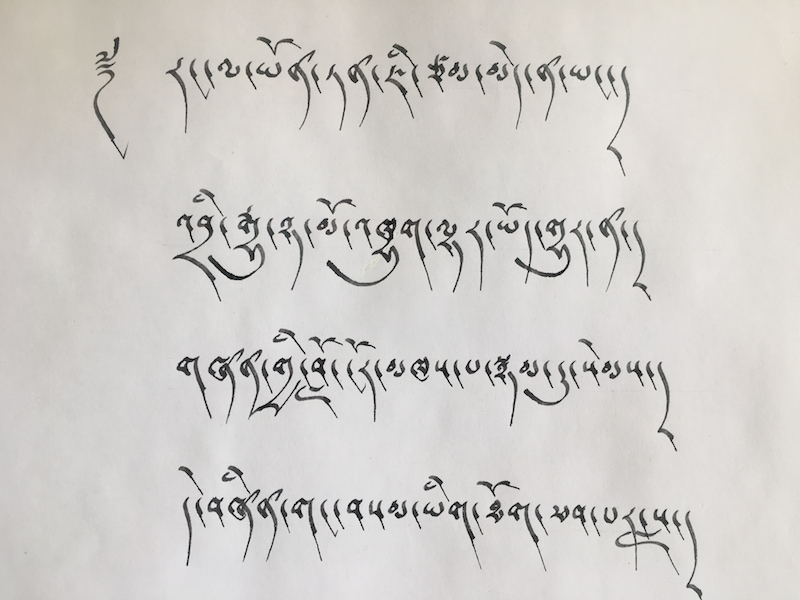
Tibetan calligraphy, Tibetan writing, calligraphy, Tibetan language, Tibetan culture, Tibetan Nuns Project, Shugsep Nunnery, drutsa script

This example of Tibetan calligraphy was pinned to a classroom bulletin board at Shugsep Nunnery. It was written by a nun in the Drutsa style of Tibetan writing. It says, “Even if one is not highly learned, if your handwriting is elegant like the shape of a fish, others will think you are highly learned, and therefore it is easy to write what you think and feel!”

What do Tibetan Buddhist nuns study?

We are often asked what the Tibetan Buddhist nuns study.

In addition to providing basic educational requirements, the Tibetan Nuns Project seeks to elevate the educational standards and the position of women within the monastic community. To prepare the nuns for positions of leadership and moral authority in a culture that is going through a very challenging transition, it is essential to combine traditional religious studies with aspects of a modern education.

Tibetan Nuns, Tibetan Nuns Project, Tibetan education, Tibetan culture, what Tibetan Buddhist nuns learn

Nuns at Shugsep Nunnery learning geography. Photo courtesy of Brian Harris

A primary goal of the Tibetan Nuns Project is to assist nuns in reaching the same level of education as the monks. Each of the four traditions schools of Tibetan Buddhism has its own specific curriculum and degrees attained, but much is shared. All are based on the teachings of the Buddha and the Indian commentaries that developed to explicate them.

Tibetan Nuns, Tibetan Nuns Project, Tibetan education, Tibetan culture, what Tibetan Buddhist nuns learn, Sherab Choeling, Tibetan Buddhist nuns

Nuns at Sherab Choeling Nunnery in the remote Spiti Valley at an outdoor classroom. Photo courtesy of Olivier Adam

Exactly which commentaries the nuns most closely rely on varies between traditions as do the number of years of study, but there is uniformity as to the basic topics. Thus, all the nuns study:

  • Logic and Epistemology, which provide the basic tools for advanced philosophical study;
  • Perfection of Wisdom for understanding of the Buddhist path;
  • Middle Way for understanding of Buddhist philosophy; and
  • Tantra for the final level of teachings.

Continue reading

Tibetan nuns Geshema Graduation Ceremony December 2016

This blog post is our special record of the historic milestone, the Geshema graduation ceremony, and is a permanent placeholder for the video of the event.

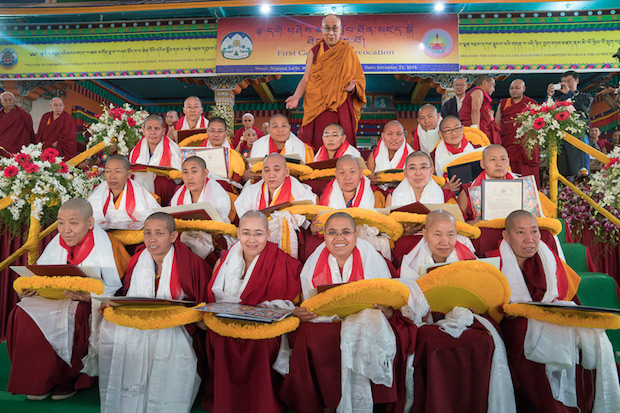
On December 22, 2016, His Holiness the Dalai Lama awarded 20 Tibetan Buddhist nuns with Geshema degrees at a ceremony at Drepung Monastery in Mundgod, South India.

Geshema graduation ceremony

His Holiness the Dalai Lama with the 20 Geshema graduates at the degree ceremony in Mundgod, December 22, 2016. Photo courtesy of OHHDL.

The Geshema degree is equivalent to a doctorate in Buddhist philosophy and is the highest level of training in the Gelugpa school of Tibetan Buddhism. It could previously only be earned by monks and is called the Geshe degree.

This historic milestone for the 20 nuns was the culmination of decades of study and dedication. The rigorous exam process for the Geshema degree takes a total of four years to complete. Each May  the nuns  took 12 days of exams to test their knowledge gained in a 17-year course of study.

nuns watching Geshema graduation ceremony

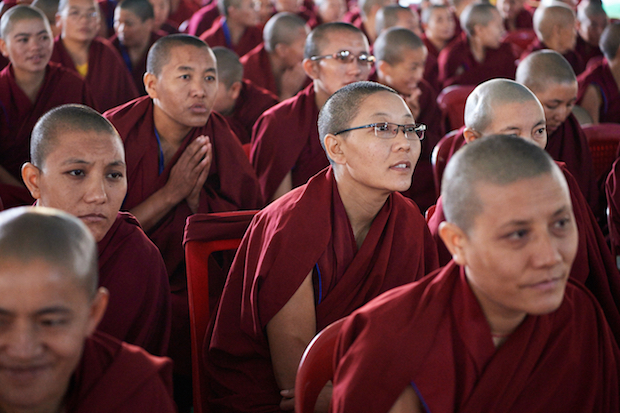
Nuns attending the first Geshema convocation at Drepung Lachi in Mundgod, Karnataka, India on December 22, 2016. Photo courtesy of Olivier Adam.

At the graduation ceremony, His Holiness the Dalai Lama spoke about the important of education for women and girls. “Through the power of education, women have been able to rise up to prominent roles including leadership in various societies. Education has played a big role in the advancement of gender equality and material development,” His Holiness said.

Tibetan political leader Sikyong Dr Lobsang Sangay was also in attendance, offering congratulations for the nuns’ hard work and dedication.

As doctors of philosophy, the nuns will now be expected to teach, a role reserved only for men until this point.

On the day following the ceremony, the Tibetan Nuns Project shared many messages of congratulation that came from around the world for the nuns.

Geshema nuns, Tibetan Buddhist nuns

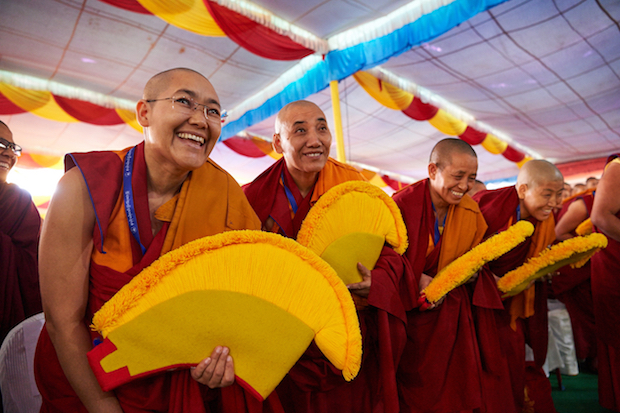
A joyous occasion. Some of the 20 nuns react to a comment by His Holiness the Dalai Lama. The ceremony took place in the courtyard of Drepung Lachi Monastery in Mundgod, Karnataka, India on December 22, 2016. Photo courtesy of Olivier Adam.

Interview with a Geshema nun: Tenzin Kunsel

The following is an interview from May 2014 with Venerable Tenzin Kunsel who, at the time, had just completed her second round of examinations for the Geshema Degree, a degree equivalent to a doctorate in Tibetan Buddhism. Since this interview was made, Venerable Tenzin Kunsel has successfully completed all four rounds of her examinations. In July 2016 it was announced that she and 19 other nuns will formally receive their Geshema degrees from His Holiness the Dalai Lama at a special ceremony at Drepung Monastery in South India on December 22nd 2016. Venerable Tenzin Kunsel is one of the first Geshemas (female Geshes) in the history of Tibet.

portrait of Tibetan Buddhist nun Tenzin Kunsel

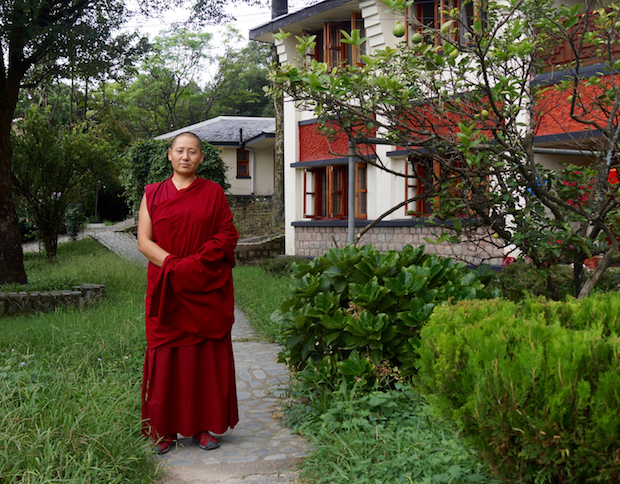
Venerable Tenzin Kunsel who will become one of the first Geshemas in the history of Tibet

Background

I was born to a simple family near Lhasa and I came to exile in 1991. When I was in Tibet, we were not given a Buddhist education; instead we had to do prayers for the people who made offerings at the nunnery. It was really disappointing as well as sad that we were not given the education we needed. I strongly felt that the best way to become educated in Buddhist studies was to come to India. Along with 75 other newly arrived nuns, I came to Dolma Ling Nunnery. Today I am here for the 2nd round of the historic Geshema examinations.

Q: How has being at the nunnery made a difference in your life?
A: When I first reached Dolma Ling Nunnery, its facilities weren’t as good as now. But I never lost hope. Many times, my family pressured me to go to school rather than the nunnery. But I never wanted to go to school because I thought I would not get a proper Buddhist education.

After being admitted to the nunnery, I started my studies from the basic education. It gave me special comfort and peace of mind, making me strongly feel that I had not made the wrong decision to join the nunnery in India.

Q: If you could speak directly to the sponsor who is helping you get education, food and health care at the nunnery, what would you say to that person?
A: I always feel grateful and fortunate to have sponsors who are truly kind. We are from totally different worlds with no blood relation, yet they still extend financial as well as moral support. It is partly because of the sponsor that I am one of those lucky nuns able to grab the rare opportunity to obtain the Geshema qualification.

I also feel that the sponsors are much more generous than my own parents. Parents are bound with the universal responsibility for looking after their own child, but our sponsors are never bound with the responsibility to look after me and take care of me like their own child. I always pray for their happiness and success in their lives. Continue reading