The primary difference between the Tibetan calendar and the Gregorian calendar is that the Tibetan calendar uses both the moon phases and solar cycles, whereas the Gregorian calendar uses only the sun.
The Tibetan calendar is thousands of years old and extremely complex. It is used in daily life to calculate the dates for religious holidays, various Buddhist offering ceremonies or tsog, and both auspicious and inauspicious days. It differs from the Gregorian calendar, which is the international standard used almost everywhere in the world for civil purposes. The Gregorian calendar modified the earlier Julian calendar, reducing the average year from 365.25 days to 365.2425 days and spacing leap years.
While the Gregorian calendar is a purely solar calendar, the Tibetan calendar (Tibetan: ལོ་ཐོ, Wylie: lo-tho) is a lunisolar calendar. This means that the Tibetan year has either 12 or 13 lunar months, each beginning and ending with a new moon. A thirteenth month is added every two or three years so that an average Tibetan year is equal to the solar year.

Our 2026 calendar is available through our online store at tnp.org and all proceeds help provide education, food, shelter, clothing, and healthcare to Tibetan Buddhist nuns in India.
The Tibetan Calendar
In the traditional Tibetan calendar, each year is associated with three things: an animal, an element, and a number. For instance, the Tibetan year of the Fire Horse, 2153 begins on February 18, 2026. This is Losar, the Tibetan New Year.
The Tibetan calendar operates with a 60-year cycle of five elements and twelve animals. The animals in the Tibetan calendar are similar to those in the Chinese zodiac and are in the following order: Mouse, Ox, Tiger, Rabbit, Dragon, Snake, Horse, Sheep, Monkey, Bird, Dog, and Boar. The five elements are in this order: Wood, Fire, Earth, Iron, and Water.

Here are some Losar offerings for Tibetan New Year. The nuns make elaborate butter sculptures of flowers and animals like this sheep, which corresponded to the animal associated with that year.
The 60-year Tibetan cycle is called Rabjung (Tib. རབ་བྱུང་). So each Tibetan year is properly identified by three parts. The first two, the Element and Animal, correspond roughly to similar identifiers used in the Chinese calendar. The third part is the Rabjung, the number of the 60-year cycle. The first year of the first Rabjung cycle started in 1027.
Tibetan New Year or Losar falls in either February or March, so each year of a Rabjung cycle spans two Western years. This is why each Tibetan Nuns Project calendar goes partway into the next Western year, to include Losar. Thus, our 2026 calendar spans from January 1, 2026, to the end of February 2027, to accommodate Losar which falls on February 7th in 2027 and marks the start of the Year of the Fire Sheep, 2154, according to the Tibetan calendar.
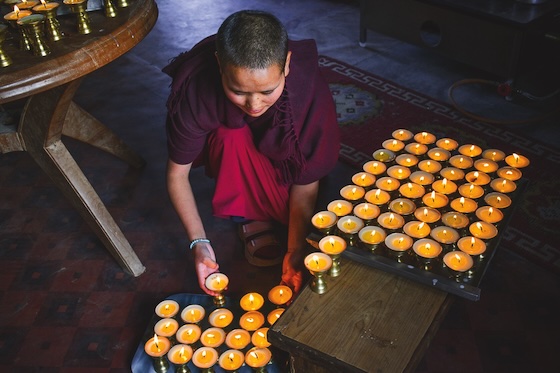
Here is one of the images from Tibetan Nuns Project 2026 calendar. Sales help to support the nunneries and nuns.
The Tibetan calendar and almanac entail five calendar features: the lunar weekday, the date of the lunar month, the moon’s constellation, the combination period, and the action period. The first two are also used to bring the lunar and solar calendars into harmony.
For a deeper dive into the complexity of the Tibetan calendar, see this article by Dr. Alexander Berzin.
The Story of the Tibetan Nuns Project Calendar
Each year, the Tibetan Nuns Project sells a wall calendar through our online store. Our 2026 Tibetan Nuns Project calendar is available for purchase. The cost is $13, and all proceeds go to support Tibetan Buddhist nuns at seven nunneries in northern India, as well as some nuns living on their own.
The Tibetan Nuns Project calendar was started over 20 years ago as a fundraising and friend-raising tool to help support hundreds of Tibetan Buddhist nuns at nunneries in northern India.
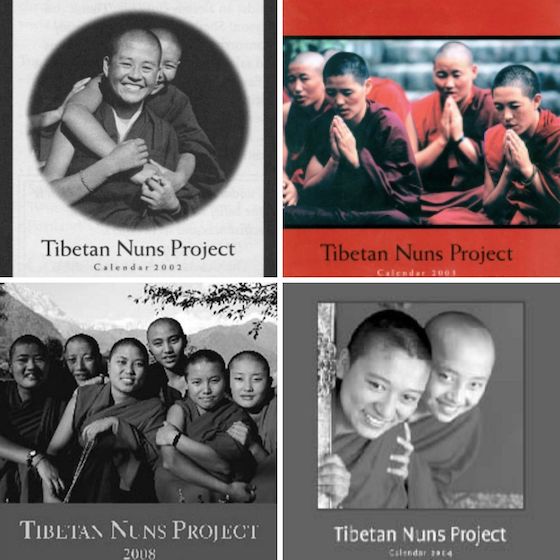
A selection of some of the early Tibetan Nuns Project charity calendars from 2002 to 2008. The Tibetan Nuns Project wall calendar is now full color and uses photos taken by the nuns themselves.
Each summer, the astrologers at the Tibetan Medical and Astrological Institute in Dharamsala (also known as Men-Tsee-Khang) supply us with the ritual and holy dates for the coming Tibetan year. It should be noted that the timings of the solstices and equinoxes in the calendar are based on north-eastern India where the nuns live, so they may be slightly different from where you are.
The Tibetan Nuns Project calendar uses almost exclusively photographs taken by the nuns themselves. These photographs provide an intimate insight into the daily lives and religious and cultural practices of the nuns.
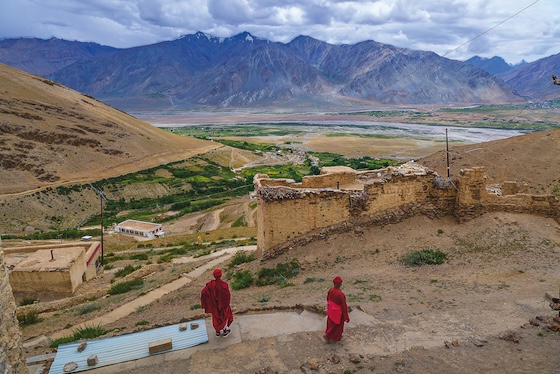
The October 2026 image from Tibetan Nuns Project calendar. This photo was taken from Dorjee Zong Nunnery in Zanskar.
Throughout the year, the nunneries that we support send a selection of photos for possible inclusion in the upcoming calendar. Once all the photos are gathered together, we make a final selection. We try to balance the images, choosing at least one photograph from each nunnery. We select photographs that are windows into the nuns’ lives.
Each photo is captioned and paired with quotations from inspirational people, such as His Holiness the Dalai Lama.
“It’s really exciting to open up emails from India and see the photos sent by the nuns for the calendar,” says Lisa Farmer, Executive Director of the Tibetan Nuns Project.
The proceeds from the sale of the Tibetan Nuns Project calendar are used to support approximately 900 Tibetan Buddhist nuns and seven nunneries in India. The calendar cost $13 plus shipping and is 6.5″ x 7″.
Thank you for buying our 2026 Tibetan Nuns Project calendar and helping the nuns!
 We’ve been selling our beautiful charity calendar since 1996 to raise funds to support hundreds of Tibetan Buddhist nuns living in India. All proceeds from the sale of the 2016 calendar will help provide food, shelter, health care and education to over 700 nuns living at seven nunneries supported by the Tibetan Nuns Project.