Here’s a chance for you to take a trip behind the scenes at some of the Tibetan Buddhist nunneries in India that are supported by the Tibetan Nuns Project.
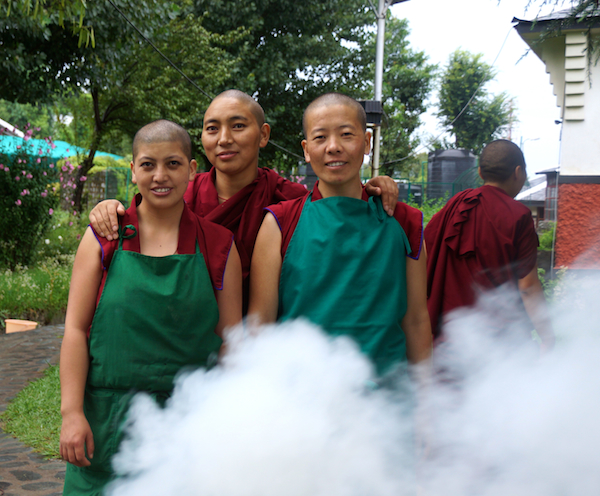
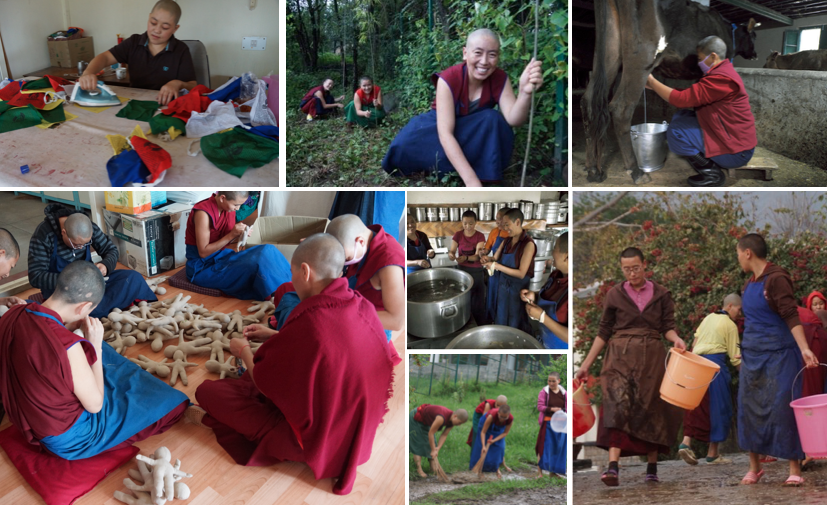
Whether the nunnery is large or small, there are many tasks or chores that the nuns must do to ensure that they are as self-sufficient as possible and to make sure that the nunneries function smoothly and are well maintained.
Collage of some of the many tasks of the nuns at Dolma Ling Nunnery in India, in addition to their studies and prayers.
In terms of regular tasks, one could view a nunnery as something like a cross between a very large household and a university or college. As you can imagine, there’s a lot of chores that need to be done each day, week, month, and year in order to keep everything running like a well-oiled machine. Continue reading →
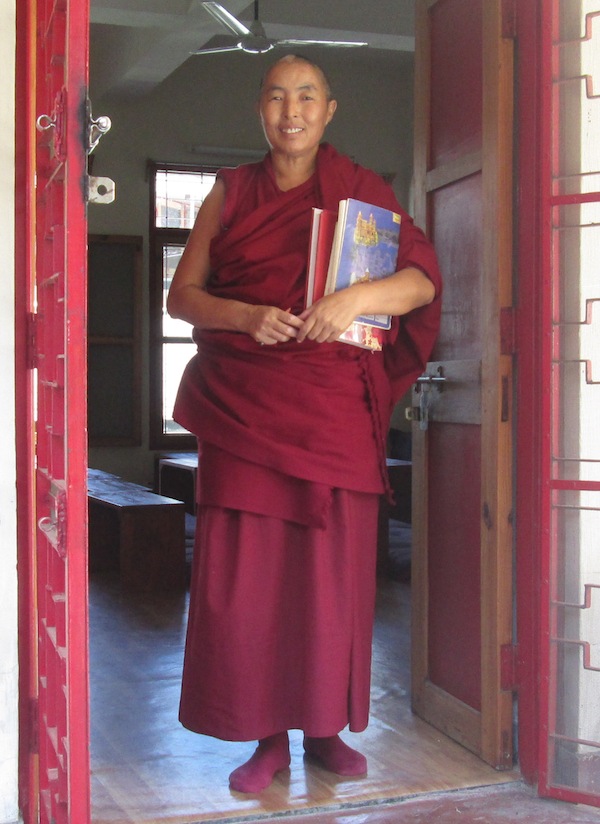
Born into a simple family in eastern Tibet, Lobsang Dolkar, became a nun in her teens. With no opportunity to study, she spent her days in household chores and tending livestock. Being a nun meant reciting mantras and doing prostrations.
Venerable Lobsang Dolkar, one of the first Dolma Ling nuns
When her brother married, she became free to make a pilgrimage to Lhasa where she made friends with another nun. They decided to go to India to attend
the 1990 Kalachakra being given by His Holiness the Dalai Lama. Caught twice crossing into Nepal and handed back to the Chinese, their third attempt was successful.
Lobsang Dolker had not planned to stay in India, but her friend convinced her it was no use returning to Tibet and they should instead enroll in the newly founded nunnery, Dolma Ling.
She is among the first batch of nuns who entered the study program and at the same time helped with its construction. It was a joyous moment in 1994 when they moved into newly constructed rooms and had a home in India. Sadly she did not see her parents again; they passed away two years ago.
When she began her studies, it was hard for her to grasp what was being taught since she had had no previous education. But she never gave up. She feels that the opportunity to earn the Geshema Degree is very special and is grateful to His Holiness the Dalai Lama for his continuous support of nuns’ education. Access to this degree encourages nuns to persevere.
Lobsang says that, in the beginning, she was scared to sit the Geshema exams, but she never thought of backing out because she did not want younger nuns to accept failure without trying hard for their degree. In May she successfully passed Year 2 of the four-year exams. All being well, she will be a Geshema in 2017.
Looking back on how far she has come, Lobsang appreciates the importance
of education and is grateful to all the teachers and staff for their dedication to the nuns.
We are looking for more sponsors. You can sponsor a nun for less that $1 a day and help provide food, education, shelter and health care. 100% of your sponsorship gifts go to India. Learn more at https://tnp.org/youcanhelp/sponsor/
Dolma Ling Nunnery and Institute is a unique center of higher learning for Tibetan Buddhist nuns in India.
On December 8, 2015 we celebrate the 10th anniversary of the inauguration of Dolma Ling by His Holiness the Dalai Lama. We also celebrate the powerful vision and mission behind this special institution, the many supporters who made it possible, and the nuns themselves for their bravery and dedication.
Dolma Ling Nunnery was started in 1991 to meet the needs of the many nuns who fled Tibet in search of the freedom to study and practice their religion.
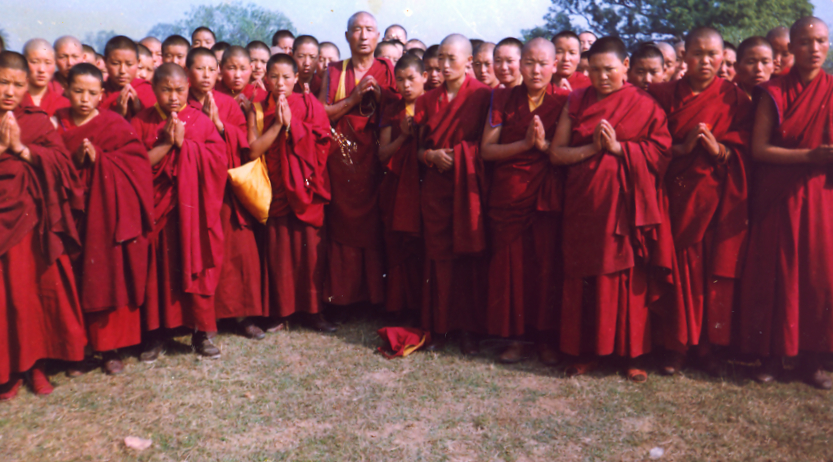
Newly arrived nuns in India. The Tibetan Nuns Project and Dolma Ling Nunnery were created in response to a huge influx of nuns who arrived in India after escaping from Tibet. These nuns had made the arduous journey by foot over the Himalayas, and were ill and exhausted. Existing nunneries were already overcrowded.
Dolma Ling is fully funded by the Tibetan Nuns Project and was one of the first institutions dedicated specifically to higher Buddhist education for Tibetan Buddhist nuns from all traditions. Currently about 250 nuns live and study at Dolma Ling.
The Story of Dolma Ling Nunnery
Dolma Ling is set in a serene area of the North Indian state of Himachal Pradesh at the foothills of the Himalayas. The nunnery is surrounded by green terraced wheat and rice fields and has beautiful views up towards the snowy mountain peaks of the nearby Dhauladhar range. The town of Dharamsala, home to His Holiness the Dalai Lama and the Central Tibetan Administration is about 20-minutes drive from Dolma Ling.
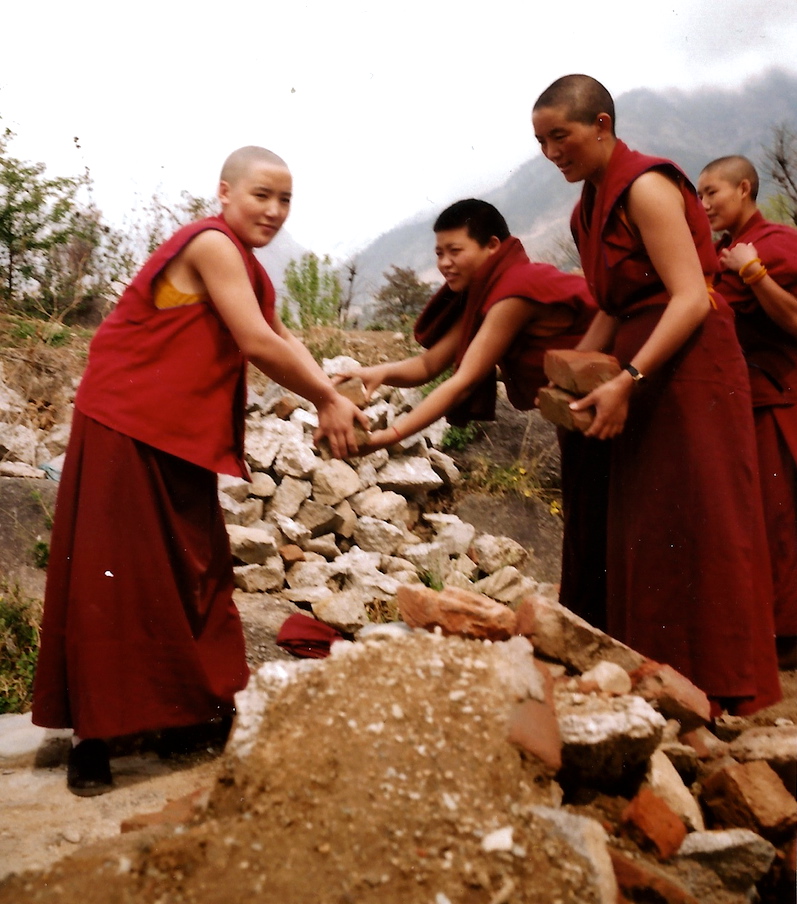
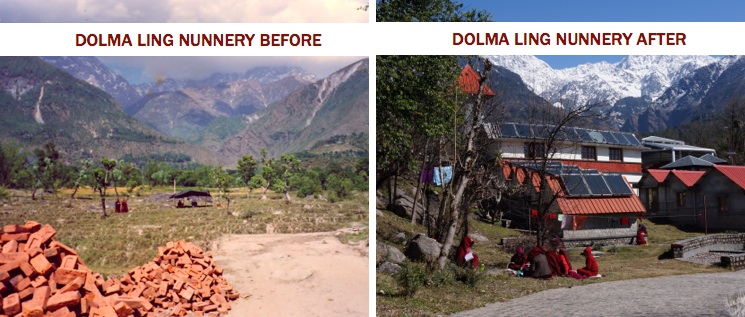
The nuns themselves took part in the construction of the nunnery, laboring to carry bricks and mortar, to dig the foundations, and to landscape and create the lush flower gardens that are a refuge for birds and insects. Photo courtesy of Jessica Tampas
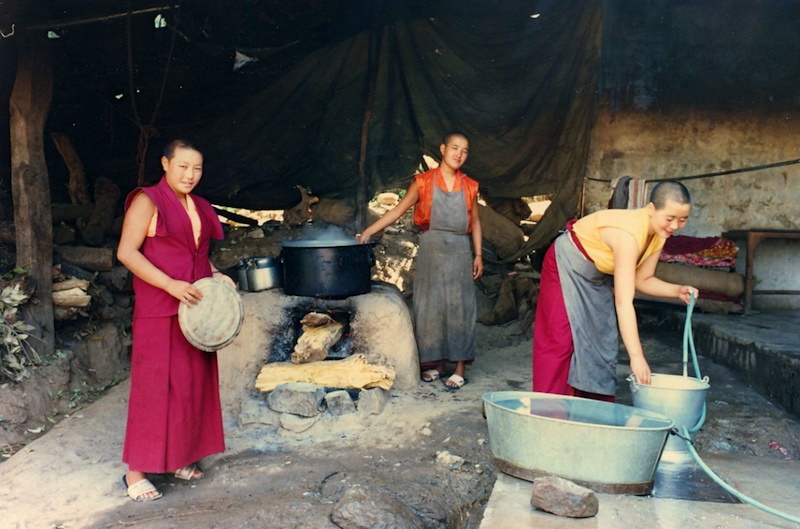
Nuns working in the temporary kitchen during the construction of Dolma Ling Nunnery. As the nunnery was being built, the nuns lived first in tents and then in a rented house. Many of their activities, such as their studies, took place outdoors.
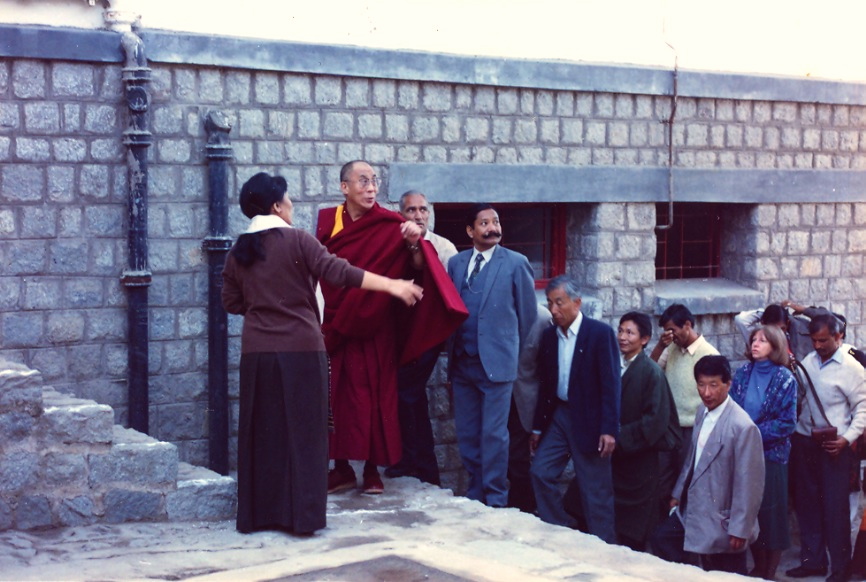
Construction of Dolma Ling began in 1993 and took nearly 13 years to fully complete. The nuns moved into the first buildings in 1994. His Holiness the Dalai Lama first visited in 1995 and encouraged the nuns in their studies. Upon its completion, he returned to Dolma Ling to officially inaugurate it on December 8, 2005.
His Holiness the Dalai Lama on his first visit to Dolma Ling Nunnery and Institute in 1995
The red and white buildings of the nunnery are constructed around a central courtyard that is the main hub of the nunnery. The focal building is the temple, which contains the prayer hall and library. Six two-story buildings linked by verandas and courtyards serve as housing and classrooms, in addition to an infirmary, kitchen, dining hall, and solar bath house.
Nuns gather in the courtyard each morning for prayers, announcements and the singing of the Tibetan national anthem. For a sense of life at Dolma Ling, see our video “A Day in the Life at Dolma Ling Nunnery”.
Education at Dolma Ling
Dolma Ling Institute and Nunnery is unique in that it offers a 19-year curriculum of traditional Buddhist philosophy and debate along with modern courses in Tibetan language, English, mathematics, and computer skills.
Dolma Ling is open to those from all schools of Tibetan Buddhism and is the first of its kind to offer this sort of education to Tibetan women. The nunnery is officially non-sectarian and has teachers from different traditions.
A panorama of part of Dolma Ling Nunnery taken by Brian Harris
Upon graduation from the 19-year program, the nuns will be thoroughly trained in their Buddhist tradition and will be eligible to receive a Geshema degree, equivalent to a Ph.D. The first Tibetan Geshemas are due to graduate in 2016 after a rigorous 4-year examination process.
In addition to traditional and modern education, the nuns are also provided with skills training so that they can become more self-sufficient and generate income for the nunnery, reducing the need for outside support. The nunnery has various income generating projects such as our annual calendar with photos by the nuns, the nuns’ café which opened in 2015, the tailoring section that makes prayer flags and handmade dolls, and the tofu kitchen which provides fresh tofu for the Dolma Ling nuns.
Educating women is powerful. It’s not just about books. As we’ve shown at Dolma Ling Nunnery and the other six nunneries we support, it is also about helping nuns acquire the skills they need to run their own institutions and create models for future success and expansion. It’s about enabling the nuns to be teachers in their own right and to take on leadership roles at a critical time in their nation’s history.
Major New Project Coming Soon to Dolma Ling
The Tibetan Nuns Project is working to develop plans for a major new project at Dolma Ling Nunnery, a study center that will focus particularly on laywomen, Tibetan and non-Tibetan, who wish to seriously study Buddhism.
In the past many have expressed interest in studying the philosophical texts just as the nuns do, but could not be readily accommodated in the nunneries. We seek to establish a center at Dolma Ling so that laywomen can have a safe environment within the nunnery grounds in which to live, study and practice. The study center will also provide accommodation and facilities for visiting nuns during the annual inter-nunnery debate session and during the Geshema exams. We will share more information about this exciting new project in 2016 as plans are finalized!
Our thanks
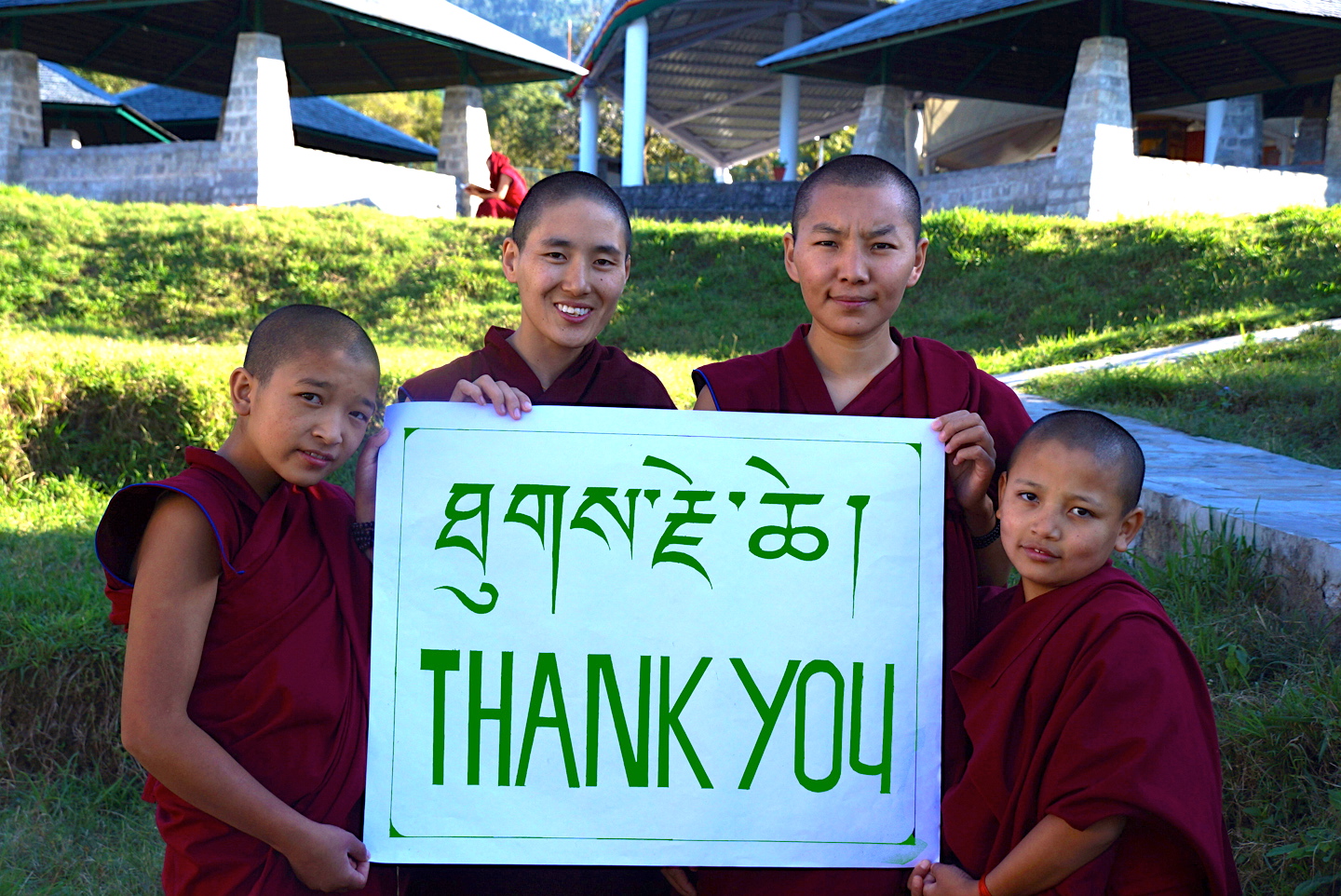
Thank you to our supporters worldwide who have helped turn a big idea into reality.
The situation in Tibet remains very alarming. The religion and culture is under tremendous threat. Nunneries are under surveillance and, in one case this year, many nuns were expelled and their nunnery was destroyed.
The nuns and the nunneries that you are supporting with your donations to the Tibetan Nuns Project are a beacon of hope for the future.
With the power of an idea, together we have created something that once seemed almost impossible—institutions and educational systems for Buddhist women that have the potential to transform generations to come.
The 2015 Great Winter Debate Event, also known as the Jang Gonchoe, took place at Geden Choeling Nunnery in Dharamsala, India and started on October 3rd. This year marks the 20th anniversary of this special annual event.
Nuns gather for a formal debate presentation with His Holiness the Dalai Lama on October 31. Photo courtesy of Tenzin Choejor, OHHDL
This year 359 nuns from 7 nunneries in India and Nepal took part in the month-long debates, with the event fully funded by the Tibetan Nuns Project. The $100 scholarships given by Tibetan Nuns Project donors cover costs such as transportation, food and accommodation. Continue reading →
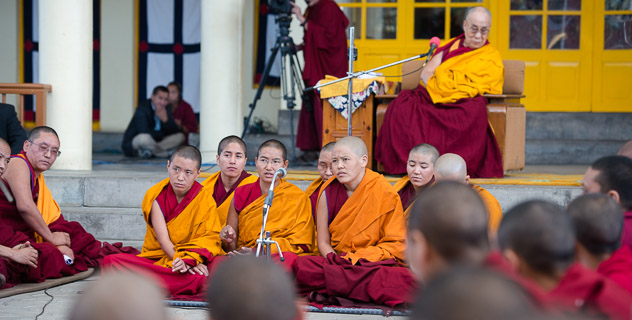
On October 31 nuns from seven nunneries who were taking part in the annual inter-nunnery debate, the Jang Gonchoe, gathered at the main temple in Dharamsala and gave a special debate presentation to His Holiness the Dalai Lama.
This year marks the 20th anniversary of the nuns’ Jang Gonchoe debate session. Prior to 1995 the Jang Gonchoe was open only to monks, but now Tibetan Buddhist nuns are building their own strong tradition of debate.
According to a report on the event on the Dalai Lama’s website, His Holiness addressed the nuns and congratulated them twice, noting that there are nuns who have almost completed their study of Buddhist philosophy and who will take their final exams to qualify as Geshemas next year. The Geshema degree is the equivalent to a doctorate in Tibetan Buddhist studies.
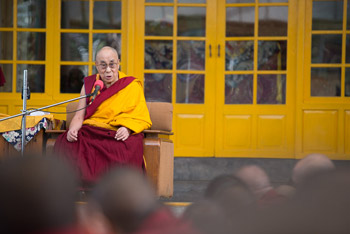
His Holiness the Dalai Lama addressing nuns gathered for the annual debate session. Photo/Tenzin Choejor/OHHDL
His Holiness the Dalai Lama spoke at some length about the importance of reason and understanding in the Tibetan Buddhist tradition. He told the nuns, “This is the 21st century and we need to understand the Buddha’s teachings in the light of reason. When we teach, we need to do so on the basis of reason. I’ve met followers of the Pali tradition, monks from Thailand who are scrupulous in their observance of Vinaya [the monastic rules for monks and nuns]. I asked them whether they explain the Four Noble Truths according to reason or citing scriptural authority. They answered that they rely on the authority of scripture.” Continue reading →
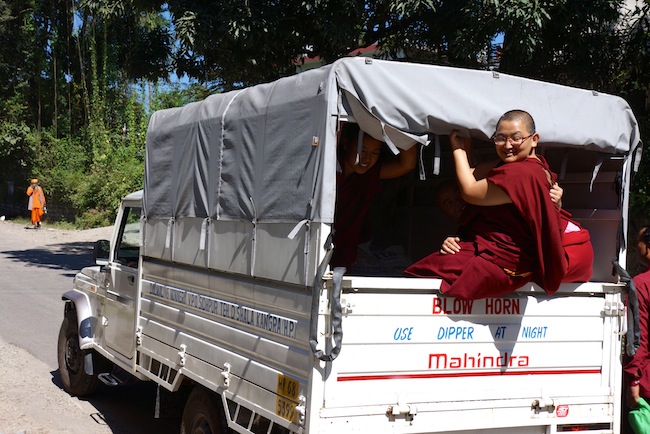
This summer the nuns at Dolma Ling requested help to purchase a new truck that would allow them to manage their many transportation tasks.
Thanks to a special anonymous donor and to Alicia, Margaret, Karen, Swetlana, and Robert, we were able to purchase the small, multi-purpose truck. This blog post shows the nuns, through video and photos taken by the nuns themselves, on some of their many recent expeditions.
The nuns leave for shopping
With 240 nuns at the nunnery, the nuns must travel often to buy vegetables and other food, as well as supplies for the their small shop, the nunnery’s tailoring section, for the tofu-making facility, and for the paper-recycling section. Continue reading →
This is a special report from Rinchen Khando Choegyal, Founder and Director of the Tibetan Nuns Project and Tsering Diki, Project Co-Ordinator. The beautiful photos are all by media nun, Delek Yangdron, who accompanied us on the trip.
In August 2015, we travelled for three days over rough, bumpy roads from Leh in Ladakh to Zanskar, a remote area in northern India. Located in this majestic, arid landscape is Dorjee Zong Nunnery, home to 19 nuns.
It was good to see the nuns and the nunnery once again. Since 2010 the Tibetan Nuns Project has been helping this small nunnery with sponsorship and a teacher’s salary, and it was wonderful to see the assistance we have been providing used to the fullest extent. The nuns are very happy to be receiving support and care from us and their sponsors.
During our short visit, the Director gave a warm and personal talk to all of the nuns and we could see how inspired they were and how cared for they felt. This was encouraging and inspiring for those of us who are trying to work for them.
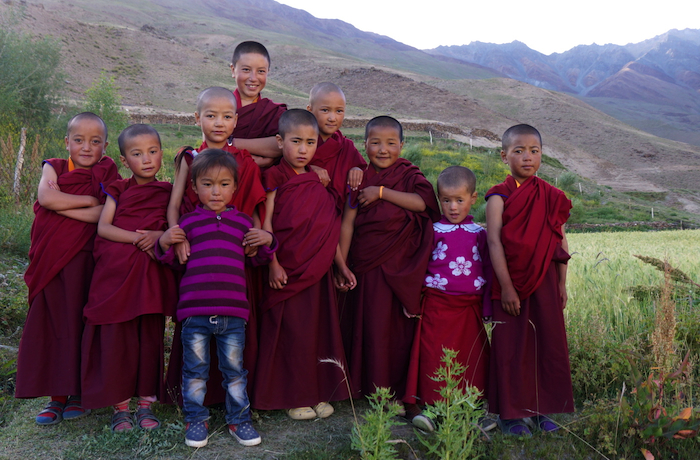
There are 12 young nuns and 7 elder nuns. The younger nuns looked very bright and happy to be where they are, and we felt energized to help them even more. Our focus will be mainly on education, health care, and overall development, including setting up infrastructure for an education system and facilitating a good educational programme. Continue reading →
His Holiness the Dalai Lama’s 80th birthday on July 6th was celebrated by Tibetans all over the world with great excitement and prayers for his good health and long life.
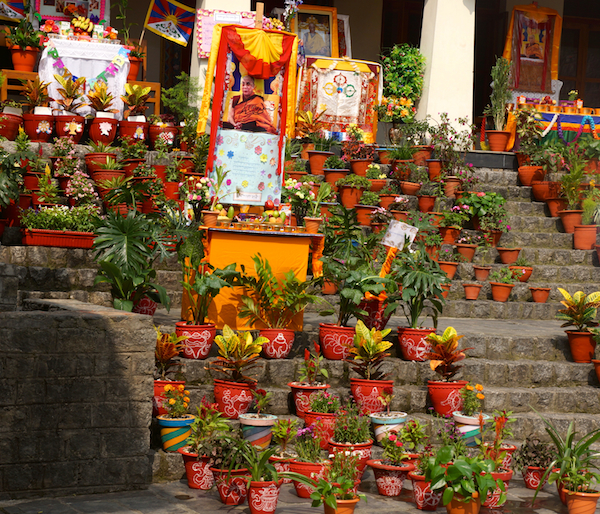
Nuns offering prayer scarves to portrait of His Holiness the Dalai Lama
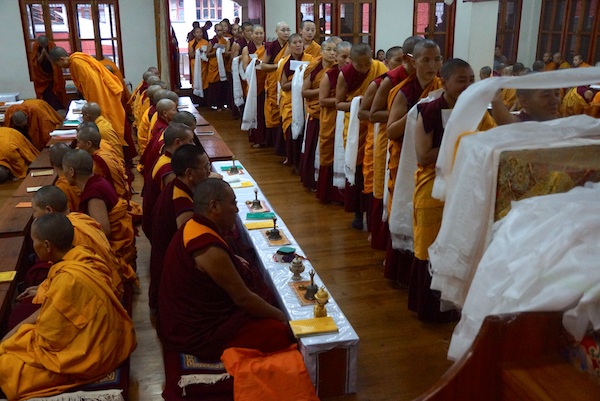
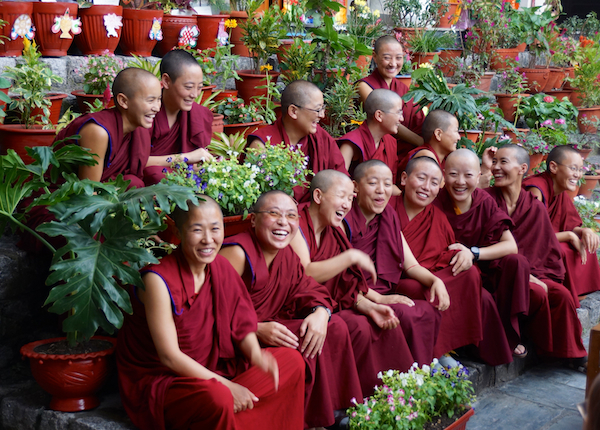
At Dolma Ling Nunnery and Institute, home to over 230 nuns, the day started at 6 am with everyone — the nuns, teachers and all the staff — seated in the prayer hall at 6 for tsok and offerings of khataks (prayer scarves) to His Holiness.
At 7 am they had sangsol (incense offering) after which breakfast was served in the nuns’ dining hall.
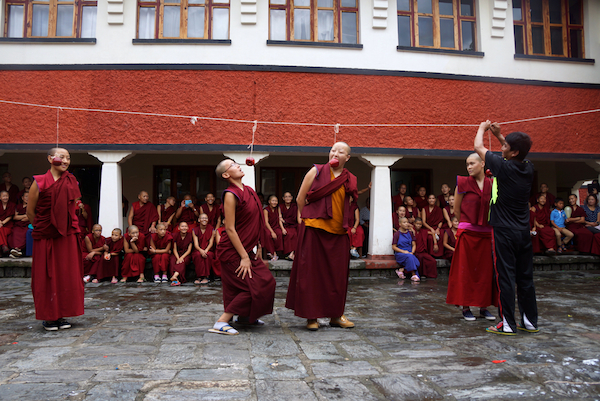
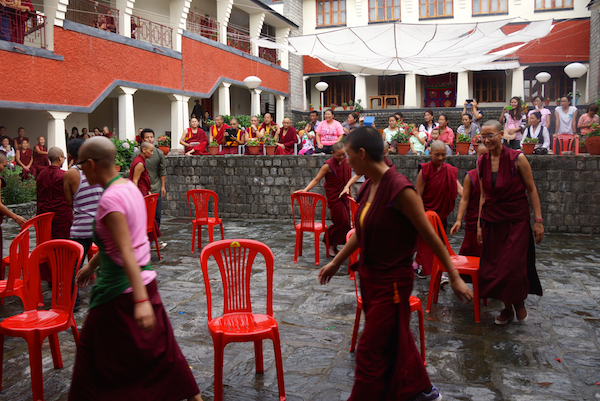
After this everyone enjoyed the morning playing outdoor games such as a relay race, a tug-of-war between different groups of nuns, staff, and teachers, a game musical chairs, a sack race and other competitions and games such as the bursting of a balloon tied on another person’s ankle.
For lunch a beautiful vegetarian meal was served. This was then followed by a open quiz competition in philosophy, general knowledge, English and Tibetan. The person with the correct answer was given a surprise gift.
Tibetan Buddhist nuns playing musical chairs as part of the day of celebration for His Holiness’s birthday.
All around the courtyard area we could see nuns and staff enjoying games such as badminton, cricket, and football.
Judging the annual flower competition on July 2nd, Universal Prayer Day
Dinner which was served at 7pm and the winner of the annual flower competition, held on July 2nd, was called and given her prize. On July 2nd, Universal Prayer Day, the old debate courtyard at the nunnery was filled with beautiful potted flowers placed in-front of portraits of His Holiness. Scoring for the competition was done by the teachers.
After dinner everyone gathered together and the nuns showcased little dramas that they had prepared for the occasion and then the floor was open to anyone to show their talent.
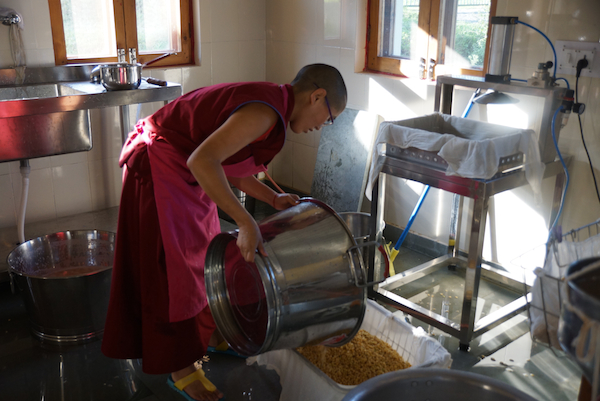
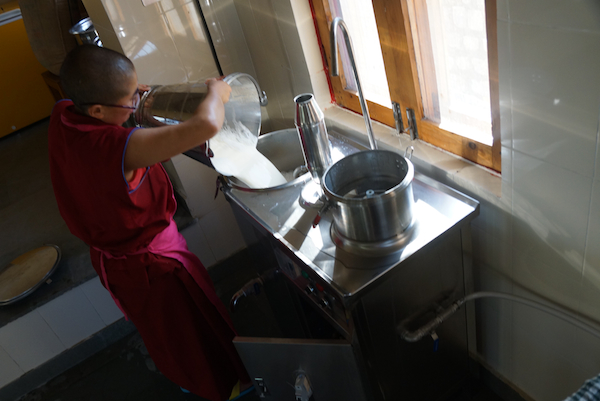
We are delighted to report that the new tofu-making machine is now in use at Dolma Ling Nunnery and Institute in northern India, home to almost 250 nuns.
Thanks to some very special donors, in particular Norman Steinberg and another private donor from Canada, this spring the nuns were able to fulfill their long-term dream of purchasing a new tofu machine and establishing it in a purpose-built facility. In April we shared a blog post with a video made in 2012 by the nuns of the old tofu-making process at the nunnery.
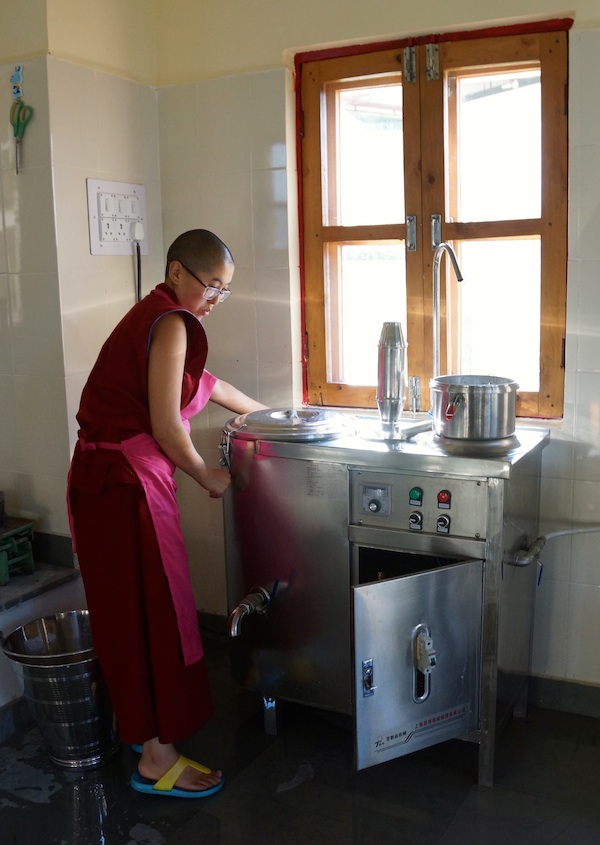
The nuns at Dolma Ling make tofu every Saturday. The new tofu machine allows the nuns to produce more tofu more efficiently. It takes the nuns much less time to make tofu for the nunnery and for other customers.
The nuns at Dolma Ling follow a vegetarian diet so tofu is an important source of nourishment and protein for them. The tofu is supplied regularly each week to the nunnery kitchen for consumption by the nuns and 2kg is bought every week by the nunnery café.
At the moment the nunnery is also getting regular orders for tofu from Namgyal Monastery in Dharamsala and sometimes from a few local Tibetan restaurants in the nearby refugee settlement of McLeod Ganj, located above Dharamsala. Both the monastery and the restaurants order as per their needs.
There are six nuns at Dolma Ling who know how to make tofu. Each Saturday a team of three of those nuns makes the tofu, with the nuns taking turns to do the work. They start working at 6am and finish normally by 2pm. However, on occasions when they have large orders, their work ends at 10pm.
The market value for tofu is 150 Indian rupees per kg (about US$2.36) while the nuns sell it for Rs.130 per kg or approximately US$2.05.
The Tibetan Nuns Project is extremely grateful to Norman Steinberg and the other donors from around the world who made the new tofu-making facility possible.
If you would like to learn more about how the nuns are moving towards greater self-sufficiency, or to help fund these efforts, please contact us at info@tnp.org or donate at https://tnp.org/youcanhelp/donate/.
All photos are courtesy of Venerable Delek Yangdron.
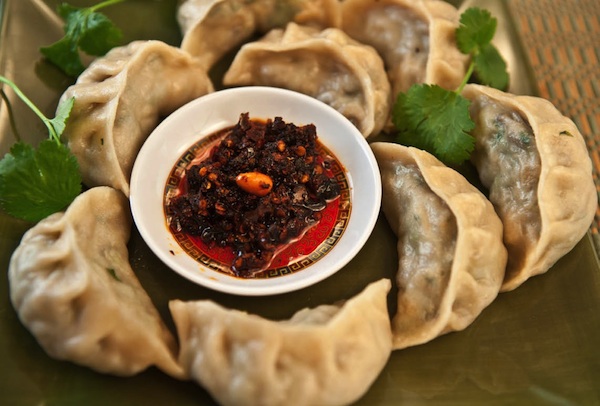
If you ask someone to name their favorite Tibetan food there’s a good chance they’ll say Tibetan momos. Momos are steamed savoury dumplings that are much loved by Tibetans around the world and that are often made on traditional holidays.
Photo of vegetarian Tibetan momos and chili sauce courtesy of YoWangdu Tibetan Culture.
Momos are a bit of a delicacy because of the work involved in making them. They can be stuffed with a variety of fillings such as beef, yak meat, cheese, potatoes or vegetables.
The nuns at Dolma Ling Nunnery and Institute near Dharamsala in northern India (one of the seven nunneries in India supported by the Tibetan Nuns Project) follow a vegetarian diet and make momos on special occasions such as Tibetan New Year and His Holiness the Dalai Lama’s birthday.
Here’s a lovely video that the nuns made in 2012 ago showing them preparing momos to celebrate His Holiness the Dalai Lama’s birthday on July 6th. As you will see from the video, it’s no small task to make enough momos to serve over 230 nuns!



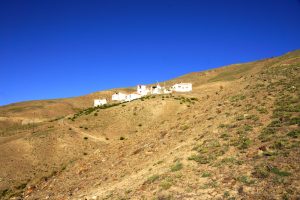 In August 2015, we travelled for three days over rough, bumpy roads from Leh in Ladakh to Zanskar, a remote area in northern India. Located in this majestic, arid landscape is Dorjee Zong Nunnery, home to 19 nuns.