Category Archives: Khenmo Enthronement

Historic First Khenmo Enthronement at Shugsep Nunnery: Photos and Video

The first-ever Khenmo enthronement at Shugsep Nunnery was held on February 18, 2026, the first day of Tibetan New Year or Losar. Here is a report with photos by the media nuns at Shugsep Nunnery.
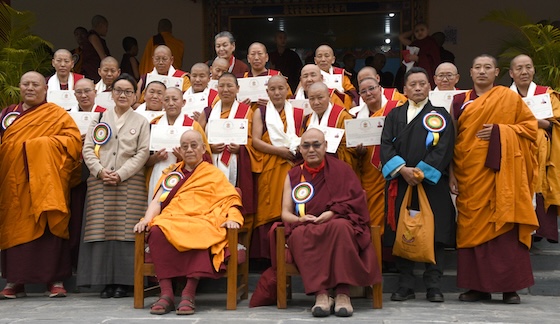
Historic Khenmo Enthronement Ceremony Shugsep Nunnery 2026

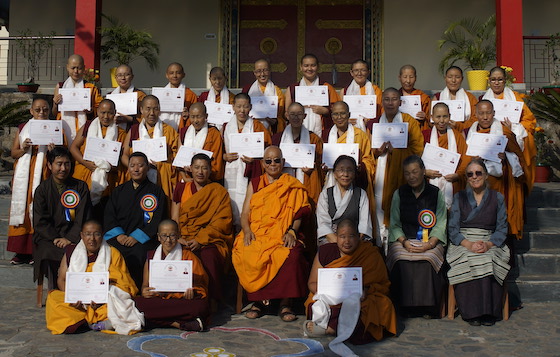
At the historic Khenmo enthronement on February 18, 2026 with chief guests. There are only 18 Khenmos pictured instead of 19 because one nun is currently teaching in the United States and was unable to attend the ceremony.

A Khenmo is the highest scholarly and teaching title for nuns in the Nyingma tradition of Tibetan Buddhism. It is equivalent to the Khenpo title given to monks.
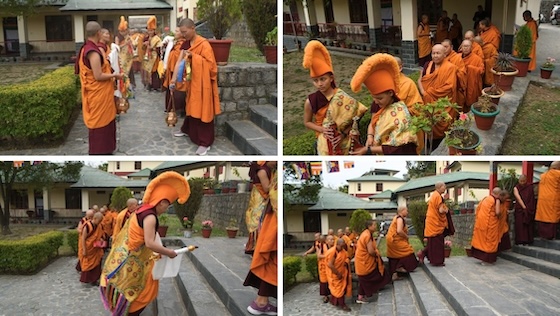
Ceremonial procession for the historic Khenmo enthronement Feb 2026 Shugsep Nunnery

A collage of photos showing the ceremonial procession for the historic Khenmo enthronement on February 18, 2026.

The ceremony was led by Khenchen Pema Sherab Rinpoche, the main preceptor for the enthronement. The event included traditional ritual prayers, a white scarf (katak) offering ceremony, speeches by various dignitaries, and the presentation of special items such as the red hat signifying the Khenmos’ status.
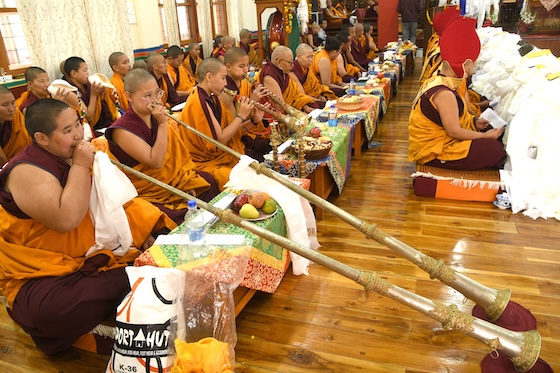
Nuns playing Tibetan long horns or dungchens

Nuns playing Tibetan long horns or dungchen, They have a deep, low sound and are played to welcome high lamas and Rinpoches to a monastery or temple.

On this day, in the presence of Khenchen Pema Sherab, all 19 nuns received the Khenmo title through the enthronement ceremony, followed by oath-taking, rituals, the offering of ceremonial scarves, and speeches.
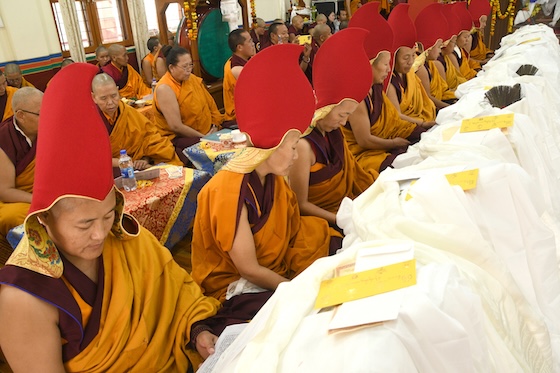
New Khenmos at Shugsep Nunnery receiving ceremonial kataks

The Khenmos, wearing their red hats signifying their status, are seated in front of huge piles of ceremonial white scarves or kataks given to them as a mark of respect.

The day was also covered by the Voice of Tibet news station, based in Dharamsala. Here is the video. Can’t see the video? Click here.

Special Guests

The guest list included:
– Chief Guest Khenpo Sonam Tenphel, Speaker of the Tibetan Parliament-in-Exile
– Mr. Dhondul Dorjee, Secretary of the Department of Religion and Culture, Central Tibetan Administration
– Staff members of the Tibetan Nuns Project India office
– Ms. Nangsa Choedon, Former Director of the Tibetan Nuns Project office in India
– Representatives from nunneries, monasteries, and non-governmental organizations around Dharamsala

Khenchen and Shugsep Khenpo Namgyal shared the history of Shugsep and the significance of the Khenmo title, and expressed gratitude to the Tibetan Nuns Project for its continuous support.

Tibetan Nuns Project Director Youdon Aukatsang, Mr. Dhondul Dorjee (Secretary of the Department of Religion and Culture, CTA), and the Chief Guest Khenpo Sonam Tenphel (Speaker of Tibetan Parliament in Exile) also delivered speeches.
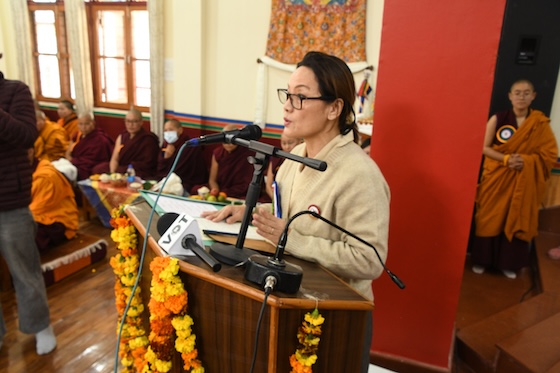
TNP India Director Youdon Aukatsang speaking at the Khenmo Enthronement

Youdon Aukatsang, the Director of the Tibetan Nuns Project office in India, speaking at the Khenmo enthronement.

During the ceremony, Shugsep Nunnery also presented souvenirs to honor Rinchen Khando Choegyal (TNP’s Founding Director and Special Advisor) and Dr. Elizabeth (Betsy) Napper (TNP’s U.S. Founder and Board Chair) for their lifelong support and service to the nunneries.
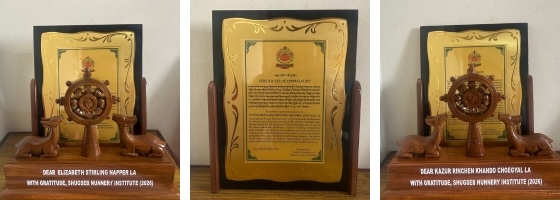
certificates of appreciation from Shugsep Nunnery

The souvenirs for Rinchen Khando Choegyal and Dr. Elizabeth (Betsy) Napper and one of the two certificates of appreciation from Shugsep Nunnery marking their decades of dedication to the nuns.

Part of the text on the Certificate of Appreciation reads:

… for the upliftment of Tibetan Buddhist nuns in exile in all aspects — education, healthcare, character building, management skills, resilience and above all self-confidence and community service. Thanks to your unflinching support, many nuns have been successful in graduating with Loponma, Geshema and Khenmo degrees, the highest certification in advanced Buddhist philosophical studies which is unprecedented in the history of traditional Tibetan Buddhist nunneries.

What is a Khenmo?

A Khenmo is the highest scholarly and teaching title for nuns in the Nyingma tradition of Tibetan Buddhism. It is equivalent to the Khenpo title given to monks. To become eligible for Khenmo:

  • A nun must complete nine years of rigorous Buddhist studies.
  • She has received the Loponma degree, equivalent to a Master’s degree.
  • After this, she must serve the nunnery for at least four years.
  • Service includes teaching, administration, guiding students, or other responsibilities.
  • She must maintain pure discipline, with no record of serious violations.

Unlike the Geshema degree, there is no written examination for the Khenmo title. Eligibility is based on education, years of service, leadership, and moral conduct.
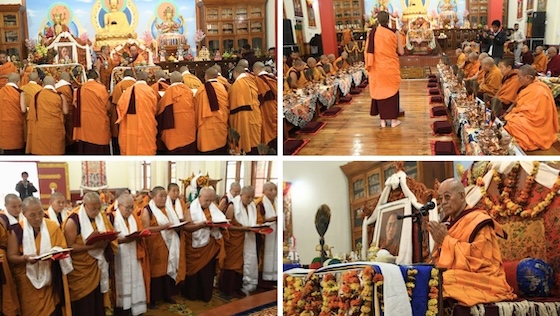
A collage of photos from the historic Khenmo Enthronement at Shugsep

A collage of photos from the historic Khenmo enthronement at Shugsep on February 18, 2026.

The nuns enthroned in February 2026 completed their Loponma studies between 2004 and 2022. Since then, they have fulfilled their required years of service: Some have taught Buddhist texts, some have managed administrative duties, some have guided study and revision programs for junior nuns.

Why This System is New for Nuns

Traditionally, only monks were enthroned as Khenpo. This was because the full nun ordination lineage (Gelongma) was not historically present in Tibet. Without full ordination, nuns could not receive the same monastic titles.

In recent decades, Tibetan Buddhist leaders recognized this historical gap and created a new system. Instead of requiring full Gelongma ordination, nuns who complete higher studies and long-term service can now be enthroned as Khenmo. This change opened the door for nuns to receive equal recognition as scholars and spiritual leaders.
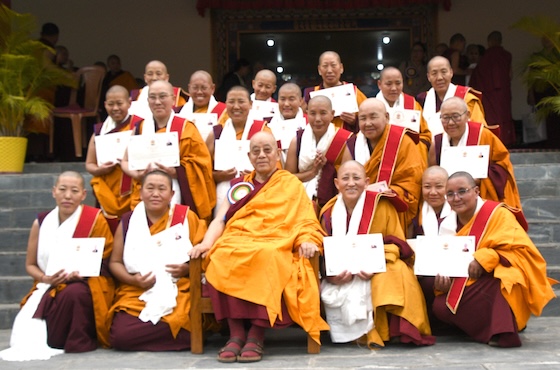
Historic Khenmo Enthronement at Shugsep Nunnery Feb 2026

The Khenmos with Khenchen Pema Sherab Rinpoche. Only 18 Khenmos are in the pictures instead of 19 because Loponma Tsering Lhamo was unable to attend the ceremony, as she is currently serving as a teacher at Tara Mandala International Buddhist Community in the United States.

Responsibilities After Enthronement and Impact

The role of the Khenmos is not only scholarly, but also leadership and representation. After receiving the Khenmo title, the nuns will take on greater responsibilities:

  • Some will continue teaching advanced Buddhist studies.
  • Some will lead administrative management of the nunnery.
  • Some will enter long-term retreat.
  • During major events, Khenmos will represent Shugsep Nunnery in religious gatherings and official functions.
  • Some will train for the research center.

The Khenmo enthronement strengthens leadership among nuns, raises educational standards in the nunnery, ensures self-sufficiency in teaching and training, inspires younger nuns to pursue higher studies, and promotes gender equality in Tibetan Buddhism.
Historic First Khenmo Enthronement at Shugsep Nunnery

On February 18th, 2026, the first day of the Tibetan New Year, Shugsep Nunnery and Institute will hold its first-ever Khenmo Enthronement Ceremony. A total of 19 nuns will be enthroned as Khenmo, making this a historic milestone for the nunnery.

Shugsep Nunnery follows the education system of Namdroling Monastery and Namdroling Nunnery. Namdroling Nunnery held its first Khenmo enthronement in 2022. Following the same tradition and system, Shugsep Nunnery will now celebrate its own first Khenmo enthronement this year.

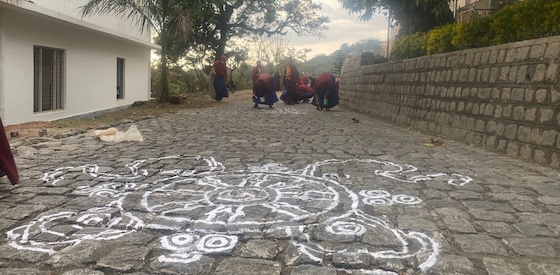
sacred Buddhist symbols

The nuns paint sacred Buddhist symbols to welcome Khenchen Pema Sherab Rinpoche, the chief guest of the upcoming Khenmo Enthronement.

What is a Khenmo?

A Khenmo is the highest scholarly and teaching title for nuns in the Nyingma tradition of Tibetan Buddhism. It is equivalent to the Khenpo title given to monks. To become eligible for Khenmo:

  • A nun must complete nine years of rigorous Buddhist studies.
  • She has received the Loponma degree, equivalent to a Master’s degree.
  • After this, she must serve the nunnery for at least four years.
  • Service includes teaching, administration, guiding students, or other responsibilities.
  • She must maintain pure discipline, with no record of serious violations.

Unlike the Geshema degree, there is no written examination for the Khenmo title. Eligibility is based on education, years of service, leadership, and moral conduct.

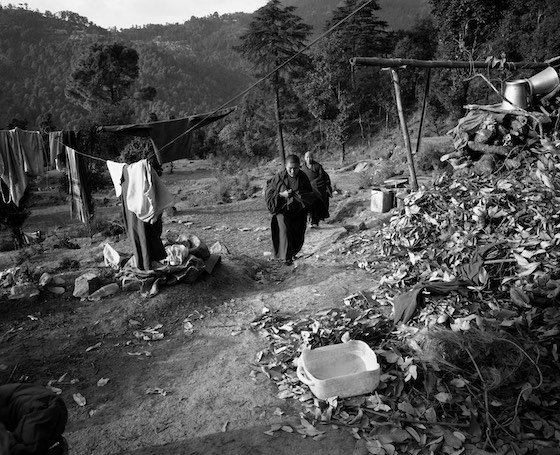
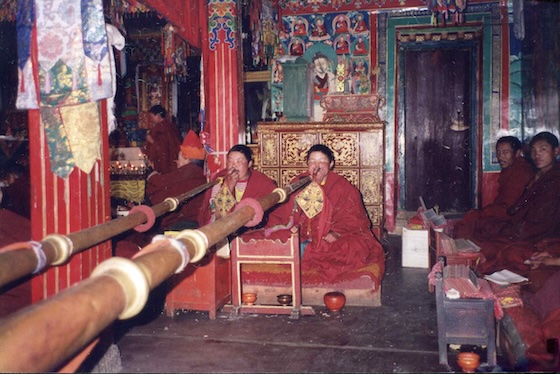
Shugsep nunnery in Tibet, Tibetan nuns

A photo from Shugsep Nunnery in Tibet in 1998. After many Shugsep nuns escaped to India in the 1990s, the nunnery was re-established by the Tibetan Nuns Project near Dharamsala. Photo by Julie Brittain.

The 19 nuns being enthroned this year completed their Loponma studies between 2004 and 2022. Since then, they have fulfilled their required years of service: Some have taught Buddhist texts, some have managed administrative duties, some have guided study and revision programs for junior nuns.

Why This System is New for Nuns

Traditionally, only monks were enthroned as Khenpo. This was because the full nun ordination lineage (Gelongma) was not historically present in Tibet. Without full ordination, nuns could not receive the same monastic titles.

In recent decades, Tibetan Buddhist leaders recognized this historical gap and created a new system. Instead of requiring full Gelongma ordination, nuns who complete higher studies and long-term service can now be enthroned as Khenmo. This change opened the door for nuns to receive equal recognition as scholars and spiritual leaders.

Shugsep graduation 2022

On October 28 2022, Shugsep Nunnery and Institute held an important graduation ceremony in which Pharchin, Uma, and Lopon nuns were given their graduation certificates. As of 2023, 49 Shugsep nuns had attained the Lopon degree, equivalent to a Master’s degree – a remarkable achievement given the many obstacles on their path.

The Enthronement Ceremony

On January 29th, the Shugsep nuns welcomed Khenchen Pema Sherab Rinpoche, the chief guest of the upcoming Khenmo Enthronement.

On January 29th, the Shugsep nuns welcomed Khenchen Pema Sherab Rinpoche, the chief guest of the upcoming Khenmo Enthronement. They presented him with kataks, the Tibetan white scarves given as a sign of respect.

The ceremony will be led by Khenchen Pema Sherab Rinpoche, who will serve as the chief guest and main preceptor for the enthronement. The event will include:

  • Traditional ritual prayers
  • White scarf (katak) offering ceremony
  • Attendance by dignitaries from monasteries, nunneries, and government departments
  • Each newly enthroned Khenmo will receive traditional gifts, including:
  • A ceremonial hat
  • A small Buddha statue
  • A pair of ritual vases
  • A mandala offering set
  • A container for the “three whites and three sweets”
  • A ritual bell and vajra
  • A new set of monastic robes
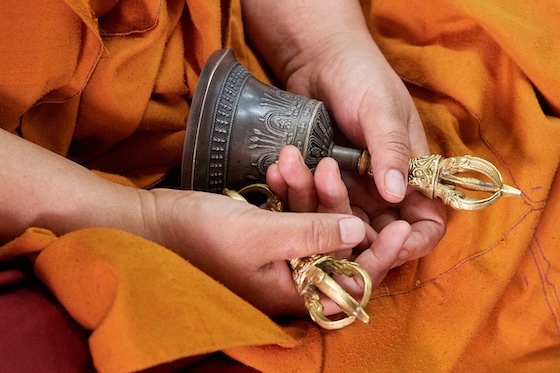
A Tibetan Buddhist nun holds a traditional bell and dorje.

A Tibetan Buddhist nun holds a traditional bell and vajra (dorje), essential Tibetan Buddhist ritual items representing the inseparable union of wisdom and compassion. Photo by Olivier Adam.

Responsibilities After Enthronement

At present, there will be no replacement involved in this Khenmo enthronement. According to the nunnery’s administration, this ceremony is not filling a vacant position or replacing an existing Khenpo.

After receiving the Khenmo title, the nuns will take on greater responsibilities:

  • Some will continue teaching advanced Buddhist studies.
  • Some will lead administrative management of the nunnery.
  • Some will enter long-term retreat.
  • During major events, Khenmos will represent Shugsep Nunnery in religious gatherings and official functions.
  • Some will train for the research center.

Their role is not only scholarly, but also leadership and representation.

Impact on the Nunnery

This Khenmo enthronement will:

  • Strengthen leadership among nuns.
  • Raise educational standards in the nunnery.
  • Ensure self-sufficiency in teaching and training.
  • Inspire younger nuns to pursue higher studies.
  • Promote gender equality in Tibetan Buddhism.
Ani Ugyen Dolma

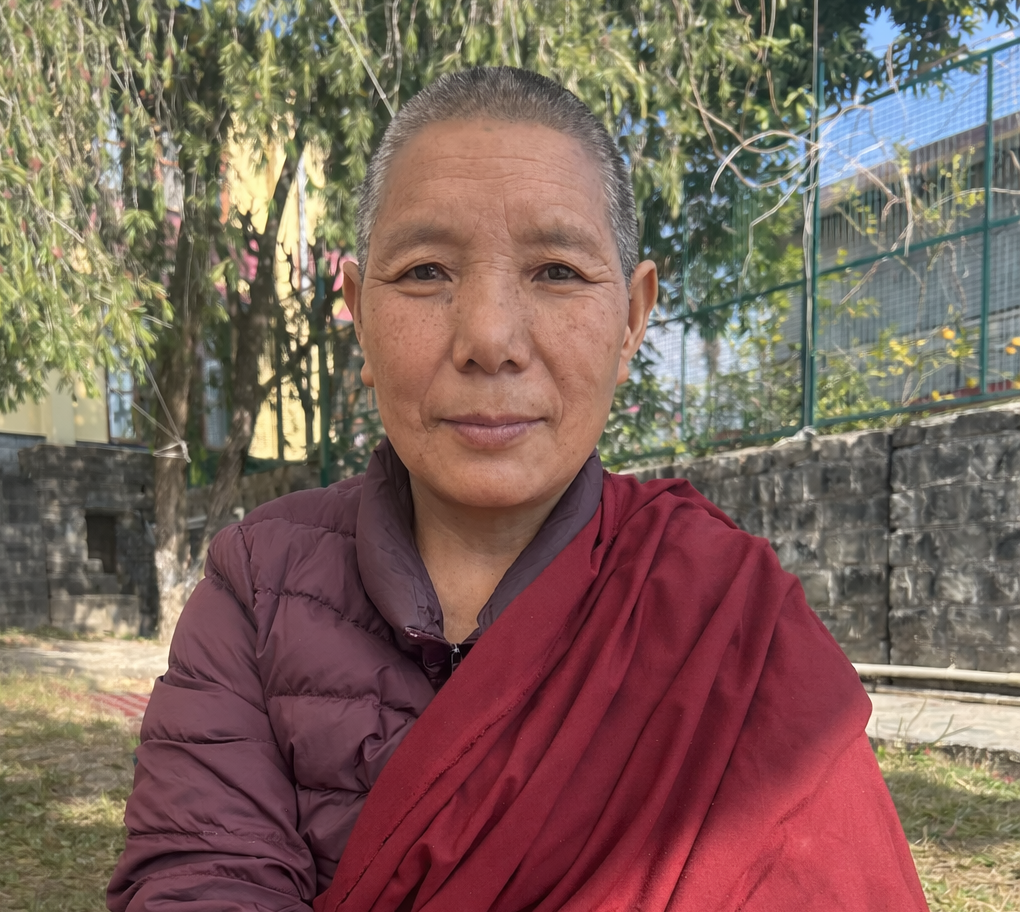
Ani Ugyen Dolma is a senior nun in her 50s, originally from Tibet. She belongs to Shugsep Nunnery in Tibet and was among the very first group of nuns to arrive in Shugsep Nunnery in India. She is one of the nuns who will be enthroned in February 2026.

Ani Ugyen Dolma will be enthroned as a khenmo in Feb 2026

Ani Ugyen Dolma is one of the nuns at Shugsep who will be enthroned as khenmo on February 18, 2026.

She first arrived in India in 1990, as part of the first batch of 22 nuns who came from Tibet to the new Shugsep Nunnery in exile. Since then, she has remained continuously involved in the growth and development of the nunnery, from its earliest days to the present.

In 2004, Ani Ugyen Dolma completed her Loponma degree, becoming part of the first-ever Loponma graduating batch at Shugsep Nunnery. That historic batch included eight nuns, marking the beginning of advanced Buddhist scholastic education for nuns at Shugsep.

From 2010 to 2017, she served as the Director of Shugsep Nunnery, taking responsibility for the administration, discipline, and overall management of the community.

After the nunnery later invited a Khenpo to strengthen higher Buddhist education in the nunnery, Ani Ugyen Dolma focused mainly on teaching and academic guidance. She has been:

  • Teaching Buddhist scriptures and philosophy
  • Guiding the studies of junior nuns
  • Supporting examination preparation and study programs
  • She continues to serve in this teaching role today.

Currently, Ani Ugyen Dolma is preparing to receive the Khenmo title in the upcoming enthronement ceremony. After enthronement, she plans either to enter a period of spiritual retreat or continue teaching and guiding nuns at Shugsep.

Refugee Tibetan Buddhist nuns, Tibetan refugees, Tibetan Buddhist nuns, Dharamsala

The Shugsep nuns story is one of perseverance, dedication, and hope. Many Shugsep nuns escaped  from Tibet with nothing, not knowing how to read and write, traumatized in the prisons, beaten by the prison guards, and with many health problems. Shugsep Nunnery was re-established by the Tibetan Nuns Project in India. Photo of refugee nuns in 1991 by Susan Lirakis.