Tag Archives: monastic debate

The 2025 Geshema Graduation and Inter-Nunnery Debate

On November 6th, 47 Tibetan Buddhist nuns graduated as Geshemas in the holy city of Bodh Gaya. The Geshema degree is the highest academic degree in the Gelug tradition and was only opened to women in 2012. This is the largest group of Geshema graduates since the first Geshema graduation took place in 2016, bringing the total number of Geshemas to 120.
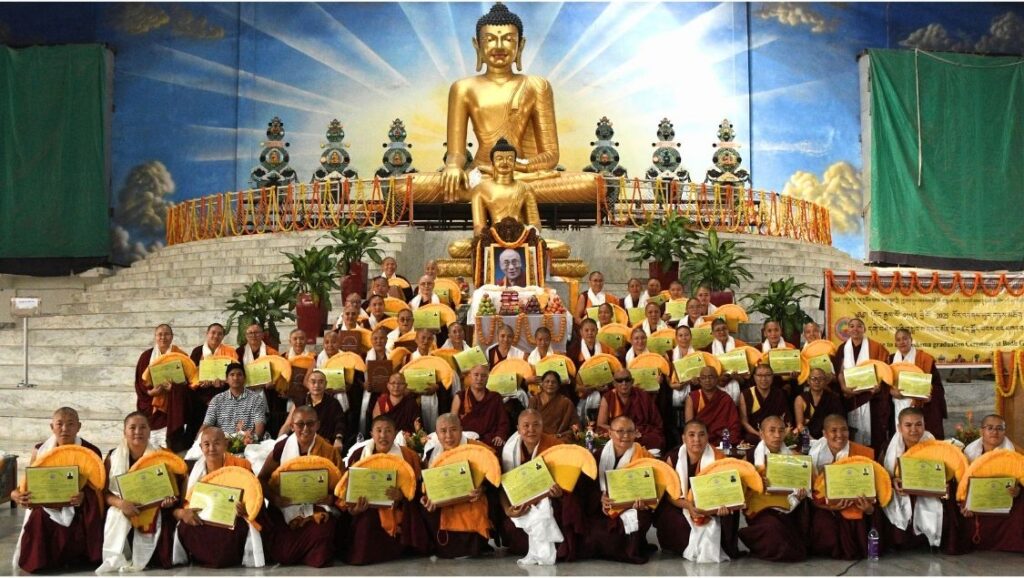
47 Geshemas graduated in November 2025

Congratulations to the 47 Tibetan Buddhist nuns who graduated in November 2025 as Geshemas.

In this blog post, we share photos taken by the Dolma Ling Media Nuns of the special event and news of the annual inter-nunnery debate, the Jang Gonchoe, which started 30 years ago in 1995.

Record Number of Nuns Earn Geshema Degrees

In the summer of 2025, a record number of nuns took various levels of exams for the Geshema degree, equivalent to a PhD in Tibetan Buddhist philosophy. The rigorous written and oral are completed over four years, with one set held each year. To be eligible to take their Geshema exams, the nuns must first complete at least 17 years of study.
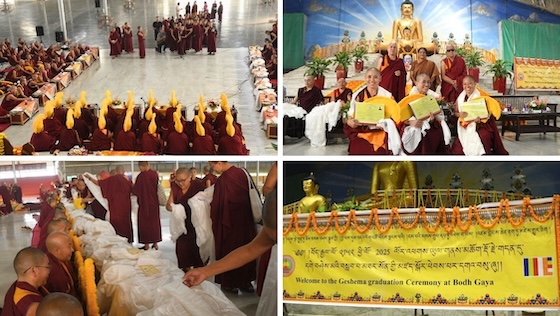
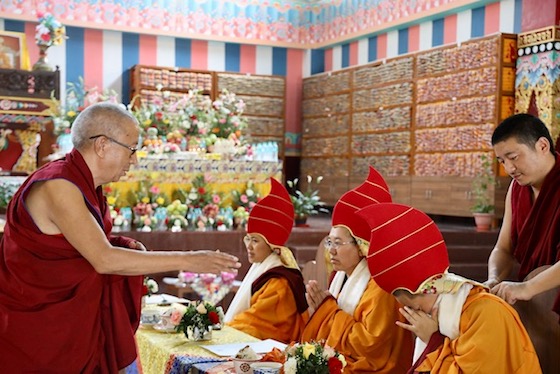
A collage showing parts of the Geshema graduation ceremony in November 2025. Elements include an oath-taking ceremony and a special debate event followed by a traditional khata (scarf)offering ceremony.

A collage showing parts of the Geshema graduation ceremony in November 2025. Elements include an oath-taking ceremony and a special debate event, followed by a traditional khata (scarf) offering ceremony.

The Geshemas are paving the way for other nuns to follow in their footsteps. The momentum is building. Not long ago, this increased status of nuns was almost unimaginable. We are so grateful for your support to educate and empower these dedicated women!
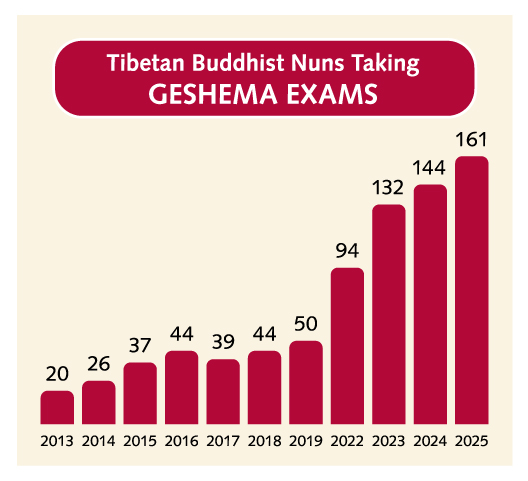
Geshema exams chart 2025

2025 marks another new record for nuns taking various levels of the 4-year Geshema exams. The degree was only opened to women in 2012. No exams were held in 2020 or 2021 due to COVID.

The exams were hosted this year by Dolma Ling Nunnery and Institute near Dharamsala from July 21 to August 16, 2025. The costs of the nuns’ travel, food, and the exam process were once again covered by the Tibetan Nuns Project’s Geshema Endowment Fund.

In November, the Jang Gonchoe closing ceremony and Geshema certification were held on the same day, attended by chief guests Dr. Mahashweta Maharathi, Secretary of the Bodh Gaya Temple Management Committee and Gen Tenzin la from Namgyal Monastery in Dharamsala.

Here’s a list of the Geshema graduations since the formal approval in 2012:

The Annual Inter-Nunnery Debate

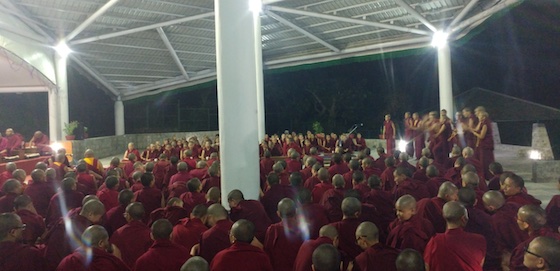
From October 5th to November 8th, 460 nuns and 23 teachers from 10 Tibetan Buddhist nunneries in India and Nepal gathered in Bodh Gaya for one month of intensive training in monastic debate.
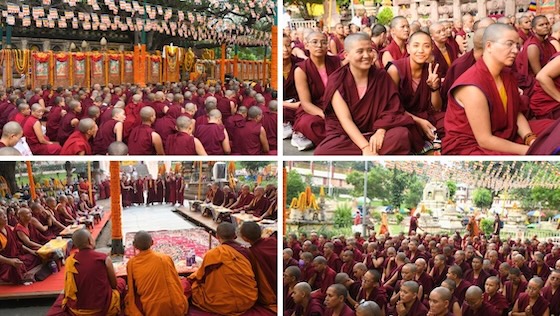
Tibetan Buddhist nuns from India and Nepal practice debating at the Mahabodhi Temple

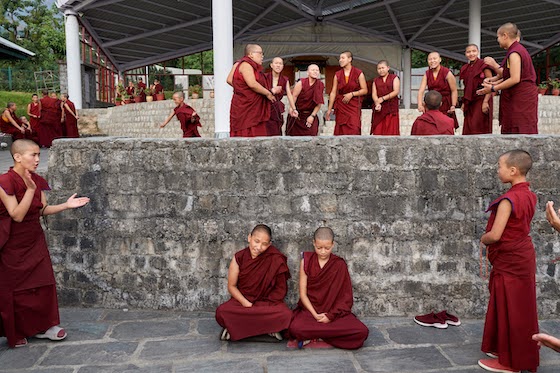
Tibetan Buddhist nuns from India and Nepal practice debating at the Mahabodhi Temple (literally the “Great Awakening Temple”) in Bodh Gaya, marking the location where the Buddha attained enlightenment.

Monastic debate is of critical importance in traditional Tibetan Buddhist learning. Through debate, nuns test and consolidate their classroom learning.
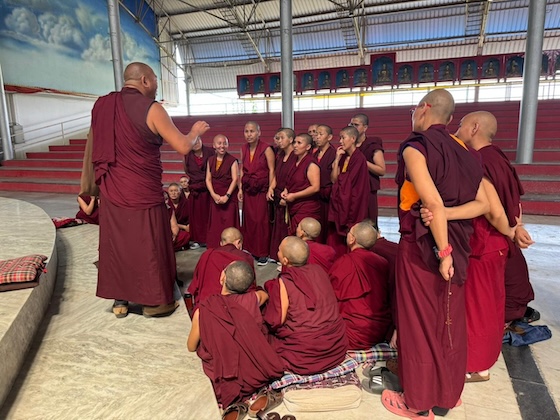
inter-nunnery debate in Bodh Gaya 2025 with Tibetan Buddhist nuns

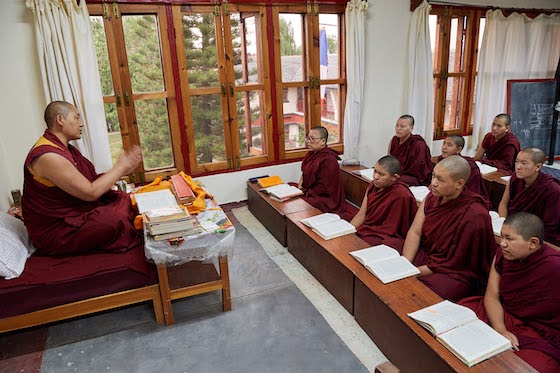
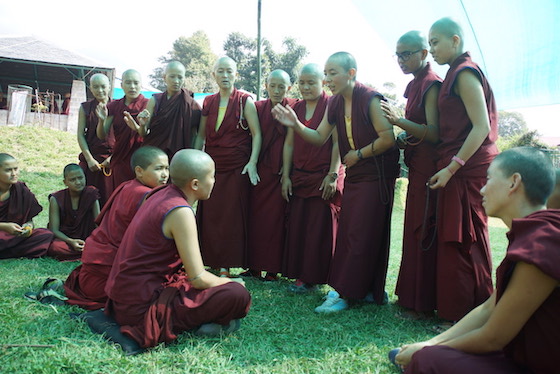
A teacher guides Tibetan Buddhist nuns during their month-long intensive training in monastic debate in Bodh Gaya. 2025 marks the 30th anniversary of the start of the Jang Gonchoe for nuns in 1995.

Although the nuns practice debate daily at their nunneries, the annual Jang Gonchoe debate event provides essential training and practice that is vital for those who wish to pursue higher degrees. The nuns are very grateful to the Kagyu Monlam Office for lending the space since 2019 to the nunneries during Jang Gonchoe and for their continued support.

At the Jang Gonchoe, the nuns take part in structured debate sessions with individual and class-wide debates, followed by an evening inter-nunnery session where two nuns answer questions from a team from another nunnery. Debate strengthens reasoning skills, confidence, and understanding of Buddhist studies.

The inter-nunnery debate helps bring the nuns closer to equality with the monks in terms of learning opportunities and advancement along the spiritual path.

This year, nuns from these 10 nunneries participated:
1.    Geden Choeling: 3 teachers + 64 nuns = 67
2.    Jamyang Choeling: 2 teachers + 37 nuns = 39
3.    Dolma Ling: 3 teachers + 92 nuns = 95
4.    Jangchub Choeling: 4 teachers + 77 nuns = 81
5.    Kachoe Gakyil Ling: 4 teachers + 64 nuns = 68
6.    Thukche Choeling: 2 teachers + 32 nuns = 34
7.    Jangsemling: 1 teacher + 17 nuns = 18
8.    Jampa Choeling – 1 teacher + 11 nuns = 12
9.    Yangchen Choeling : 1 teacher + 26 nuns = 27
10. Sherab Choeling: 2 teachers + 39 nuns = 41
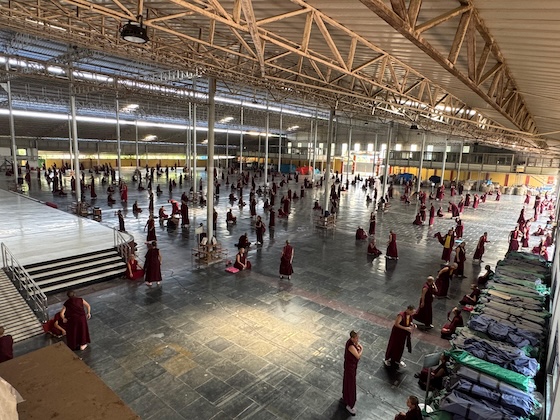
Annual internunnery debate in Bodh Gaya 2025, Jang Gonchoe

Nuns practice monastic debate in pairs and groups during the month-long Jang Gonchoe. The nuns expressed appreciation to the Kagyu Monlam Office for lending the space in Bodh Gaya for the Jang Gonchoe since 2019 and for their continued support.

1995-2025: The 30th Anniversary of the Inter-Nunnery Debate

The Jang Gonchoe for nuns was first initiated in 1995, making this year its 30th anniversary, though there was a year-long gap during the Covid pandemic when the event could not take place. Because of that missed year, the nuns’ committee has decided to count this as the 29th Jang Gonchoe instead of the 30th.
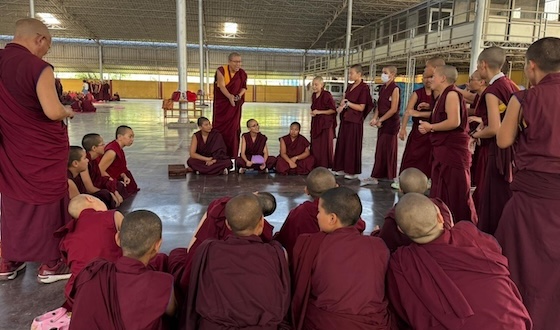
Jang Gonchoe inter nunnery debate 2025 in Bodh Gaya 2

The inter-nunnery debate has been supported since 1997 by the Tibetan Nuns Project through our Jang Gonchoe Endowment Fund. Now we want to put more of our core programs on a sustainable footing with our Long-Term Stability Fund.

Before 1995, there was no Jang Gonchoe for nuns and this learning opportunity was only open to monks. The Tibetan Nuns Project, with the wonderful support of His Holiness the Dalai Lama, played a critical role in opening up this learning opportunity to women. Establishing a comparable debate session for nuns has been an integral part of the nuns reaching their current level of excellence in their studies.

The inter-nunnery debate has been supported since 1997 by the Tibetan Nuns Project. Our Jang Gonchoe Endowment Fund covers costs such as transportation, food, and accommodation for the nuns and teachers who wish to attend.

The following video is a great primer on Tibetan Buddhist debate by nuns. It’s taken from a longer video made by the nuns at Dolma Ling Nunnery in northern India. It answers many of the frequently asked questions about Tibetan Buddhist debate, such as the meaning of the hand movements.

Can’t see the video? Click here.

Nuns Learning Tibetan Buddhist Debate

“It all happened because of the kindness, generosity, and genuine concern shown by all the wonderful donors who supported us for so many years,” said Rinchen Khando Choegyal, Founding Director and Special Advisor to the Tibetan Nuns Project, in a past interview.

“Much as we had the blessings from His Holiness the Dalai Lama and the vision, determination, and courage to pursue this matter to the full, without their generosity we would not have been able to have the Jang Gonchoe every year, which was and is the moving force behind every step of progress in education the nuns have made,” she said.
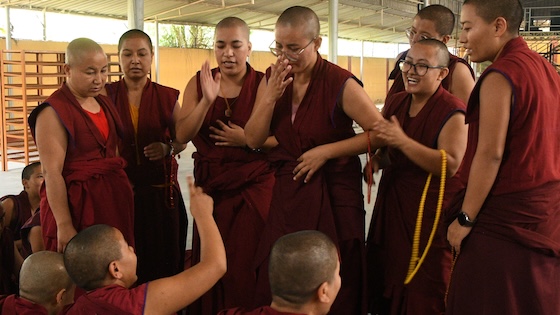
Tibetan Buddhist nuns debating 2025

In 2025, 460 nuns from ten nunneries took part in the annual inter-nunnery debate, the Jang Gonchoe. The event began in 1995. Prior to that, nuns did not have this opportunity.

His Holiness the Dalai Lama has often spoken of the need to examine the teachings of the Buddha closely and with an inquisitive mind. “This is the 21st century and we need to understand the Buddha’s teachings in the light of reason. When we teach, we need to do so on the basis of reason,” His Holiness the Dalai Lama told the nuns at the end of the 2014 Jang Gonchoe.

His Holiness added, “Nowadays, the Nalanda tradition of approaching the Buddha’s teachings with logic and reason is only found amongst Tibetans. It’s something precious we can be proud of and should strive to preserve.”
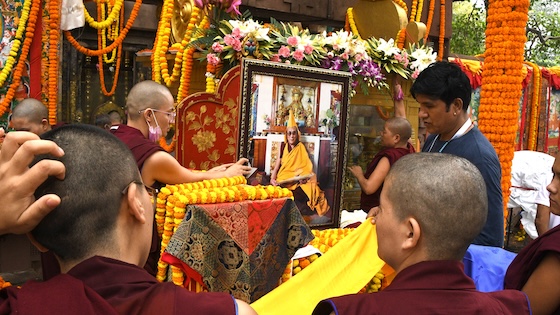
A portrait of His Holiness the Dalai Lama is placed at the Mahabodhi Temple in Bodh Gaya, marking the place where the Buddha attained enlightenment.

A portrait of His Holiness the Dalai Lama is placed at the Mahabodhi Temple in Bodh Gaya, marking the place where the Buddha attained enlightenment. His Holiness the Dalai Lama is the patron of the Tibetan Nuns Project.

Support Long-Term Stability

The annual Geshema exams and the inter-nunnery debate are both funded by endowments and are now self-sustaining thanks to our generous supporters.

We are extremely grateful to the 159 donors to the Geshema Endowment, including the Pema Chodron Foundation, the Pierre and Pamela Omidyar Fund of the Silicon Valley Community Foundation, the Frederick Family Foundation, and the Donaldson Charitable Trust. We are also very grateful to all those who sponsor nuns and help them on their path.

Now we want to put more of our core programs on a sustainable footing with our Long-Term Stability Fund. Thank you for supporting this vision. You can learn more and donate here.
 

Investing in the Future of Humanity

This is a special blog post by Steve Wilhelm, a Tibetan Nuns Project board member since 2008, a dharma teacher, and editor of Northwest Dharma News.

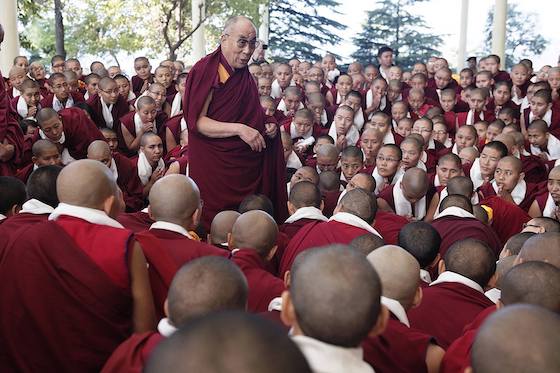
Tibetan Buddhist nuns with His Holiness the Dalai Lama 2013

His Holiness the Dalai Lama speaking to Tibetan Buddhist nuns from India and Nepal, after they debated in front of him during the annual inter-nunnery debate in 2013. Photo by Tenzin Choejor/OHHDL

When I first arrived at Dolma Ling Nunnery in 2014, on my first visit there, I heard distant shouts in the night air.

Looking east, I saw lights against the dark sky and assumed it was a soccer game or something similar somewhere just outside the nunnery. Being a curious sort I went to investigate, and to my surprise found not a lively athletic event but 40 to 50 nuns vigorously engaged in debate.

Tibetan Buddhist nuns debating at Dolma Ling Nunnery by Steve Wilhelm

Daily practice in monastic debate is critically important in traditional Tibetan Buddhist learning. Photo of Tibetan Buddhist nuns debating at Dolma Ling Nunnery by Steve Wilhelm.

Outdoors in the fall air, under metal canopies funded by donors from around the world, the nuns energetically debated subtle points about the very nature of reality. In groups of three or four, a standing nun would challenge one sitting in what was obviously brilliant repartee.

Debate practice is a central part of Buddhist practice in this tradition. In this, the nuns study a concept or text in the morning and then debate it later in the day.

A central and vivid quality of what I saw that night, and in many other encounters during this visit and a later one in 2017, was the energy and determination of the nuns.

Many times I’d encounter a nun late at night, studying under the light of an outdoor walking path light. Often they were sitting on the ground and hunched over a text, memorizing or reciting.

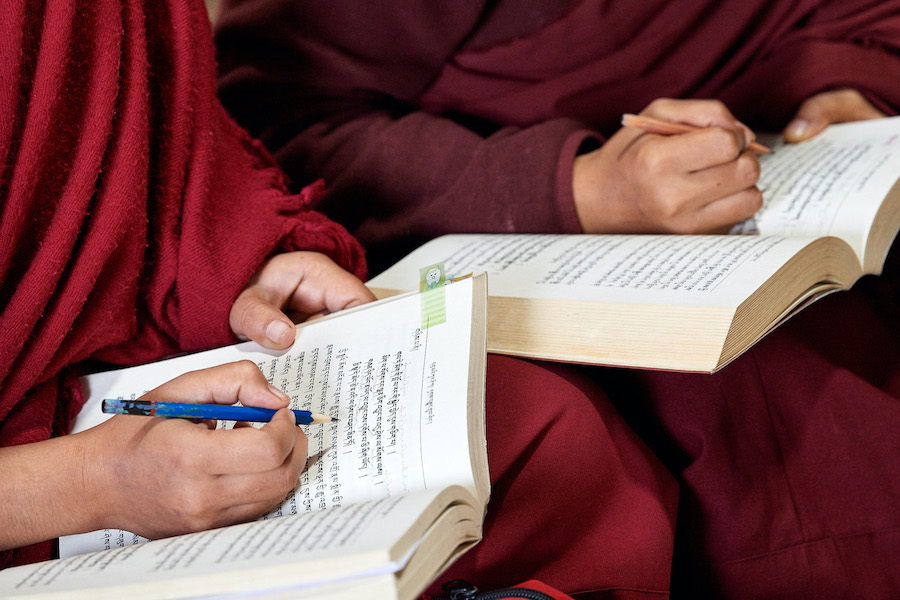
Two Tibetan Buddhist nuns studying together.

Two Tibetan Buddhist nuns studying together. Photo courtesy of Olivier Adam.

In this way, these nuns were taking advantage of the precious opportunity they have for spiritual growth, which includes growing in the capacity to benefit others.

Investing in the Future of Humanity

It was just this dedication and the potential for these nuns to benefit many beings far into the future, which inspired me to leave a bequest for the Tibetan Nuns Project in my will.

Supporting the future of the Tibetan Nuns Project, and in turn nurturing the future of the nuns that the Tibetan Nuns Project supports, seems one of the best possible investments in the future of humanity.

The world is in a perilous condition here in 2025, with too many national leaders, almost exclusively male, filled with too much hubris around power and strength.

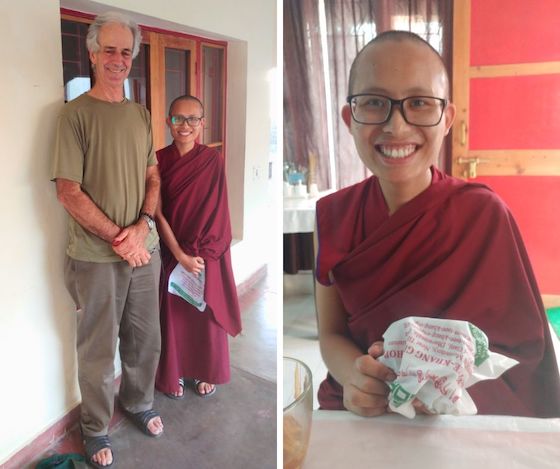
Steve Wilhelm and the Tibetan Buddhist nun he and his partner Ellen sponsor

Steve and Dechen, the nun he and his wife Ellen sponsor. “Dechen embodies the nuns’ promise for the future and wants to become a Geshema,” says Steve. Photos by Steve Wilhelm

By comparison, these nuns are deeply dedicated to spiritual practice, to refining themselves in a perfection of ethics, kindness, and wisdom. These are qualities deeply needed in this compromised era. These nuns will set an example, a standard, for generations to come and especially for future young people.

In addition, it simply seems that we need more women in leadership in every aspect of society, to bring more compassion into decisions of global import. The growing number of Buddhist nuns around the world is a key part of that empowerment, and the Tibetan Nuns Project has been a leader in this work.

The Tibetan Nuns Project has supported nuns in their education and their practice, and in their attaining Geshema degrees, the monastic equivalent of a doctorate degree.

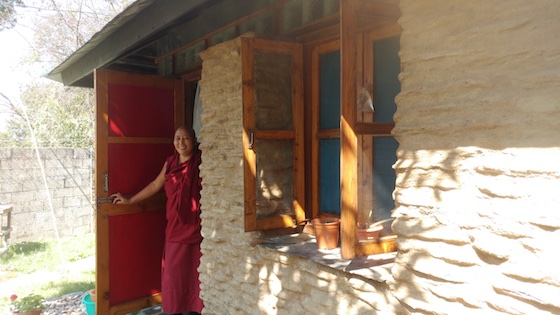
A Geshema nun practicing retreat at hut at Dolma Ling photo by Steve Wilhelm

A Geshema nun practicing in a retreat hut at Dolma Ling. The Geshema degree is the highest level of training in the Gelug tradition and was only formally opened to women in 2012. Photo by Steve Wilhelm.

These Geshema degrees put the nuns on an equal footing with the most educated male monastics and empower them to teach other nuns in the future. The difference is a profound transformation, ending 1,200 years of sexist bias in which only male monastics could reach this highest level of accreditation.

Added up, these factors are why my wife Ellen and I have dedicated a portion of our legacy, in my will, to the Tibetan Nuns Project.

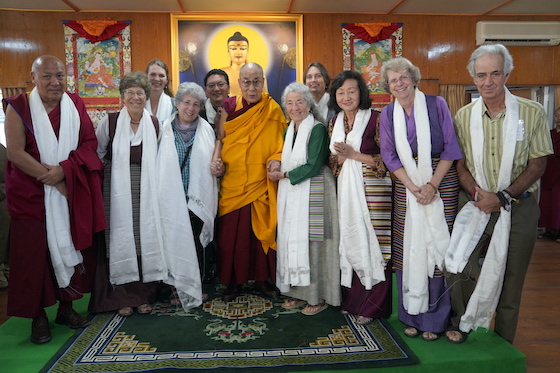
Tibetan Nuns Project board of directors in 2017

The Tibetan Nuns Project’s 2017 board of directors had an audience with His Holiness the Dalai Lama during the 30th anniversary celebrations. Steve is on the right.

I’ve served on the board of the Tibetan Nuns Project since 2008 because it’s been continually clear just how important this work is. Now adding a donation to the Tibetan Nuns Project as a legacy in my will means that this kindness and generosity will continue long after I am gone.

If you are so moved, please do the same. You can learn more about leaving a legacy to help the nuns here.

Educating and Empowering Tibetan Buddhist Nuns

Education is the Key

The Tibetan Nuns Project believes that education is the key to empowerment. We seek to give Tibetan Buddhist nuns the resources to carve out independent, creative identities for themselves. In this blog post, we’ll explain what and how the nuns study and give an outline of their degrees and curriculum.

Through all its work, the Tibetan Nuns Project is strengthening Tibet’s unique religion and culture — both under great threat due to the occupation of Tibet — by educating and empowering women. These dedicated women were previously denied equal access to education and the opportunity in Tibet to freely and safely practice their faith. The nuns are an integral part of the spiritual roots of the society and are teachers and leaders of the future.

Starting from Scratch

When the Tibetan Nuns Project was founded in 1987 in response to many nuns escaping from Tibet to India, most of the newly arrived nuns had no education in their language. Many were illiterate and were unable even to write their names. While in Tibet they had also been denied education in their religious heritage.

outside classroom, Tibetan Buddhist nuns, educating Tibetan Buddhist nuns

An outside classroom in the early days of the Tibetan Nuns Project. TNP had to create an education program for the nuns from the ground up.

The Tibetan Nuns Project has created a groundbreaking education system aimed at both preserving Tibetan culture and equipping and empowering these women to live and become leaders in the modern world.

The Tibetan Nuns Project aims:
– To combine traditional religious studies with the best of a modern education
– To preserve Tibet’s rich culture and religion through giving ordained Buddhist women educational opportunities
– To elevate the educational standards and the position of women within the monastic community.
– To prepare the nuns for positions of leadership and moral authority in a culture that is going through a very challenging transition
– To support a number of nuns who opt to live in meditative retreat rather than in a nunnery.

The Tibetan Nuns Project also serves women from the remote and impoverished border areas of India such as Ladakh, Zanskar, Spiti, and Arunachal Pradesh. The women and girls from these areas have traditionally been given far less education than the men and boys and were often removed from school as early as Grade 4 if they were sent to school at all. Our programs give them a chance for education that they would not have otherwise.

educating girls, educating women, empowering women and girls, Zanskar, Spiti

Photos by Olivier Adam showing girls receiving education at nunneries supported by TNP in the remote Spiti Valley (top) and Zanskar (bottom). Girls and women in these regions lack equal access to education.

Since the Tibetan Nuns Project was founded in 1987, many nuns have been educated and have assumed leadership roles in their community, such as teachers in Tibetan schools, instructors for other nuns, health care providers and other roles serving the Tibetan-exile community. Thanks in part to consistent effort from the Tibetan Nuns Project, for the first time in Tibetan history, nuns are now receiving educational opportunities previously available only to monks.

educating and empowering women, educating women, Geshema teaching, Geshemas, Dolma Ling

In May 2023, Geshema Delek Wangmo (shown) and Geshema Tenzin Kunsel gave online teaching via Facebook Live with help from two Dolma Ling media nuns. Geshemas from other nunneries also attended to learn how to deliver such basic philosophical knowledge to the lay community. Photo courtesy of the Dolma Ling Media Nuns.

Another goal of the Tibetan Nuns Project is to empower nuns to teach Buddhist philosophy in nunneries and schools. To do this, the nuns must achieve equal academic standing with the monks, proving their qualifications by earning the highest degrees. For monks, depending on their tradition, these degrees are called the Geshe or Khenpo degrees; for nuns, the equivalents are the Geshema or Khenmo degrees.

Geshemas teaching Tibetan children, compassion in action, Tibetan education, Dolma Ling

Wisdom and compassion. The Geshemas at Dolma Ling teach Tibetan refugee children during the children’s school holidays. Photos by the Dolma Ling Media Nuns.

The Curriculum

The education program varies by nunnery but the nuns have been introduced to a systematic form of education in their respective nunneries. Though their core subject is Buddhist philosophy they have also been equally educated in Tibetan and English languages since the very beginning. The nuns have built up a strong foundation in Tibetan language over the years.

The curriculum at the nunneries is divided into two parts: (1) secular subjects such as the Tibetan language, Tibetan history, English, social sciences, mathematics, and science and (2) monastic education. The nuns have quizzes and exams and are now able to proceed through a degree-granting program. If the nuns are very young as may be the case in the very remote nunneries, they do not receive teaching in philosophy, but rather a basic education in subjects like reading, writing, and arithmetic. Once that is established a more robust curriculum is used.

education and empowering Tibetan Buddhist nuns, educating women, classroom Dolma Ling Nunnery

Geshema Tenzin Kunsel teaching Tibetan Buddhist nuns at Dolma Ling Nunnery. Photo by Olivier Adam

Most courses take place in classrooms, much as in a school, except for the practice of monastic debate, which takes place in the open air.  As part of their monastic education the nuns are also instructed in the performance of ritual music, the creation of butter sculptures, and other Tibetan Buddhist ritual arts.

The curriculum of the nunneries varies depending on which of the four main schools of Tibetan Buddhism the nunnery follows:
– Nyingma (founded in the 8th century)
– Kagyu (founded in the early 11th century)
– Sakya (founded in 1073)
– Gelug (founded in 1409)
The Tibetan Nuns Project supports nuns from all four traditions.

Tibetan debate, monastic debate, Dolma Ling Nunnery

Tibetan Buddhist nuns practice monastic debate each day at Dolma Ling Nunnery and Institute. Through debate, nuns and monks test and consolidate their classroom learning and gain a thorough understanding of the Buddhist teachings. Photo by Olivier Adam.

The Gelukpa monastic curriculum in Dolma Ling for example is as follows:
Preliminary studies: 4 years
Perfection of Wisdom: 7 years
Middle Path: 3 years
Phenomenology or “meta-doctrine”: 3 years
Monastic discipline: 1 year

After about ten years, the nuns receive a first diploma called Parchin which is equivalent to a BA and allows the students who so desire to continue to higher studies. The Geshema degree is the highest level of training in the Gelugpa tradition and is equivalent to a PhD in Tibetan Buddhism. The degree was only formally opened to women in 2012 thanks to the work of the Tibetan Nuns Project.

Khenmo enthronement, Sakya College for Nuns, Tibetan Buddhist nuns, Buddhist women teachers

In 2022, Tibetan Buddhist nuns made history as the first group of Khenmos were enthroned at Sakya College for Nuns. The Khenmo degree for nuns, like the Khenpo degree for males, is roughly equivalent to a PhD. In the Nyingma, Kagyu, and Sakya traditions, the title is awarded usually after 13 years of intensive post-secondary study. The comparable title in the Gelug and Bon lineages is Geshe or, for nuns, Geshema.

In the Nyingma, Kagyu, and Sakya traditions, the Khenmo degree for nuns, like the Khenpo degree for males, is roughly equivalent to a PhD. This title is awarded usually after 13 years of intensive post-secondary study. A nun who holds the title Khenmo is recognized as a female Buddhist teacher/scholar who can give official and high-level teachings to nuns.

Reacing the highest degrees in the monastic curriculum takes between 20 and 25 years. Our goal is to support nuns’ education and to enable them to progress to higher degrees such as the Geshema and Khenmo degrees if they so wish.

Thank you for supporting the Tibetan Nuns Project and educating and empowering Tibetan Buddhist nuns!

Debate Courtyard Expansion Completed!

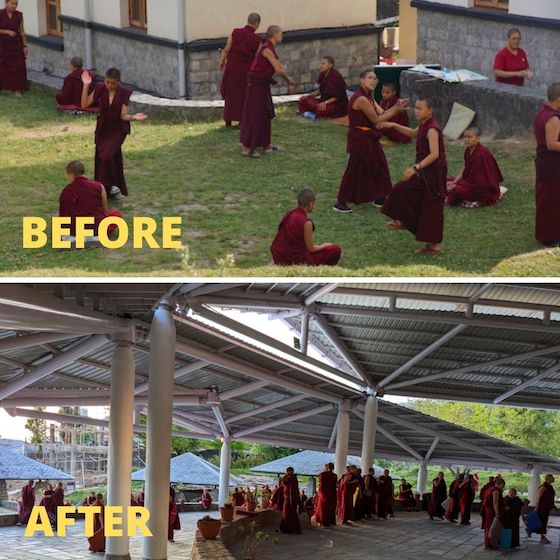
We are very pleased to report that the debate courtyard expansion at Dolma Ling Nunnery and Institute is now complete. The improved courtyard provides an additional 2,500 square feet of covered area. With 60% more covered area than the old debate courtyard, all the nuns can have shelter as they practice daily monastic debate.

This big project was kindly funded by Tibetan Nuns Project donors. We are extremely grateful to the donors and the entire team for their hard work and dedication which has resulted in this elegant structure, totally in keeping with the original design.

Tibetan Buddhist nuns debating at Dolma Ling Nunnery and Institute

Before the debate courtyard was expanded there was not enough sheltered space for the nuns to debate. The improved courtyard has an additional 2,500 square feet of covered space along with other improvements such as sliding windows on the back and sides of the courtyard to prevent rain coming in.

The nuns are already using the courtyard for their daily debates. Monastic debate is of critical importance in traditional Tibetan Buddhist learning. Through debate, nuns test and consolidate their classroom learning. Without training and practice in debate they are unable to attain higher academic degrees such as the Geshema degree.

The Impact of the Improved Debate Courtyard

In the spring of 2022 the Tibetan Nuns Project launched a fundraising campaign to expand and improve the debate courtyard at Dolma Ling.

Over the years, the number of nuns at this large non-sectarian nunnery increased to over 260 nuns. The existing debate courtyard was too small and at least two-thirds of the paved area was open to the elements, so many nuns were forced to debate in the open under the hot sun. When it rained, as it does throughout the summer monsoon season, the unprotected space was unusable.

Tibetan Buddhist nuns practicing monastic debate under tarp at Dolma Ling Nunnery and Institute

In an attempt to create more shelter the nuns have been stringing up tarps for years as they practice monastic debate. The area near Dharamsala experiences one of the heaviest monsoons in India and the sun is also fierce.

During their debate sessions, pairs of nuns spread out across the courtyards and even onto the adjoining grassy areas and steps. Some distance is required between the pairs or groups of challengers and responders. The aim of the project was to provide enough covered space to shelter the nuns as they do their daily practice of Tibetan monastic debate.

Work on the courtyard began in January 2022. The first phase involved protecting the upper courtyard from rain by enclosing the back and sides with sliding windows that can open to allow ventilation during the hot season.

Debate Courtyard Expansion project at Dolma Ling Nunnery and Institute

Work on Phase 1 to improve the debate facilities at Dolma Ling. This part of the project involved enclosing the back and sides of the existing debate courtyard to prevent rain coming in.

The steel roofing over the upper section was also extended on all four sides to prevent rain from blowing in. Finally, an additional row of stone seating was added at the back and sides of the courtyard in front of the windows.

Olivier Adam photo of Tibetan Buddhist nuns debating at Dolma Ling Nunnery

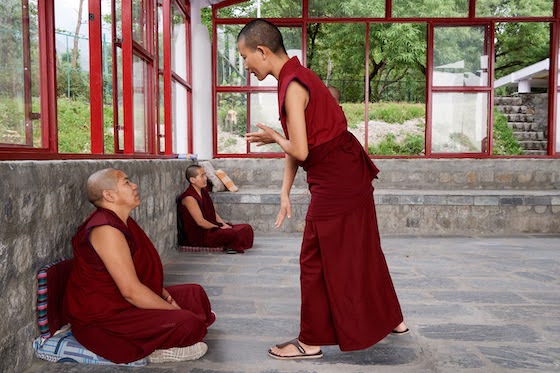
Nuns debating in front of the new windows at the back of the debate courtyard. Because of its reputation for providing excellent teachers and the best facilities for nuns to study, the number of nuns applying to join Dolma Ling has increased substantially. In 2022, 32 nuns joined the nunnery. Photo courtesy of Olivier Adam

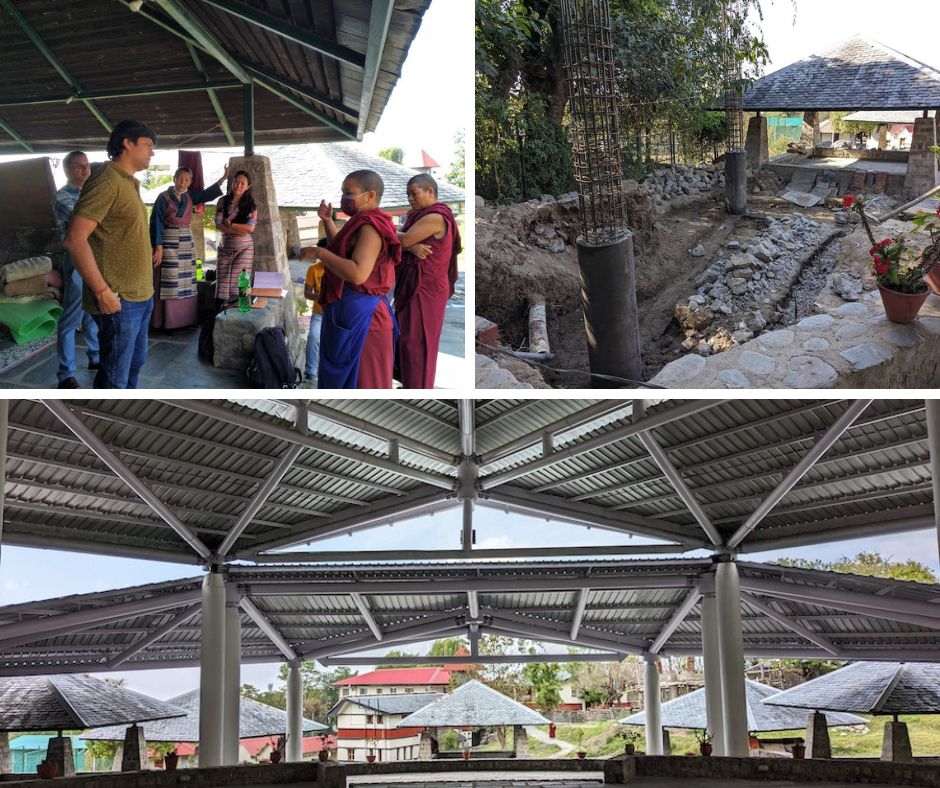
In the early autumn of 2022, the Tibetan Nuns Project office in India signed a contract with the contractors for Phase 2 of the expansion project. On September 29th, the architect for the project came to assist the contractor with the positioning of the 8 new pillars for the extension roof.

debate courtyard at Dolma Ling Nunnery

Phase 2 of the debate courtyard expansion began in October 2022 and involved excavating and building 8 more columns and extending the roof.

The nuns were very involved in the design of the new space and in discussions with the architect and engineers. Building specifications for this high-risk seismic zone were made and the extension complies with current building standards. In addition to the eight new columns, there had to be tie beams and two additional below-ground-level columns because they are building in previously filled land.

The Important of Tibetan Buddhist Debate

Dolma Ling is unique because it offers a 17-year curriculum of traditional Buddhist philosophy and debate, as well as modern courses in Tibetan language, English, basic mathematics, science and computer skills. Training in Buddhist debate, the extensively practised method for examining philosophical, moral and doctrinal issues, is an essential part of monastic education in the Tibetan tradition.

Until recently, Tibetan nuns did not have the opportunity to fully study and practise Tibetan Buddhist debate, a process that uses logical enquiry to build a deeper understanding of Buddhist philosophy. The Tibetan Nuns Project has worked hard to make this opportunity available to nuns by including debate as a core part of their education, which enables them to extend their use of logic and deepen their understanding of the arguments asserted in the texts they are studying.

monastic debate, Tibetan Buddhist nuns debating, Buddhist debate

Before: Tibetan nuns practice debate on the grass under a makeshift shelter of netting. Since the Tibetan Nuns Project was founded in 1987, nuns are training in debate for the first time in the history of Tibet.

“Opening up education to the women, particularly in conjunction with training in debate, has been transformative for the nuns,” says Dr. Elizabeth Napper, US Founder and Board Chair of the Tibetan Nuns Project. “Not only have they been given access to the full intellectual richness of their Buddhist tradition but also, through debate, they have been trained to actively engage with it in a way that gives them confidence in their knowledge. Their body language changes from the traditional meekness of nuns to that of women who occupy space with confidence in their right to do so.”

The practice of debate takes many years to master fully and is critical to the nuns’ ability to assume roles as fully qualified teachers of their tradition.

We are very grateful to everyone who has contributed to providing this unique opportunity to build capacity and equality for the nuns, to help ensure that a centuries-old tradition of learning continues to expand to include more nuns, and to foster the dharma for future generations.

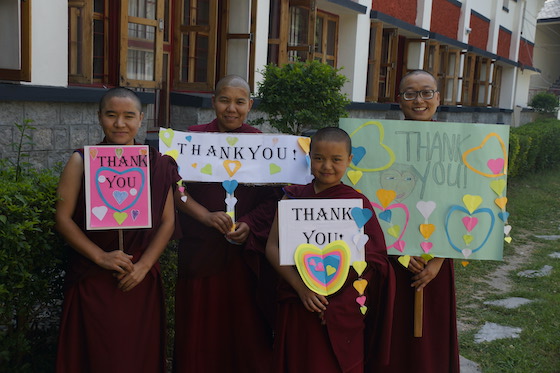
Tibetan Buddhist Nuns holding thank you signs