Interview with a Tibetan Buddhist Nun

Venerable Tenzin P. studied at Dolma Ling Nunnery and Institute from 1990 to 2009 and then trained to become a teacher of Buddhist philosophy. In 2009 she began teaching at the Central School for Tibetans in a Tibetan settlement called Hunsur. She is now fully self-supporting from her teacher’s salary. Venerable Tenzin P. is one of 29 nuns who sat Geshema exams in May 2014.

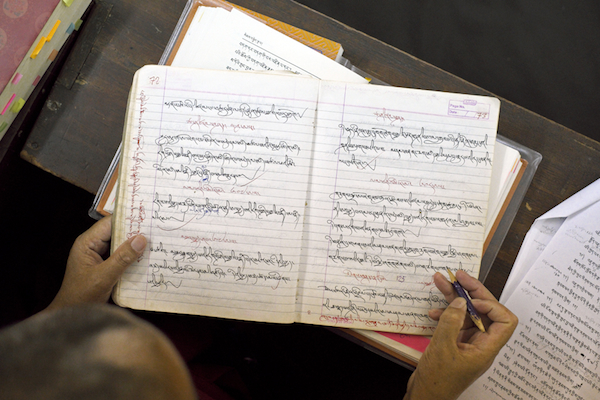
detailed photo of Tibetan writing in A Tibetan nun's notebook at Dolma Ling Nunnery and Institute

A Tibetan nun’s notebook at Dolma Ling Nunnery and Institute. Photo courtesy of Brian Harris.

Here’s an interview conducted in the spring of 2014:

I came from Tibet in 1990 and got this rare opportunity to study in Dolma Ling Nunnery. In 2009, the Department of Education [of the Central Tibetan Administration in Dharamsala, India] had facilitated a competition for the Religious Teacher’s post from which I was selected. I had to leave the nunnery for three-months training to become a qualified religious teacher at a school. After completing my training successfully, I was sent to Hunsur Tibetan Settlement as a religious teacher where I have been working for over five years. Since last year, His Holiness the Dalai Lama has gifted the nuns with the opportunity to acquire Geshema degree. Because of this I got really inspired and applied for this examination. This is the second year of my Geshema examination.

sashes around waist of Tibetan Buddhist nun

Sashes around the waist of a Tibetan Buddhist nun. Photo courtesy of Brian Harris.

Q: How has being at the nunnery made a difference in your life?

A: Before coming into exile, I was nun just in a namesake. Back in Tibet, we do not have an opportunity to study and go into the depth of Buddhist studies like we do at the nunneries in India. So I escaped from Tibet with the hope that I would get a much better and proper education from all aspects. After reaching India, I was admitted to Dolma Ling Nunnery to study here. Whatever I am today is all because of the opportunity I got here at the nunnery and the support extended by the sponsors.

If you really commit to do something, no one can stop you from achieving your goal. And there is nothing you cant do if you have the will power.

Q: If you could speak directly to the sponsor who is helping you get education, food and health care at the nunnery, what would you say to that person?

A: They are extremely generous and amazing. I would like to give the example of my own sponsor, Lynda K_____ [surname removed for privacy reasons] from the USA. She sponsored me from the time I escaped to India in 1990 until I left Dolma Ling Nunnery in 2009. I was extremely surprised as well as blessed when she asked me whether I needed her support even after getting a dignified job. She has never seen me, never heard my voice, never seen me growing up, but still she helped me for almost half a decade I should say. I am sure that the case is the same for all sponsors who have helped nuns at the nunneries.

Sometimes I feel sad thinking that I can’t even talk with her sweetly and thank her personally for whatever she has done for me in the past years. I always wished to meet her at least once. If I ever happen to meet her, I will really be fortunate and will welcome her my like my own mother.

Last but not least, I would like to sincerely thank all our sponsors for their continuous and generous support.

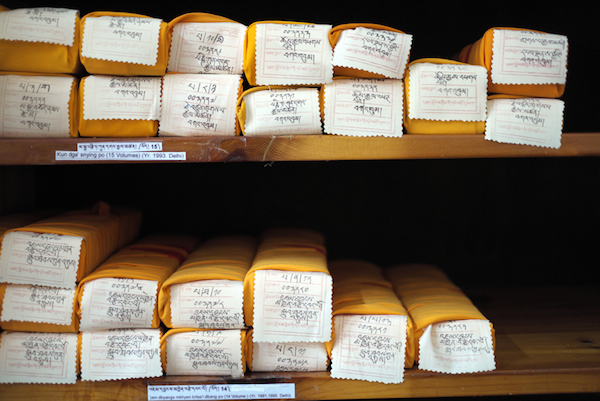
Tibetan Buddhist texts at Dolma Ling Nunnery.

Tibetan Buddhist texts at Dolma Ling Nunnery. Photo courtesy of Brian Harris

Q: What do you think is special about this moment in history of Tibetan nuns of your nunnery and why?

A: In the past, we have always thought that pursuing the Geshema qualification is nearly impossible and is not our cup of tea. After sitting and passing the first year of the Geshema exams, I strongly felt that it is our mentality that makes everything seem difficult. If you have the willpower, commitment and dedication, nothing is impossible. We nuns can also make our nunnery feel proud.

Q: How would you like to use the education that you are receiving at the nunnery?

A: With the grace and blessing of His Holiness the Dalai Lama, along with Ama Rinchen Khando Choegyal, I have such an incomparable opportunity to study and sit for the second year of the Geshema exams. His Holiness used to bless us with his words about getting enlightened and social service. I feel that doing social service is something I can do wholeheartedly for sure. It has been five years since I started working as a religious teacher and I never faced any problems while teaching my students.

Recently on January 10th, 2014, His Holiness the Dalai Lama visited our school and our students debated in front of him and appreciated what I taught them. His precious words have inspired and motivated me to continue to serve our community in a much better way.

Q: What is one thing you’d like Tibetan Nuns Project supporters to know about your life at the nunnery?

A: I really want the supporters to know that their generous support has and will never be in vain. When I first came to India and got admitted to the nunnery, I was not well versed like I am now. The level of education has become much higher, for which I feel is a huge success in my life.

Q: What has been the happiest day of your life?

A: I do not have a specific happiest day as such, but the day when I get to do everything according my plan, that day turns out to be meaningful and happy day for me.

Q: What are the benefits you get from education and being in the nunnery?

A: I have learned everything from the nunnery and it has given me a new life with a bright future. I learned how to communicate differently with various people in a much better way. I never had to face or struggle for basic needs like common people do. With the help of sponsors, our basic needs are fulfilled without any difficulty.

Q: What are the difficulties you face during your course of study?

A: [Laughs] Yes! We have many different subjects and so many things to learn. That is why we lack time to cover all the educational materials.

Global good wishes to the Geshema exam nuns

People from around the world have sent messages of good luck and support to the 29 nuns sitting their Geshema exams in India. The exams have taken place over the last two weeks and finish today, May 15th. The exams are the culmination of a rigorous 17-year course of study and are a landmark achievement for Tibetan women.

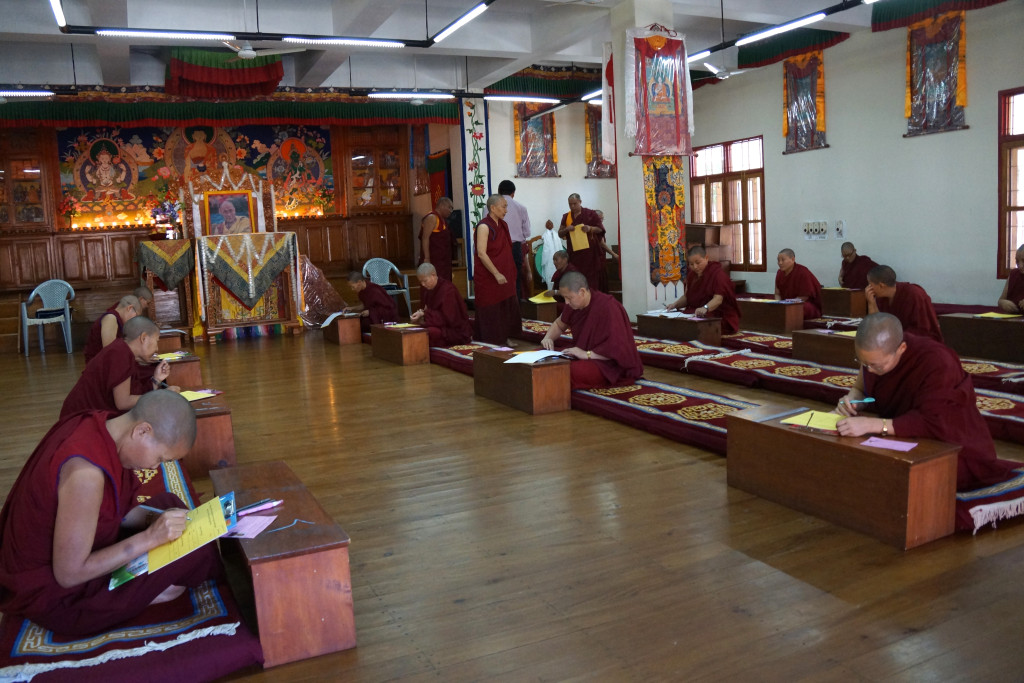
Tibetan Buddhist nuns and their teachers during oral examination Geshema exams 2014

A photograph taken during the oral examinations of the May 2014 Geshema exams for Tibetan Buddhist nuns

Twenty-nine Tibetan Buddhist nuns from various nunneries gathered for 1 month at Dolma Ling Nunnery and Institute in the Kangra Valley, near Dharamsala, northern India. During the last two weeks of April, the nuns took part in an intensive study session and then on May 1st they began their oral and written exams. This is only the second year that Geshema exams for Tibetan nuns have taken place. This year, 23 of the 29 nuns have been sitting Part 2 of the four-part exam, while 6 nuns have been taking Part 1.

Here are some of the many heartfelt messages that the nuns received via the Tibetan Nuns Project Facebook page:

Andrew from Canada wrote, “Good luck, just don’t be very nervous because you have worked so hard and you are wise and virtuous already.”

Rita from USA wrote, “I am so glad this day has come! No need to send you luck for it is your dedication and self-discipline that will bring you the success you deserve. I know you are all masters at meditation so I am confident that your minds will be clear and focused. I celebrate this day with each of you! The Buddha is smiling!
”

Ugyen, a Tibetan woman from Bhutan, said, “Best of luck !!! Very appreciative of His Holiness the Dalai Lama’s advocacy to change the landscape of religious education. Hope to see a lot more Geshemas.”

Colleen in Australia wrote, “Sending blessings to all participating in these exams that they may succeed in passing. Blessings also to all teachers involved with passing on their knowledge. May all children receive blessings of education, and may all beings be free from suffering.”

Barbara from New Mexico, sent this message, “Good luck, and though you are studying hard, be sure to take time to eat and sleep! All of us out here are wishing you the best!”

Marci from the USA sent these words, “We know you will all do well. Many blessings and much gratitude for your efforts, each and every one. May you attain enlightenment for the benefit of all beings.”

If you would like to see all the messages of good luck and support, join the Tibetan Nuns Project Facebook page.

Nuns reading messages of support to the Geshema candidates

Nuns reading messages of support from other nuns to the Geshema candidates

The nuns themselves also wrote and shared letters, poems and messages of support to their sisters writing the exams.

poem of good luck written in Tibetan by a Buddhist nun

A good luck poem written by a fellow nun and posted on the noticeboard of Dolma Ling Nunnery in support of the nuns taking their Geshema exams.


Tibetan Buddhist nuns sit Geshema exams

It’s exam time again and we’re excited to share our latest news and photos with you.

For one month, from April 15th to May 15th, 29 nuns from different nunneries will make history as they prepare for and sit their exams for their Geshema degree – the equivalent of a doctorate in Tibetan Buddhist Philosophy.

Geshema exams May 2014

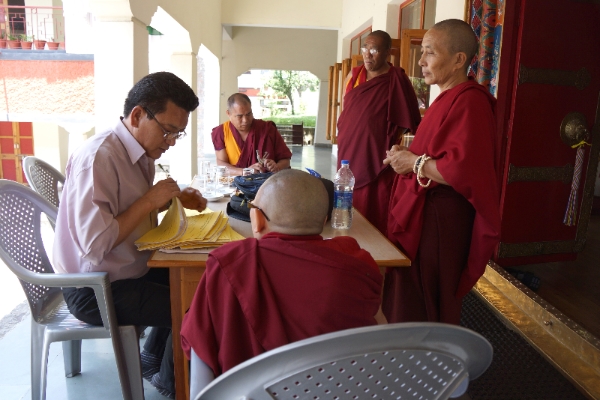
A nun doing her oral examination as part of the 2 weeks of Geshema exams in May 2014

This year 23 nuns will be sitting Part 2 of the exam while 6 nuns are taking Part 1. The first 2 weeks were an intensive study period, and the actual examinations began on May 1st.

The Geshema exams, which are a 4-year process are the culmination of a rigorous 17-year course of study and are a landmark achievement for Tibetan women.

Geshes, and soon also Geshemas, are the most educated monastics, carrying much of the responsibility for preserving and maintaining the Tibetan religion and culture. This will enable the nuns to take up leadership roles as educators for future generations of Buddhist practitioners.

Tibetan Buddhist nuns taking Geshema exams

The nuns who are taking their Geshema exams this May

Some of the nuns sitting the doctoral exams could not even write their own names when they escaped from Tibet. Your kindness and generosity have made possible their immense leap in capacity.

This would not have been possible without the support of His Holiness the Dalai Lama, the Department of Religion and Culture of the Tibetan government in exile, high lamas and teachers, and the compassion and generosity of Tibetan Nuns Project donors like you.

Nuns reading messages of support to the Geshema candidates

Nuns reading messages sent from their sister nuns giving best wishes to the Geshema candidates

Today we received photos of the noticeboard at Dolma Ling Nunnery and Institute where the nuns had been sharing messages of support and good wishes. In addition, the nuns have received about 100 heartfelt messages of support and good luck from around the world via the Tibetan Nuns Project Facebook page.

noticeboard at Dolma Ling with messages of support for Geshema candidates

We hope you will rejoice with us this historic milestone.

The role of teachers in empowering Tibetan Buddhist nuns

Education of Tibetan Buddhist nuns from all traditions is a core component of the work of the Tibetan Nuns Project. One way this is done is through the funding of teachers’ salaries.

Each year, the Tibetan Nuns Project seeks to fund the salaries of 10 to 15 teachers at different nunneries in India and Nepal. The annual cost of one teacher’s salary ranges from $1500 to $5000, depending on the location of the nunnery and the skills of the teacher, so the total annual budget for this program is approximately $40,000.

Monk teaching Tibetan Buddhist nuns by Brian Harris The ultimate goal is to empower the nuns to become teachers and leaders in their own right and to help preserve Tibet’s unique culture and religion. The Tibetan Nuns Project believes that education is the key to empowerment, and we seek to give nuns the resources to carve out independent, creative identities for themselves.

In addition to providing basic educational requirements, the Tibetan Nuns Project seeks to elevate the educational standards and the position of women within the monastic community. To prepare the nuns for positions of leadership and moral authority in a culture that is going through a very challenging transition, it is essential to combine traditional religious studies with aspects of a modern education.

Tibetan Buddhist nun studying in classroom Tibetan Nuns Project

In the spring of 2014, the Tibetan Nuns Project launched a fund teachers’ salaries for the nuns. You cansupport this and empower the nuns:

  • By making a multi-year pledge to support one or more teacher or by giving a one-time gift to fund part or all of a teacher’s salary for a year
  • By making an online donation at www.tnp.org or mailing a check to the Tibetan Nuns Project, 815 Seattle Boulevard South #216, Seattle, WA 98134 USA
  • By calling our office in Seattle at 1-206-652-8901 to talk about your wish to help

BACKGROUND ON NUNNERIES IN TIBET

After their takeover of Tibet in 1959, the People’s Republic of China attempted to destroy traditional Tibetan culture, particularly its unique religious heritage and rich tradition of spiritual practice and scholarship. In an attempt to eliminate Buddhism in Tibet, more than 6000 nunneries and monasteries were destroyed between 1959 and 1980. Monks and nuns in great numbers were imprisoned, tortured, and forced to give up the ordained way of life. Teaching, study, and prayer were strictly prohibited, and religious texts and objects were demolished.

Before the Chinese takeover in 1959, there were at least 818 nunneries and nearly 28,000 nuns living in Tibet. Traditional education in the nunneries included reading, writing, and lessons in ancient scriptures and prayers taught by the senior nuns or lamas from monasteries.

Most nuns newly arrived in India have been denied basic educational opportunities in Tibet, including education in their own Tibetan language and Tibetan Buddhist religious heritage. The majority of nuns arrived in India illiterate and unable to write their own names.

HELPING THE NUNS BECOME TEACHERS AND LEADERS

Tibetan Buddhist nun trained as teacherSince the Tibetan Nuns Project was founded in 1987 and basic education programs for nuns initiated, education for nuns is now well underway and nuns have begun to assume leadership roles in their community, such as teachers in Tibetan schools, instructors for other nuns, as health care providers and in other roles serving the Tibetan exile community.

Thanks in part to consistent effort from the Tibetan Nuns Project, for the first time in Tibetan history, nuns are now receiving educational opportunities previously available only to monks.

At Dolma Ling Nunnery and Institute, for example, nuns can pursue the 17-year program of philosophical studies required for a Geshema degree, like a PhD in Buddhist philosophy. Courses are also offered in Tibetan language, English, mathematics, and computer skills, as well as in ritual arts such as sand mandalas and butter sculpture. Many smaller nunneries in more remote areas are at much earlier stages in the educational process, and we are providing them with their first full-time teacher.

Video of Losar at a Tibetan Buddhist nunnery

The Tibetan New Year – Losar – is a very special time of year. This year, 2014, the first day of fell on March 2nd which, by the Tibetan calendar, is the first day of the Wood Horse Year of 2141.

Losar Video

Losar-related rituals fall into two distinct parts. First, the nuns like all Tibetans, say goodbye to the old year and let go of all its negative or bad aspects. Part of this involves cleaning one’s home from top to bottom. After that, the “new year” or Losar is welcomed, with prayers and by inviting all good, auspicious things into our homes and our lives.

Here’s a Losar video showing preparations and celebrations at Dolma Ling Nunnery and Institute near Dharamsala, northern India with photos taken by the nuns themselves. The nunnery is home to over 230 nuns. Enjoy and Happy Losar!


Celebrating Losar at a Buddhist Nunnery

Losar, or Tibetan New Year, falls this year on March 2nd 2014 and is the start of the Wood Horse Year, which is year 2141 in the Tibetan lunar calendar.

Happy Losar card - nuns hanging prayer flags by Olivier Adam

Photo of nuns hanging prayer flags courtesy of Olivier Adam

This year will be the first time in many years that Losar celebrations will take place at Tibetan exile communities and at Dolma Ling Nunnery near Dharamsala, India and other nunneries.

Since 2008 and the unrest in Tibet, many of the Tibetan settlements, monasteries and nunneries in India have not been celebrating Losar. With many Tibetans self-immolating for the cause in Tibet, Tibetans in exile have joined together in prayers, but have not followed traditional Losar celebrations.

Continue reading

Vegetarian Momo Recipe

Tsel Momo or Vegetarian Momos: Steamed Vegetable Dumplings
Our profound thanks to Lobsang and Yolanda at YoWangdu Tibetan Culture for their support of the nuns and for sharing both this recipe and their beautiful photos. The recipe has been edited here for length. If you want to see more of their Tibetan recipes, including meat momos, visit their website at www.yowangdu.com

Tibetan momos or dumplingsTraditionally in Central Tibet, there were sha (meat) momos and eventually vegetable fillings began to appear as well. Typical vegetarian momos (tsel momos) are stuffed with a potato filling, but Lobsang at YoWangdu Tibetan Culture has created his own blend of tofu, bok choy and shiitake mushrooms to make momos that are light and delicious.

For 2 people (Makes about 25 momos)

Dough Ingredients

  • 2 cups white all-purpose flour
  • 3/4 cup water

If you don’t have time to make them yourself, look for dumpling wrappers, wonton, potsticker, gyoza or shu mai wrappers in many major grocery stores. These will taste a bit different than the kind we make, but they will work.

Filling Ingredients for Vegetarian Momos

  • 1/2 large onion (we use red onion)
  • 1 and 1/2 tablespoons minced fresh ginger
  • 4 cloves of garlic
  • 1/2 cup minced cilantro
  • 1 cup baby bok choy (about 2 clusters) or cabbage
  • 5 ounces super firm tofu
  • 2 stalks green onion
  • 6 largish shiitake mushrooms (you can substitute white mushrooms)
  • 1 teaspoon salt, or to your taste
  • 1 tablespoon of soy sauce
  • 1/2 tablespoon vegetable bouillon
  • 1/4 cup of cooking oil (we use Canola)

Prepare the Dough

  • Mix the flour and water very well by hand; knead until you make a smooth, flexible ball of dough (About 5 minutes)
  • Leave your dough in a pot with the lid on, or in a plastic bag, while you prepare the rest of the ingredients. You should not let the dough dry out or it will be hard to work with.

ingredients for veggie momosPrepare the Filling for Vegetarian Momos

  • Chop the onion, ginger, garlic, cilantro, bok choy, tofu, green onions and mushrooms into very small pieces.
  • Heat 1/4 cup of cooking oil in a pan to high and add chopped tofu. Cook on medium high for 2 minutes, until the edges are brown (cooking all water out).
  • Add chopped mushroom and cook another 3-4 minutes. Cool completely (very important) and add to filling mix.

making Tibetan momosMaking the Momo Dough Circles

When your dough and filling are both ready, it is time for the tricky part of making the dumpling shapes.

  • Place the dough on a chopping board and use a rolling pin to roll it out thinly, about 1/8 inch thick. It should not be so thin that you can see through it when you pick it up.
  • Cutting the dough into circles: Turn a small cup or glass upside down and cut out circles about the size of your palm. Pinch the edges of each circle to thin them.

Shaping a Half-Moon Momo

(To do this, you might want to also watch this video showing how the two traditional shapes are made.)

  • Prepare a non-stick surface and a damp cloth or lid to keep the momos you’ve made from drying out while you’re finishing the others (lightly-greased trays of steamer with lid or wax paper and a damp cloth).
  • Hold a dough circle in your left hand, slightly cupping it. Put about a tablespoon of your veggie filling in the center of the dough. Start with a small amount, try to not overfill.
  • Starting on one edge and moving to the other, pinch the two sides of the dough together, creating a curved crescent shape. The bottom side of the momo will stay relatively flat, whereas the pinched edge has folds to allow for the bulk of the filling.  Be sure to close all gaps so that you don’t lose juice while cooking.

making Tibetan momos

Cook Your Momos!

  • Finally, you should boil water in a large steamer. (Tibetans often use a double-decker steamer, to make many momos at one time.)
  • Oil the steamer surface lightly.
  • Once the water is boiling, place the momos a little distance apart in the steamer as they will expand a little bit when they cook.
  • Steam the momos for 10-12 minutes, with the water boiling continuously.
  • Momos are done once the dough is cooked.

cooked Tibetan momosServing

  • Serve the momos right off the stove, with the dipping sauce of your choice. At home, we mix together soy sauce and Patak’s Lime Relish, which we get in Indian stores, or the Asian section of supermarkets. Tibetan hot sauce is also very good.
  • Be careful when you take the first bite of the hot momos since the juice is very, very hot, and can burn you easily.

Enjoy!

2013 Milestone: Geshema Exams for the Tibetan Nuns

May 2013 marked the beginning of the first ever Geshema examinations. After years of rigorous study, 27 nuns from 5 nunneries – 6 from Jangchub Choeling, 7 from Jamyang Choeling, 2 from Geden Choeling, 2 from Khacho Gakyiling (Kopan) and 10 from Dolma Ling Nunnery and Institute – gathered at Jamyang Choeling near Dharamsala, India, to complete the first round of a four-year examination process.

The nuns were tested on a variety of areas of study, including the Perfection of Wisdom, the Middle Way, and other subjects such as Tibetan grammar and science through both written examination and demonstration of their debating skills.

Tibetan nuns debate Geshema exams May 2013


In July, just in time for the celebrations of His Holiness the Dalai Lama’s birthday, the examination results for the first round of examinations were released with the very good news that 25 of the 27 candidates successfully passed the first round. If these nuns can continue to successfully demonstrate their knowledge over the next three years, they will be awarded the prestigious Geshema degree.

The Geshema degree will be the highest degree in Buddhist philosophy for nuns. A basic requirement for the nuns to take the exams is to have completed the full 17-year course of study with average marks of 75% or higher.

low res Yangdron_Delek_2013_05_GeshemeExam_24 copy

The opportunity to take the examinations to earn this degree has been made available especially by the continuous support of His Holiness the Dalai Lama, the dedication of the nuns, and the Department of Religion and Culture of the Kasur Rinchen Khando la meeting with the nuns Central Tibetan Administration. The Tibetan Nuns Project and its supporters have also played a significant role in making this landmark achievement possible, working over the past 25 years to increase the educational level of the nuns.

low res Yangdron_Delek_2013_05_GeshemeExam_19 copy

Rinchen Khando Choegyal, the founder of the Tibetan Nuns Project, addresses the nuns at the Geshema exams.

The higher-level educational opportunities that nuns have today were not always available, creating a gap between the education of monks and nuns. The Tibetan Nuns Project has worked to close this gap and prepare the nuns to demonstrate their skills and learning. The debating practice that nuns undertake daily, as well as at the annual Jang Gönchoe inter-nunnery debate, have been highly beneficial to the nuns, expanding their understanding of the Buddhist philosophical texts and allowing them to develop the debating skills that are tested during the Geshema exams.

Congratulations to all the nuns who have successfully completed the first round of exams!

low res Yangdron_Delek_2013_05_GeshemeExam_20 copyEstablished in 1987, the Tibetan Nuns Project provides education and support to more than 700 nuns in northern India.


A Message from the Directors of the Tibetan Nuns Project

5 Tibetan Buddhist nuns hold a thank you sign in Tibetan and EnglishThank you for being a supporter of the Tibetan Nuns Project.

You are part of a community of compassionate people who care deeply about providing equal access to education for ordained Buddhist women, about the Dharma, and about preserving Tibet’s unique culture.

We wanted to share with you some of our achievements this year that you’ve helped make possible:

  • 23 nuns reached an historic milestone when they sat the first part of the Geshema exam in May, like a PhD in Tibetan Buddhism;
  • 8 retreat huts at Dolma Ling Nunnery have been built and furnished. Now, for the first time, the nuns of Dolma Ling can go on retreat;
  • Over 400 nuns from 8 nunneries in India and Nepal have participated in the month-long Jang Gonchoe debate session in October, a special step in their learning;
  • Over 700 nuns living in exile have been provided with food, shelter, education and health care.

We still need your help urgently.

Within Tibet the situation is truly dire. There is no real freedom for the nuns there to practice their religion. They, like their sisters in India, wish nothing more than to live, study, practice, and teach in accordance with their spiritual beliefs. With your help we can ensure the survival of Tibet’s religion and culture and we can offer refuge to those who have escaped and help heal their trauma.

Inflation and rising food prices in India are stressing all of the nunneries. With hundreds of mouths to feed each day, you can imagine the effect of skyrocketing food and fuel prices. Sponsorship dollars were only meeting about 2/3rd of the daily needs of the nuns so we did a big sponsorship push this summer. We are incredibly grateful to everyone who signed up as a sponsor, who renewed a past sponsorship, or who generously agreed to increase their sponsorship contribution.

HERE ARE 7 WAYS YOU CAN HELP THE NUNS:

1. SPONSOR A NUN
For $1 a day you can sponsor a nun and help provide her with food, shelter, education and health care. 100% of the funds go directly to India and you will receive updates about the impact of your gifts.

2. MAKE A SINGLE DONATION
We have a number of current projects where you can direct your gifts or you can make an undesignated gift and we will direct the funds where they are needed most.

3. LEAVE A LEGACY OF COMPASSION
By including a gift in your will to the Tibetan Nuns Project, you will be leaving a legacy of compassion that will have a ripple effect for generations to come.

4. GIVE A GIFT IN HONOR OF SOMEONE
Celebrate a loved one this holiday season, thank a spiritual teacher, or honor the memory of someone with a gift. When you make a tribute gift, we can send a beautiful card to the person being honored.

5. BUY TNP PRODUCTS
We always have a range of products available through our online shop or by calling the office. Our products include the 2014 Calendar, malas, prayer flags, TNP sweatshirts, and much more. Many of the products are made by the nuns to generate income for the nunneries.

6. DEDICATE PRAYERS
Through our online shop you can request that the nuns say prayers or perform special pujas for you or for someone dear to you who may need spiritual help.

7. DO YOUR OWN THING!
Explore your own creative idea for helping the nuns. Every little bit helps. Whether it’s hosting a house party using our kit or coming up with your own idea, like New York artist Miya Ando who created a series of glowing “Prayer Flag” paintings and auctioned them off raising over $4,000 to help with the nuns Media Center and Café at Dolma Ling.

We’re going to give the last word to one of our supporters who wrote to tell us why the Tibetan Nuns Project was important to her:

“Each aspect you are addressing is important not just to these women, but to women, refugees, Buddhists and non-Buddhist religious women EVERYWHERE. This is a model for the future for any group of displaced, religiously persecuted, and in-need-of-support-to-sustain-themselves group. I applaud the efforts of your organization very highly.”
Linda Anne, Idyllwild CA

With our deepest thanks for your compassion and generosity,


Rinchen Khando Choegyal, Director
Elizabeth Napper, Co-Director

Rinchen Khando Choegyal interviewed in Tricycle Magazine

Rinchen Khando ChoegyalThe Winter 2013 issue of Tricycle Magazine features an interview with Tibetan Nuns Project founder and co-director, Rinchen Khando Choegyal.

The article, entitled “Standing as Equals” is written by Barbara Gates.

In the sitting room at Kashmir Cottage, situated between the main town of Dharamsala and the area that is the seat of the exiled Tibetan government in India, I shared a pot of ginger tea with Rinchen Khando Choegyal, founder and director of the Tibetan Nuns Project and wife of the younger brother of His Holiness the Dalai Lama. I enjoyed the resonant cadence of her voice as she described the history of the project and the work of women, lay and monastic, in keeping alive the teachings of the Buddha and the richness of Tibetan culture amid the hardships of exile.

Rinchen Khando was born in eastern Tibet; her parents, from a farming and business background, were, as she put it, “well-to-do, but very devout and simple people.” At the end of 1958, her family came to India for a pilgrimage to Bodh Gaya and Varanasi. The plan was to leave the young Rinchen in India to attend a boarding school run by Catholic nuns. But before her parents returned home, the Chinese invaded Tibet. Since then, her family has lived in India. “Because we were already in India in 1959,” said Rinchen Khando, “we were saved.” They’d left behind almost everything they had.

cover of Winter 2013 Tricycle magazineIn 1987, together with other activist women in the exile community, Rinchen Khando established the Tibetan Nuns Project (TNP). The project is committed to education, empowerment and improved status for ordained Tibetan women. It now supports over 700 Tibetan nuns living in North India. Continue reading